
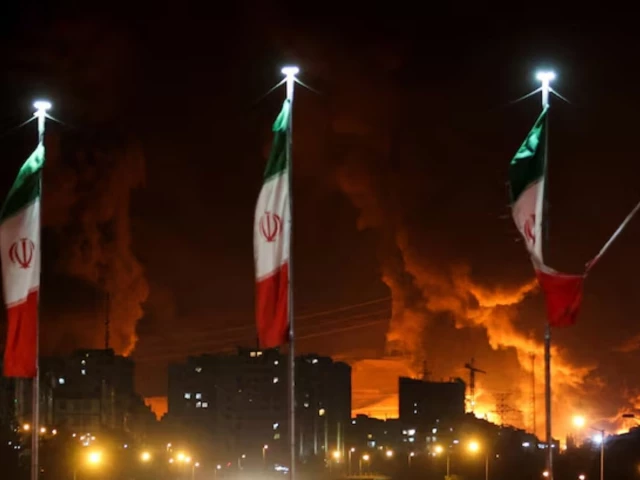
As the United States & Israel's war with Iran enters its second month, President Trump, in a prime-time address on 1st April 2026, once again repeated his rhetoric on the objectives of this unconstitutional and unlawful war.
While the world was looking for a message of hope and peace, the speech caused disappointment and fear of escalating tension and sparked international disapproval on multiple counts. Unclear objectives, vacillating positions, failure to provide a solution for the global energy crisis, and above all, no vision for ending and exiting from his war of choice. Many analysts termed it a repetition of what the US president has been expressing through his earlier tweets. So what does the speech reveal? In short, the president is not clear and does not have a plan.
Multiple opinion polls suggest that a larger part of US nationals are strongly opposed to the war, which they mostly perceive to have been initiated on Israel’s behest.
More worrisome is Trump calling the war with Iran a mere “Excursion”, which not only defies the US Constitution, international law, international humanitarian law, and ethics of war but also lacks empathy and respect for a rules-based international order. In early March, Trump told the Republican lawmakers, at Miami, “We took a little excursion” to the Middle East “to get rid of some evil. And, I think you’ll see it’s going to be a short-term excursion.”
It is deeply disturbing to label a full-scale war as “short or little excursion” when scores of innocent women and children have died in Iran, Lebanon, Middle East and the US soldiers, after five weeks into the war, disrupted global supply chain due to closure of Hormuz Strait, and causing a nosedive of the global financial system, which may cause yet another global economic recession if the war prolongs. Let’s examine what could have possibly prompted this assertion to label the war as “an excursion”.
Trump, in his speech on 1st April 2026, asserted that if Iran failed to agree to a deal, it would be bombed back into the “stone age where they belong” and further declared, “ If there is no deal, we are going to hit every one of their electric generating plants very hard and probably simultaneously.”
Attacks on civilian infrastructure, population centres, and essential civic facilities amount to war crimes and are against the international humanitarian law, more specifically the Geneva Convention and its Protocol.
In this backdrop, Trump’s escalatory rhetoric sets a dangerous precedent & undermines foundational pillars of a rules-based order. Recently, over 100 US-based international law experts and former legal professionals have raised concerns about the violation of international law in the US-Iran war, by signing a declaration which says, “Recent statements from senior US government officials describing the rules governing military engagement as 'stupid' and prioritising 'lethality' over 'legality' are profoundly alarming and dangerously short-sighted.
These claims, particularly in combination with the observable conduct of US forces, are harming the international legal order and the system of international law that we have devoted our lives to promoting.”
Digging deeper into the Trump administration’s possible motivations for labelling the war as “short-term or little excursion” in his talk to Republican lawmakers, it is not the first time that Trump has demonstrated utter disregard for international law. Earlier in March 2026, he had stated that the US may conduct strikes on Iran “just for fun.”
Such ruses may be meant to frame the war as a short-term adventure to minimise its impact, allay domestic public concerns, reduce global economic anxieties, and bypass constitutionally needed congressional authorisation for war beyond 60 days as enshrined in the US War Powers Act of 1973.
The UN charter prohibits the use of force in inter-state relations except for self-defence against an imminent threat. Notably, in a Senate Intelligence Committee hearing in March 2026, Director of National Intelligence (DNI) Ms Tulsi Gabbard failed to present evidence on the imminence of a threat from Iran when pressed if Iran posed an imminent nuclear threat before the US-Israel strikes.
Even during the war, conduct of the belligerents is regulated by the Geneva Convention and its protocols, which prohibit, inter alia, attacking non-combatants, civil infrastructure, civic facilities & structures such as schools, hospitals, power grids, nuclear facilities, religious sites, and basic sources of survival.
The current US-Israel war against Iran, prima facie, brushes aside international rules by preferring “lethality” over “legality” and principles over geo-strategic self-interests. Over the past years, the US has not only walked away from arms control and disarmament treaties, but it has also bypassed established international rules through unilateral military actions.
Treating war as “an excursion” defies rational leadership, normalises breaches of the UN Charter, ignores bilateral & multilateral treaties, and disregards international humanitarian law. This shift signals the erosion of the post-war international order and threatens to dismantle the global governance framework.




COMMENTS
Comments are moderated and generally will be posted if they are on-topic and not abusive.
For more information, please see our Comments FAQ