
US President Donald Trump’s second-term foreign policy increasingly bypasses the State Department, relying instead on a tight circle of handpicked political appointees and family members for direct decision-making, according to influential American magazine The Atlantic.
Foreign governments are engaging Washington through lobbyists, back channels, and personal connections rather than formal diplomatic processes, writes Vivian Salama, a staff writer at The Atlantic. The effect, she says, is a more ad hoc, personality-driven approach to diplomacy, one that prefers quick deals and political optics over structured processes, professional expertise, and long-term alliance management.
This mercurial, transactional diplomacy, together with the sweeping “reciprocal” tariff offensives of President Trump and his combative bluster toward allies and adversaries alike, has eroded confidence in the United States, alienated partners, and shaken the foundations of the transatlantic alliance system.
The uncertainty spawned by these often whimsical policies is reshaping global geopolitics and geo-economics, as America’s traditional allies appear to drift away. In this volatile environment, China is emerging as a pillar of stability, with a growing number of European and Western leaders turning to Beijing. Friedrich Merz is the latest among a number of US allies to visit China.
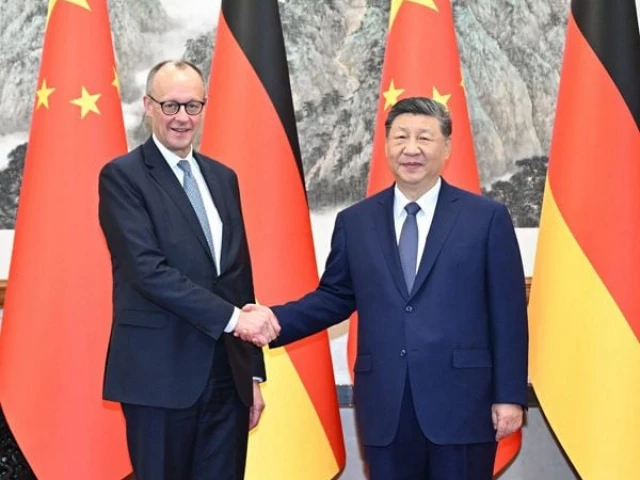
The German chancellor met with Chinese President Xi Jinping and Premier Li Qiang in a development that signals Europe’s cautious but pragmatic effort to recalibrate its China policy while adapting to a more fragmented global order. Merz’s tour follows a series of European engagements with China, including trips by French President Emmanuel Macron and British Prime Minister Keir Starmer, as well as outreach from Canadian Prime Minister Mark Carney.
In his meeting with Merz, President Xi spoke about the importance of China-Germany ties at a time of the most “profound global transformations” since World War II. As the world remains in flux, the Chinese leader called for stronger strategic communication, deeper mutual trust, and sustained progress in the Beijing–Berlin all-round strategic partnership.
The two leaders agreed to promote dialogue, expand cooperation, and uphold multilateralism and free trade — principles increasingly under strain in today’s geopolitical climate. Xi stressed that China remains committed to peaceful development and is willing to share its growth opportunities with Germany and the wider world.
For his part, the German chancellor reiterated his country’s commitment to the “One-China policy” and expressed Berlin’s willingness to deepen cooperation based on mutual respect and openness. Merz’s remarks reflected continuity in Germany’s China policy, even as debates within Europe around “de-risking” and strategic autonomy continue to evolve.
The Xi-Merz meeting, according to analysts, carries importance beyond bilateral ties. As the world’s second- and third-largest economies, China and Germany play a crucial role in shaping broader China-Europe relations. The two countries’ ability to maintain stable relations could influence the trajectory of global trade and economic governance.
Economic engagement remains the backbone of their relationship, with bilateral trade reaching €251.8 billion in 2025, with China once again emerging as Germany’s largest trading partner. German industrial behemoths continue to expand their footprint in China, while Chinese firms are increasingly active in Europe’s energy and digital sectors.
During the visit, Merz and Li Qiang attended a symposium of the China-Germany economic advisory committee, where both sides voiced readiness to strengthen cooperation in key industries such as machinery, chemicals, and advanced manufacturing. The presence of dozens of German business leaders in Merz’s delegation showed the private sector’s growing interest in the Chinese market.
Xi also highlighted opportunities for collaboration in emerging fields, including artificial intelligence, digital development, and green technologies. He called for greater synergy between development strategies and stressed the importance of maintaining stable and open industrial and supply chains.
The joint statement issued after Merz’s visit reflects a careful balancing act. While acknowledging Germany’s concerns about de-risking, trade imbalances, and export controls, the document also notes China’s concerns regarding the “securitisation” of economic ties. Crucially, both sides agreed that such differences should be addressed through candid dialogue rather than leading to systemic decoupling.
This approach suggests that Berlin and Beijing are seeking to manage competition without undermining the broader framework of economic cooperation — a model increasingly described by analysts as “managed interdependence.”
Another key pillar of the German chancellor’s tour was the shared commitment to multilateralism. The Chinese leader called on both countries to uphold the central role of the United Nations and defend the international rule-based order, while opposing protectionism and unilateralism.
Though no country was named, the remarks appeared directed at the US, which under President Trump has unilaterally imposed sweeping tariffs, contravening World Trade Organisation rules under the pretext of protecting American industry.
Merz echoed these sentiments, saying that Germany and China bear huge responsibility in tackling global challenges. He expressed support for enhanced EU-China dialogue and cooperation, particularly in areas such as climate change and global trade governance.
The emphasis on multilateralism is particularly important given the current global context. Rising trade barriers, geopolitical rivalries, and economic fragmentation have placed unprecedented pressure on international institutions. In this environment, coordination between major economies like China and Germany could serve as a stabilising force.
China’s Foreign Ministry described the visit as “fruitful and meaningful,” highlighting the reiteration of a stable and constructive bilateral relationship. Speaking at a press briefing on Thursday, spokesperson Mao Ning said both sides had committed to deepening cooperation, enhancing strategic communication, and resolving differences through open and respectful dialogue. She added that the visit culminated in the signing of several cooperation agreements spanning green transition, customs, sports, and media.
According to the ministry, both countries agreed to strengthen institutional dialogue mechanisms, including the China-Germany intergovernmental consultation framework, which has historically played a key role in sustaining cooperation during periods of political divergence.
The joint statement provides perhaps the clearest insight into the evolving nature of China-Germany relations. Its language emphasises “mutual respect, mutual benefit, and win-win outcomes,” signaling a deliberate effort to avoid zero-sum thinking even as strategic competition heats up.
Climate cooperation emerged as a particularly promising area. China’s strengths in renewable energy and electric vehicles complement Germany’s expertise in green industrial technology, creating opportunities for joint innovation. Existing collaborations in offshore wind and sustainable manufacturing highlight the practical potential of this partnership.
At the same time, the statement underscores the importance of people-to-people exchanges and institutional dialogue in maintaining long-term stability. By reinforcing societal and economic linkages, both sides aim to build resilience against geopolitical shocks.
Merz’s visit illustrates a broader shift in global diplomacy. Rather than choosing between engagement and caution, major economies are increasingly attempting to pursue both simultaneously. This dual-track approach reflects the realities of a deeply interconnected but increasingly contested global system.
For Europe, the challenge lies in balancing economic interests with strategic concerns. The flurry of recent high-level visits to Beijing suggests that, despite political differences, engagement with China remains a priority. For China, strengthening ties with key European economies like Germany offers a way to counterbalance external pressures and reinforce its role in global economic governance.
To sum up, Merz’s visit ushers China-Germany ties into a new phase — one defined not by uncritical cooperation, but by a pragmatic effort to manage differences while promoting shared interests. In the current era of uncertainty, such calibrated engagement may prove essential for sustaining global stability.
The writer is an independent journalist with a special interest in geo-economics.




COMMENTS
Comments are moderated and generally will be posted if they are on-topic and not abusive.
For more information, please see our Comments FAQ