
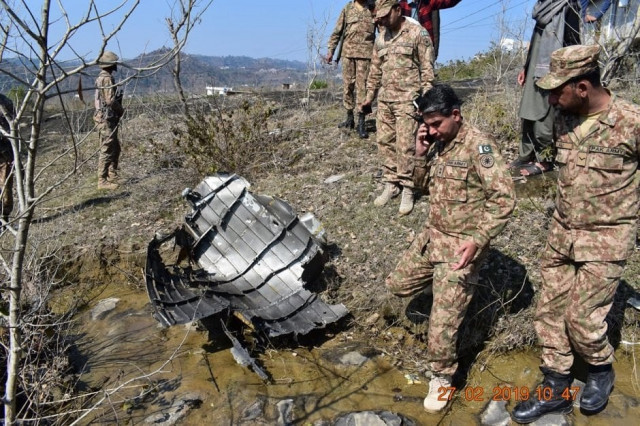
With every nation, there are days when everything that it stands for is tested—days that can make or break the nation. Pakistan, although still young, has seen its fair share of such days. On February 27, 2019, one day after the unprovoked strike by India in Balakot, Pakistan faced such a day. Pakistan, however, refused to blink in the storm. Instead, what followed was a response that was as hard-hitting as it was measured. Calibrated, rapid, and unmistakably airborne, today marks the seventh anniversary of Operation Swift Retort.
The operation was designed not only to give a fitting reply to the unwarranted aggression but also to establish an impenetrable deterrent to ensure that such ‘limited’ cross-border intrusions came to an end once and for all.
The Pakistan Air Force was at the forefront of Operation Swift Retort, and once again, rose to safeguard Pakistan’s skies. The PAF is a force that has grown to ensure readiness long before the first bullet is fired or the first siren blares out its grim wail. A clear message was sent to the adversary by the aces of the PAF: our skies are not to be taken lightly; they are guarded relentlessly by men who are ready to take on any threat.
The spark that led to an inferno was the Pulwama suicide bombing on February 14, 2019. Allegations of Pakistani involvement in the heinous attack were hurled from endless Indian sources. The escalation eventually led to an Indian airstrike on Balakot on February 26. Although Indian claims boasted the destruction of a terrorist hideout, the reality on the ground was that Indian munitions had fallen on uninhabited land. This was confirmed by on-site reporters, satellite imagery, and organisations like the Atlantic Council Digital Forensic Research Lab.
Then, Operation Swift Retort was executed. A formation of 25 PAF aircraft, including F-16s, JF-17s, and Mirages, made their way towards India. Staying within Pakistani airspace, they accomplished their mission with surgical precision. The strikes were carried out in open spaces, with no casualties.
Adding to this achievement was the fact that the PAF shot down two Indian jets. One of the jets crashed in Azad Kashmir, and the pilot was captured. This pilot was Abhinandan Varthaman, a man whose words, “The tea is fantastic,” echoed through Pakistani memes and beyond. Pakistan handed him back to India on 1 March, a much-lauded de-escalatory gesture.
To break down Pakistan’s strategy further, the entire set of events needs to be viewed with a macro lens. It was made amply clear that the strikes were carried out in open spaces, framing the mission as a controlled indication of capability while keeping escalation in check.
This transmitted the fact that Pakistan had the capability but was practising restraint. The next component of the same strategy was the safe return of the Indian pilot, Abhinandan Varthaman, garnering diplomatic praise from all spheres.
Operation Swift Retort had a far-reaching impact. It caused a snowball effect, which led to a spree of improvements and upgrades in the PAF. These changes led to the impressive performance of the PAF in the recent conflict with India, Marka-e-Haq. These changes revolved around four core areas: advanced fighters, unmanned systems, layered air defence, and sensor-led command-and-control upgrades.
Fighter induction included the addition of the J-10C multirole fighter, which gave pilots first-shot BVR capability. The second major enhancement was the JF-17 Block III platform, which added remarkable manoeuvrability, extended range, and advanced avionics.
Integral to the success of Marka-e-Haq, PAF’s unmanned systems have acquired and developed advanced platforms like the Shahpar series, the Lightning 1 and 2 loitering drones, Chinese CH-4 MALE UAVs, among various others. In the air defence sphere, the induction of the HQ-9/P surface-to-air missile system and other improvements enhanced overall capability. Surveillance and command-and-control have inducted Saab 2000 Erieye AEW&C into aircraft and ground-based C2 networks. These upgrades played a huge role in PAF’s success in Marka-e-Haq.
Beyond platforms, PAF also established indigenous R&D ecosystems, the most prominent of which is the National Aerospace Science & Technology Park (NASTP). Inaugurated in 2023, NASTP has already fostered a substantial number of innovative start-ups and initiatives, pushing the boundaries in aviation, space, cyber, artificial intelligence, and programming.
Orchestrating these changes and reining in a force like the PAF was no easy task. PAF has always been fortunate when it comes to leadership. The current Chief of the Air Staff, Air Chief Marshal Zaheer Ahmad Babar Sidhu, is a man of great foresight and action. His smart induction policies revolve around immaculately designed parameters of quality, capability, and affordability. Under his leadership, PAF has moved significantly towards indigenous production.
Project Phoenix is another initiative by the Air Chief that overhauled every aspect of pilot training and replaced it with an improved path to turn out pilots suited for the 21st century.
Anniversaries such as Operation Swift Retort are not mere dates on a calendar; they are strategic reminders of a force that has tested its doctrine in the crucible of crisis and emerged victorious. Each passing year brings a forward-looking vision rooted in readiness, resilience, and national security commitment.
As capabilities evolve from advanced fighters and network-centric warfare to indigenous R&D and self-reliance initiatives, PAF continues to signal its status as a modern, credible power in South Asia, prepared not only for today’s challenges but for the complex battle spaces of tomorrow.




COMMENTS
Comments are moderated and generally will be posted if they are on-topic and not abusive.
For more information, please see our Comments FAQ