
If I ask why tragedies in Pakistan barely register in the media of the Global North, you might laugh at me. You might tell me to brush up on history and geopolitics, drown me in reports, corruption indexes, and economic charts, and remind me where we have positioned ourselves as a country, as a nation beyond asking for loans, supplying arms, or occasionally sending aid to places devastated by natural disasters.
You would point out, correctly, that our import-export ratio is humiliating. That our institutions wobble between incompetence and capture. That in the global marketplace of power, influence, and credibility, we are almost invisible.
Fine. I accept that ledger.
But as a citizen of Pakistan who has grown up watching the same cycle repeat itself: catastrophe, mourning, protest, silence, forgetfulness; I am no longer interested only in spreadsheets and post-mortems. I want to know what our political existence actually means today. Not in theory, not in policy briefs, but in lived consequence. Where do we stand when our people burn, drown, collapse, or disappear? Who listens when we scream?
If our tragedies fail to move the world, is it because we have failed to matter — or because some lives are simply easier to ignore than others?
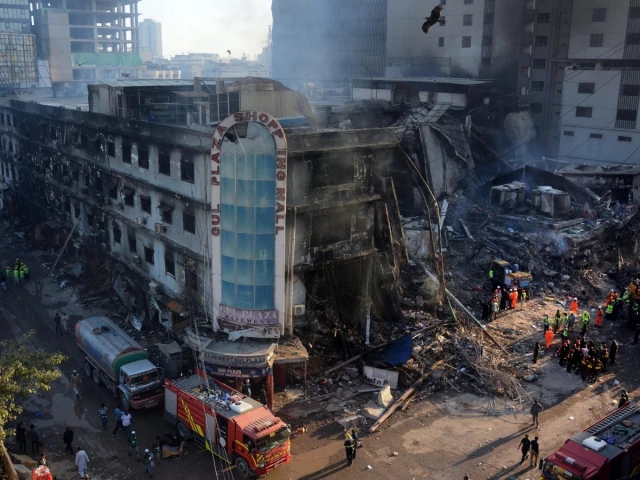
In the Global North, disasters arrive as breaking news, rolling coverage, expert panels, donor pledges, and long arcs of accountability. In Pakistan, disaster is a recurring background noise. A factory fire here, a building collapse there, a bus plunging into a ravine, floods swallowing entire districts, heatwaves killing the poor in silence, stampedes at ration points, women dying in custody, journalists threatened into quiet. Each tragedy flashes briefly across our screens before dissolving into the next emergency.
Our grief does not accumulate into reform. It evaporates into fatigue. Part of this is our own making. Decades of institutional decay, political instability, elite capture, and short-term governance have hollowed public trust. We announce inquiries that never conclude, commissions whose reports gather dust, arrests that quietly unravel. Corruption becomes a convenient explanation for everything, until it stops shocking anyone. When accountability becomes performative, tragedy becomes normalised.
But global indifference is not just about our failures. It is also about narrative economics. News attention follows power, proximity, profit, and political usefulness. Countries that shape markets, supply chains, security alliances, or technological innovation receive disproportionate moral visibility. Their crises are framed as global disruptions. Their pain becomes instructive. Their recovery becomes a story arc worth investing in.
Pakistan, by contrast, appears mainly as a problem to be managed: a security concern, a debt burden, a climate vulnerability, a population statistic. We surface in international headlines when something goes wrong, not when something evolves, builds, or imagines differently. Our complexity rarely travels. Our culture, contradictions, creative resilience, and intellectual life remain largely invisible.
We exist globally as data points, not as people.
This creates a cruel feedback loop. When the world expects dysfunction, it learns to tolerate it. When tragedy becomes predictable, empathy thins. When a place is permanently framed as broken, its suffering stops feeling urgent. Emergencies lose their moral shock value.
And yet, inside the country, people keep showing up for one another in ways that never make headlines. Strangers pull injured bodies from wreckage. Shopkeepers distribute water during heatwaves. Doctors work double shifts in understaffed hospitals. Neighbours organise crowdfunding for medical bills, funerals, and school fees. Volunteers rush toward disaster zones long before official relief arrives.
Our compassion infrastructure is stronger than our governance infrastructure.
But compassion cannot substitute for justice forever. Emotional resilience is not a development strategy. Survival is not progress.
The more uncomfortable question is this: what does Pakistan actually represent today in the global imagination? Not historically, not nostalgically, not ideologically, but materially and morally. Are we merely a reservoir of cheap labour, remittances, textile quotas, security anxieties, and seasonal fruit exports? Is our value transactional rather than civilizational? Reactive rather than visionary?
A country without a coherent story struggles to command attention, dignity, or investment — not only economically, but morally. Nations that shape narratives shape sympathy, policy, and memory. Nations that fail to narrate themselves become footnotes in other people’s crises.
We often blame the Global North for selective empathy, and rightly so. Western media ecosystems reproduce colonial hierarchies of whose suffering counts. But we also need to confront our own narrative paralysis. We have not invested seriously in cultural diplomacy, intellectual exports, regional storytelling, or global-facing institutions that translate our internal complexity into external relevance. We rarely frame ourselves beyond survival mode.
When a tragedy occurs here, the world does not see a disrupted future. It sees continuity.
That is the real danger. Not invisibility, but inevitability.
And yet, despite everything, I refuse to believe this is our permanent destiny. Pakistan is young, linguistically rich, culturally layered, technologically hungry, and intellectually restless. Our writers, filmmakers, scientists, activists, and entrepreneurs are quietly building alternative futures inside hostile systems. Our cities pulse with informal innovation, mutual aid, and creative resistance that deserve more than pity-based attention.
The question is whether we can move beyond merely enduring history toward shaping it.
Until we do, our tragedies will continue to arrive as disposable headlines rather than collective reckonings. Our dead will remain numbers rather than narratives. Our suffering will remain local rather than moral.
And we will keep asking, quietly and painfully: what exactly do we offer the world besides manpower and mangoes, and why does that feel like such a small answer for a nation of over two hundred million lives?



COMMENTS
Comments are moderated and generally will be posted if they are on-topic and not abusive.
For more information, please see our Comments FAQ