
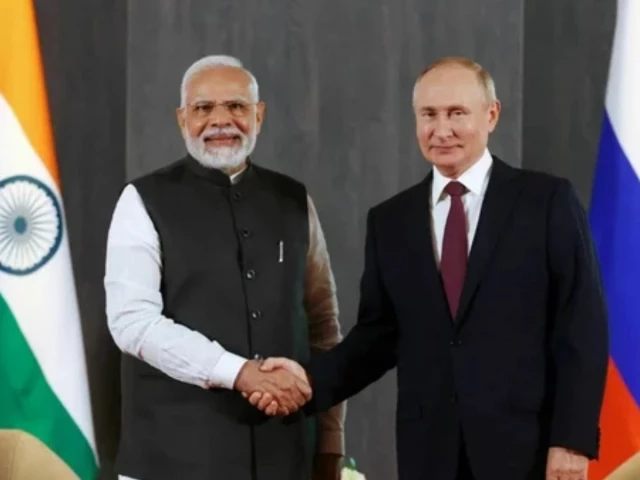
In a challenging diplomatic and geopolitical scenario, wherein decades-old strategic partners, Russia and India are both reeling under Western sanctions, Vladimir Putin visited India from 5-6 December. Modi rolled out the red carpet and sent a clear signal to Washington that India has alternatives.
Russia has been facing diplomatic isolation since the Ukraine war in 2022 and New Delhi has very cunningly exploited Russia's isolation to secure discounted oil, weapons and technology, indirectly prolonging the Ukraine war.
Although India claims to follow the policy of neutrality, the case of Russia reflects double standards. For decades, India under the garb of non-alignment posture and neutrality, has played double games with world powers. However, India's contradictory alignment and undermining of global order has exposed its dual face. For the first time, India was walking a tight rope. Modi is under immense US pressure regarding Russian oil purchases and Washington has already imposed a 50% tariff.
India is planning an additional $1.2 billion purchase of S-400 missile rounds, reinforcing structural dependency. Russia has also offered full Su-57 stealth fighter technology, including engines and materials, enabling licensed production inside India.
India supplies Russia with $60–95 million per month of restricted dual-use components critical for missile, UAV, communications and artillery systems. Joint projects include BrahMos, T-90, AK-203 rifles, and co-production of spare parts. In the economic sector, $68.7 billion bilateral trade in FY 2024–25 shows record trade volume between both countries.
India imported $63.8 billion (oil, coal, fertilizers, defence parts) while exporting only $4.9 billion, creating a massive strategic imbalance. India's huge oil purchase has increased Russian crude imports by nearly 600% since 2022. India now accounts for 38% of Russia’s oil exports, becoming Moscow’s largest wartime energy customer. This cash flow has directly financed Russia’s war machine.
India in practice has become Russia’s most reliable political cover, repeatedly abstaining on key UN resolutions and exploiting discounted Russian exports. While India claims neutrality, its policy aligns more with Russia's strategic interests, violating international rules-based order. These arrangements directly strengthen Russia’s military-industrial complex amid global sanctions. The recruitment of Indian nationals into Russian combat units, with casualties and missing personnel, indicates deeper operational alignment with Moscow’s war effort.
The US and EU increasingly view India as a “Kremlin Enabler”and main hurdle in stabilization of the region. US officials have labelled India’s behaviour as “destabilizing" accusing it of enabling Russia’s military capacity. President Trump openly called India a “Kremlin laundromat” and threatened 100% tariffs on Indian goods.
The EU criticized India’s participation in Russian military exercises, stating that India’s Russia ties obstruct deeper strategic cooperation.
India’s pursuit of US military hardware, including potential F-35 acquisition combined with the attempts to reduce Russian oil purchases illustrate an ambiguous alignment that breeds mistrust on both sides and reinforces India's image as an unreliable ally. India thus emerges as a destabilizing force in the emerging global order.
The world has seen India’s duplicity in selling arms to Ukraine (USD 1.4 million explosives) while cultivating bonhomie with Russia.
India's reliance on Russia for defence gives Russia significant leverage. India’s trade growth with Russia, deep economic ties with a sanctioned power and strategic deception highlight it as a destabilizing factor in the global order.
Russia and India share a history of defence and economic cooperation. Nearly 68–70% of all Indian military imports originate from Russia. The real test now is to see how Modi maintains this delicate balance- continue buying Russian oil while simultaneously pursuing a trade deal with Trump.




COMMENTS
Comments are moderated and generally will be posted if they are on-topic and not abusive.
For more information, please see our Comments FAQ