
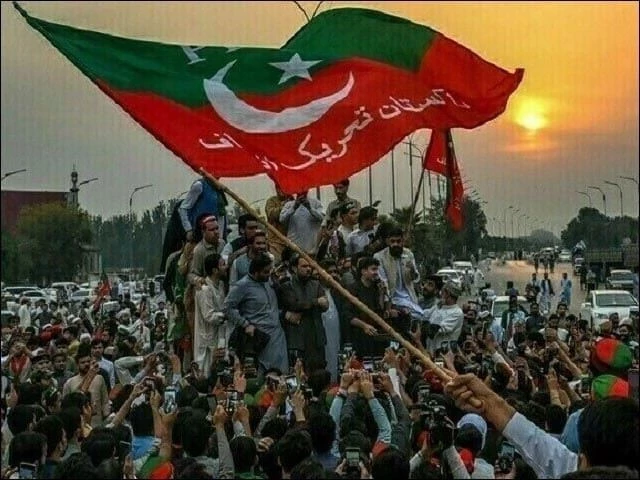
Despite its “revolutionary” history, PTI continues to struggle with the most basic of party politics. Developing into a coherent, democratic organisation, its latest memo has instead exposed the party’s enduring inability to build participatory structures or a culture of collective decision-making.
Rather than reinforcing organisational clarity, the memo has triggered unrest across the party. It imposes a rigid, quasi-military “chain of command,” instructing every tier, from the highest office-bearer to the local unit, to operate within a strictly centralised hierarchy.
For a party that once championed itself as the antidote to Pakistan’s authoritarian and “dynastic” political traditions, the symbolism is hard to ignore. A movement that built its identity around decentralisation, institutional reform, and democratic accountability now governs itself through the vocabulary of discipline, hierarchy, and obedience.
PTI’s rise from a protest movement to a national political force was rapid and dramatic. Over the years, it gained national visibility and eventually formed governments. Yet this growth was not accompanied by internal political maturation. The memo merely crystallises it, rather than evolving into an organisation that empowers grassroots-level leadership; it imposed a top-down structure centred on the core leadership.
This contradiction is self-evident. The memo elevates the secretary general to the most powerful internal authority, even though no one currently holds that office. The structural vacuum is clear, yet the instinct is not to democratise, but to formalise an already centralised command.
“No tier can break this chain of command,” the memo declares, instructing party members to “recognise their domain” and accept duties assigned from above. Authority flows from directives approved by the centre. Complaints are to be routed upward, not discussed laterally. Internal dialogue, in effect, is replaced by vertical discipline.
Such behaviour is characteristic not of a political party but of a populist cult of personality, an organisation anxious about fragmentation and compensating through tight control.
In response, PTI defended the memo as an administrative clarification related to the Election Management and Assessment Cell (EMAC), insisting that the hierarchy is already defined in the party’s 2019 constitution.
PTI frequently invokes bureaucratic language and constitutional technicalities to create a veneer of institutionalism, even though, in practice, it operates through personalised authority and reactive decision-making. Imran Khan himself once described internal debate as “the beauty of politics.” Today, however, dissent is framed as disunity, disagreement as sabotage, and alternative views as disloyalty.
This shift is not ideological; it is structural. As with many populist movements, authority becomes increasingly concentrated at the centre as the movement draws energy from charisma rather than from durable institutions. PTI mirrors this pattern almost perfectly. Despite its long presence in Pakistan’s political landscape, it remains anchored not in organic processes but in personalities.
Thus, PTI continues to behave like a movement in permanent mobilisation rather than a political party capable of responsible governance. The current turmoil is about the party’s persistent refusal to transition from a populist platform into a stable organisation. It has avoided meaningful internal elections, resisted empowering its lower tiers, and never normalised internal disagreement.
PTI has reached this crossroads before, and each time it has chosen centralisation over participation, hierarchy over debate, and personality over institution-building. Unless it confronts this foundational flaw, PTI will remain what it has always been, a political force with mass appeal but without an organisational backbone. A movement, perhaps, but still not a political party.




COMMENTS
Comments are moderated and generally will be posted if they are on-topic and not abusive.
For more information, please see our Comments FAQ