- 12 Dec 2010
TAPI gas pipeline: Presidential push for lingering project - 11 Dec 2010
President leaves for Turkmenistan - 13 Dec 2010
Media watch: Economic deals
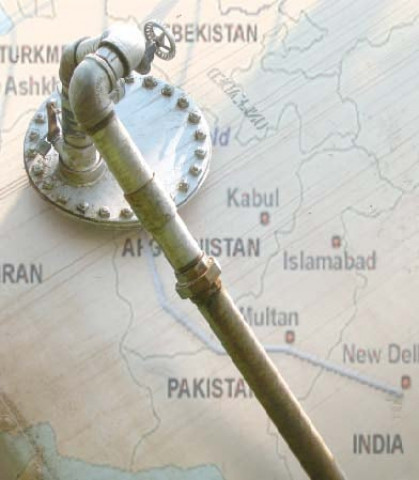
The TAPI project may help Pakistan ease energy crisis. DESIGN: FAIZAN DAWOOD
President Asif Ali Zardari’s use of his office to push for progress on the Turkmenistan-Afghanistan-Pakistan-India (TAPI) gas pipeline is a welcome step forward for the stalled project that is likely to result in significant economic gains for Pakistan, both in terms of the royalties the project yields and in terms of the more abundant supply of gas that will eventually become available to industries within the country.
The benefits that are expected to flow from the project are manifold, including a stable source of income for the government of Afghanistan and yet another reason for Pakistan and India to expand their economic ties. If the Afghan government has a steady revenue stream, the country may well be able to develop many of the institutions that it badly needs. And an expansion of economic ties between India and Pakistan should create wider constituencies in both countries that support a peaceful resolution to the outstanding political issues between them.
And yet the obstacles that stand in the way of the project are the very same ones that would be solved by its inception. Afghanistan, for instance, suffers from lawlessness which prevents most international investors from laying out firm financial commitments to the project. And political animosity between India and Pakistan has, in the past, prevented India from committing to the project. Yet the agreement reached between the governments of the four countries in the Turkmen capital last week is a significant step forward. While much work still remains to be done, the agreement of all four parties to pursue the project breathes new life into what may well turn into the foundation of a stabilising economic partnership in the region.
As India’s economy expands, it will need more energy. Much of that can come in the form of gas from Iran, Turkmenistan and other places in the Caspian region. It is in Pakistan’s benefit to accommodate India’s economic rise by facilitating each of the energy projects that needs to pass through its territory. Cooperation is likely to yield far greater prosperity for the people of both countries, compared to confrontation. For its part, India would do well to take a leap of faith and trust that Pakistan’s economic interests are aligned with theirs.
Published in The Express Tribune, December 14th, 2010.

More in Editorial
A shakier coalition
A gas pipeline should be evaluated dispassionaletely and entirely by commercial considerations – does the pipeline yield commercial benefits to all the countries involved?
One shouldnot fall in the danger of terms like “peace-pipeline”, “friendship pipe” etc… When such huge projects are built on the foundations of anything other than commercial, then only losses are in store as the project becomes unviable. Then the loss making pipelines remain propped up for “peace” and “friendship”.
And who foots the losses? – the common tax payer in each of these countries….needless to say encouragement to corruption when tax payer’s money starts dripping into the loss making pipeline…. Recommend
While I agree with the first part, I can’t blame India for not trusting Pakistan. Pakistani Army which has always controlled Pakistani foreign policy is unlikely to change its anti-India paradigm in the next three decades. India would be foolish to link its energy supply and economic interests with a country that is bent up on destroying India “through 1000 cuts in a 1000 year war” as publicly declared by Bhutto, a declaration that continues to be Pakistan’s official policy towards India.
India has alternatives to TAPI and IPI. India can build an under sea, though expensive, pipeline directly from Quatar. Or, as it has been doing, it can further expand its LNG buying program from Iran, Quatar and other middle east countries. More LNG processing facilities are being built in India’s west coast.Recommend
@Arindom
I agree. This project is very unlikely to take off.
@Author: “For its part, India would do well to take a leap of faith and trust that Pakistan’s economic interests are aligned with theirs.”
Pakistan’s economic interests take a back-seat to its “strategic” interests. Isn’t that clear from its history? It would not mind falling into the direst straits for the satisfaction of seeing India fail. Mirza Aslam Beig, former COAS of Pakistan once said that India should not think that it can get ahead of Pakistan; we will do our best to pull it down. Or words to that effect.
Well, here is a promise from a very ordinary Indian: India will rise to greater and greater heights and glory. Gen. Baig, you must already be eating your words!Recommend
More than India, I am glad that this will benefit Afghanistan, a war-torn country. It could give it leverage over Pakistan.
But, India must explore varied options to satisfy its hunger for energy as this project will not enjoy a smooth sailing.Recommend