Share this article
Print this page
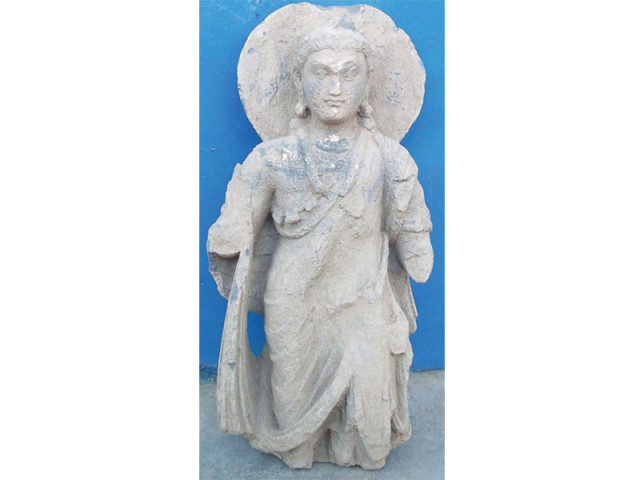
The Bodhisattva statue, which measures 60x27 cm, dates back to the 4-5th century. PHOTO: EXPRESS
SWAT: An ancient Gandhara artifact worth millions of rupees has been recovered in Swat, police said on Wednesday.
The Bodhisattva statue, which is made of Black Shift Stone and measures 60×27 cm, dates back to the 4-5th century.
According to police, they received a tip-off regarding an illegal excavation in Amlook Dara Stupa, located in Barikot.
“During our raid, we caught two people red handed and recovered the statue from them,” SHO of the Ghalegey police station Sayed Zaman told reporters.
The accused were identified as Akbar Ali, a resident of Peshawar, and Murad Ali, a resident of Swabi. According to police, they were reportedly planning to smuggle the Gandhara artifact to foreign countries, where it would be sold.
According to different sources, both the accused belong to an international gang involved in the smuggling of precious artifacts. A case has been registered against the gang and a trial is under way in courts.
“They offered a huge bribe to keep the matter discreet but police refused to do so,” a local of Amlook Dara said on condition of anonymity.
“The Bodhisattva statue is state property and we have officially asked to take possession of it, but as it is under trial it is still in police’s custody,” curator of the archaeology department Faizur Rehman told The Express Tribune. “It will be handed to our department as soon as the case is decided,” he added.
Civil Society members have demanded that the investigation into the case be handled seriously as it might lead to other thefts.
“We demand from the government and high authorities to hand the artifact to the Swat Museum as every antiquity found in Swat is the property of the museum,” Svastu Arts and Culture Association Chairman Usman Ulas yar told The Express Tribune.
Published in The Express Tribune, February 2nd, 2012.
More in KP & FATA
Foiled terror bid: Police seize explosives-laden bike in Peshawar
“they were reportedly planning to smuggle the Gandhara artifact to foreign countries, where it would be sold.”
Perhaps this should be allowed. That way any non-Islamic relic can be ensured safety.
Don’t we all know what happened to the Bamiyan Buddha?Recommend
Very good action by our police, we must appreciate it.Our cultural heritages must be protected/preserved by all of us.
Recommend
great news !
Recommend
Nice work, both the police and the statue.
Recommend
But the Archaeological department is unable to protect and preserve the already existed artifacts they rather involved in smuggling it
Recommend
@narayana murthy:
We all know what happened to Bamiyan Buddha.
But same damages has not been caused to Buddhist sites in Pakistan i.e,Taxila, Swat, Takht-e-Bahi etc.All Buddhist archaeological sites and museums in Pakistan are safe.Non-Islamic relics are safe in Pakistan. Smuggling of Gandhara artifacts to foreign countries must not allowed.
Recommend
@narayana murthy, your comment was highly disrespectful and ignorant. Firstly the Bamiyan Buddhas were in Afghanistan, not pakistan. Secondly, kudos for the way India “ensured safety” for Islamic relics like the Babri mosque. Also modern day pakistan is the site for the earliest known human settlements (Mehrgarh, Pirak) in the world. Thus we have a lot more history to take care of. Consider that there is proof, remains and evidence of farming, herding, practicing dentistry at Mehrgarh in 7000 BC while the Mahabharata was written in 400BC referring to unsubstantiated events of 3000BC.
Recommend
That is a remarkable find and surprisingly well preserved for its age. Hope it finds its due place in Pakistan’s National Museum.
Recommend
@JS:
It’s a proven fact(by gene analysis) that the earliest human settlements in the Indian Subcontinent are in South India. In fact, it was discovered that an entire village has the genetic markers that trace their ancestry back to the first migrations out of Africa.
Besides, aren’t you Arabs?
Recommend
Just goes on to show how much of our cultural treasure is still undiscovered and how useless we are at protecting it.
Recommend
@Yuri Kondratyuk;
Pakistanis have just about the same amount of Arab ancestry as indians have Estonian ancestry (please refer to Salman Rashid’s brilliant piece in this paper titled “Arab Origins”). Also would love to know the name of this village in South India…until then i suggest you read up on Mehrgarh on wikipedia. Lastly, your reasoning based on the theory that modern humans first originated and then migrated from Africa is a theory that belongs in the 1920s. East Africa is no longer considered the “cradle of civilization”…it is one of the cradles…along with the Middle East (ironically, earliest settled human remains found in Rosh Ha’Ayin, Israel) and Australia (Mungo man)
Recommend
@narayana murthy:
I feel sorry how ill-informed and ignorant you guys are. Bamiyan Buddhas were in Afghanistan not Pakistan.
Recommend
@JS:
I was being sarcastic.
Thanks for the info though. BTW, about the South Indian village, it was from a recent BBC documentary.
Recommend
Bamiyan Buddhas stood for more than 1500 years in Afghanistan protected by every Afghan ruler. It was the Taliban that destroyed this ancient monument as if to deny that this land was once Hindu and Buddhist.Recommend
We know how to protect and preserve our heritage,
Recommend
Trying again, my comments are not being posted.
@JS:
@Yuri:
http://www.unknowncountry.com/news/first-human-genes-still-alive-india
https://genographic.nationalgeographic.com/genographic/lan/en/pi/pitchappanprofile.html
http://www.raceandhistory.com/cgi-bin/forum/webbbsconfig.pl/noframes/read/1242
Here is the info you are looking for. I saw the bbc documentary too on pbs here in usa. The earliest genes and civilizations have been traced back to inda. Mehergarh is therefore a peripheral satellite of more ancient indian cultures. Jai Poompuhar. Jai kumarikandam. Jai Hind. Enjoy.Recommend
Cities 10000 to 40,000 years old found in india, calls for reevluation of history.
http://www.hermetics.org/cambay.html
Recommend