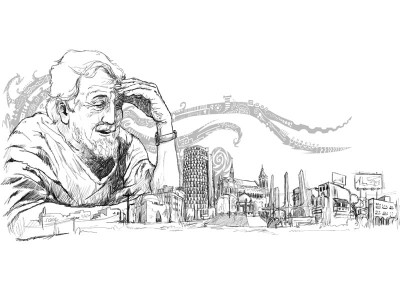
The Express Tribune » Saba Imtiaz http://tribune.com.pk Latest Breaking Pakistan News, Business, Life, Style, Cricket, Videos, Comments Sat, 19 May 2012 19:13:48 +0000 en hourly 1 http://wordpress.org/?v=3.2.1 Court marriage: Daring to say ‘I do’ in court http://tribune.com.pk/story/378785/court-marriage-daring-to-say-i-do-in-court/ Mon, 14 May 2012 20:27:42 +0000 http://tribune.com.pk/?p=378785

KARACHI: 

Court marriage: the word is whispered at family gatherings and proclaimed loudly in old Bollywood films.

But at the district and sessions courts in Karachi, a ‘court marriage’ is a routine affair and a surprisingly hassle-free one, at least on paper. It also costs far less than what it would to feed hundreds of wedding guests. The paperwork mainly involves paying the fees for a nikah, buying a copy of an affidavit and stamp paper. At the Malir District and Sessions Court, a wedding costs Rs600 and takes a couple of hours.

Often considered a last resort for couples whose parents may not approve of their plans to wed, or an option for those who can’t afford to pay hundreds of thousands of rupees in wedding festivities, a court marriage involves a few basic steps.

For starters, explains lawyer Mohammad Sharif Khanzada, a woman must sign an ‘affidavit of free will’ that states that she is of sound mind, an adult and is not being coerced into marriage.

“This statement is important,” Khanzada says. “Often when girls leave their home, their parents file a First Information Report (FIR) that they have disappeared and claim that they left with cash and jewellery. In this affidavit, the girl has to declare that she did not leave with anything, so later the couple is protected against accusations of theft.”

The girl also needs to submit proof of her age: a copy of her Computerised National Identity Card or a birth, education or medical certificate will do.

This documentation and three photos of the bride and groom are given to the Justice of Peace, who records an additional statement by the girl, explaining her reasons for registering her marriage with the court. A cleric registered by law to perform nikkahs is called in and after the ceremony is performed with four witnesses in attendance, the cleric will write on the nikkahnama that this was done in the care of the justice of peace.

Abdul Razzak Abbasi has been a justice of peace at the Malir district and sessions court for nearly three years and has seen numerous couples walk in and out of his shoebox of an office. They have often eloped or escaped to Karachi from other districts. He relies on the support of police personnel at the courts and the Al Falah police station to ensure that angry relatives do not barge in.

There have been near misses. Once, five minutes after a couple from Shaheed Benazirabad were legally wed, Abbasi learnt that the groom’s brothers had brought policemen from Katti Pahari to get a hold of the couple.

Others were not as lucky. A couple from the Gabol clan, who were related, were killed by their families nine months after they attempted to register their marriage with Abbasi. “The nikkah registrar hadn’t arrived, and the family amassed outside. Even though the couple was taken into police protection, I learnt that they had been killed.”

Khanzada recalls several fights breaking out at the court after angry parents discovered their children are eloping. “Sometimes they’ll slap the girl, sometimes the boy,” he said.

Engaging a lawyer for additional support can take the cost to Rs5,000 or even Rs10,000, depending on the lawyer’s profile. Abbasi says lawyers tend to scare a couple into believing that they could be charged with Zina and thus need legal representation. There appears to be no way to calculate the total number of marriages being registered at Karachi’s city court. Abbasi says the number is going up – in the first two weeks of April, he registered 12.

There appears to be no anonymity to the process. Abbasi and Khanzada both said that if the couple’s relatives approach them, they will show them the records. “Often they are concerned that the girl has been killed or kidnapped,” Abbasi says. “But if the couple has only been married for a day; I try and distract them so they have a chance to escape.”

When Mohammad Mujahid decided he had to get married in court, he first did a ‘survey’ at the City Court. “I went a week before and found out what the procedure was.”

A lawyer explained that often there are police and CID officials roaming around and they ask all sorts of questions, so it is best to have legal representation.

The lawyer gave him a time and then he went with his bride to the court.

The lawyer presented them before a local magistrate who separately recorded their statements. Then the lawyer took them to a qari who performed the nikah.

And so, even though the procedure is much simpler than that of a traditional wedding, it does have exactly the same end result.

SAMPLE AFFIDAVIT OF FREEWILL TEXT


I, ___________ D/O _______________, Muslim, adult, resident of ___________, do hereby state on solemn affirmation oath as under:-

That I am the deponent of this affidavit as such am fully conversant to the facts stated herein.

That I am about _ years of age, adult, major and capable of understanding of what is good and what is better for my life, as such I have a right to lead my life with my own choice for my well being.

That I want to marry a person with my own choice who will allow me to live in good atmosphere and whose name is MR. __ S/O ___ Adult, resident of _____.

That I came in court to swear this affidavit of my own freewill without any coercion or undue influence or any type of pressure from any corner.

That nobody kidnapped, enticed or abducted me to perform my legal right which has been guaranteed by Muhammadan Law.

That I have come to court for marriage with my own wish and if any person/persons lodge/report FIR against MR.____ S/O _______ the same should be consider as fake/bogus.

That I have not taken any kind of cash, gold or any other precious articles, when I was leaving my parental house.

Published in The Express Tribune, May 15th, 2012.


]]>
wedding Civil service wedding are more than just a financial solution for some couple. DESIGN: ESSA MALIK 4
The BackBencher: As law and order discussion put on hold, rumours rife of new home minister http://tribune.com.pk/story/375417/the-backbencher-as-law-and-order-discussion-put-on-hold-rumours-rife-of-new-home-minister/ Mon, 07 May 2012 22:19:24 +0000 http://tribune.com.pk/?p=375417

KARACHI: 

The rumour mill in Karachi keeps churning, and its latest grist is the question over who will be the next home minister. Bumbling Manzoor Wassan of the political dreams fame has faded into the woodwork and Sindh Chief Minister Qaim Ali Shah doesn’t appear to have much of a handle on law and order.

The MPAs have grown restless of waiting for Shah to appear in the assembly so they can continue a debate on the state of law and order and Lyari has become synonymous with Swat thanks to none other than the verbose, headline-grabbing interior minister, Rehman Malik.

The names currently doing the rounds are Nadir Magsi – the food minister who recently stepped in to solve the crisis in Lyari – and Local Government Minister Agha Siraj Durrani. While Magsi hasn’t really been a prominent figure as far as Karachi’s politics or security situation is concerned, Durrani has been a key interlocutor with all political parties in the city. The two are also on good terms with the press corps and have yet to pull off a Zulfiqar Mirza-esque stunt.

Speaking of stunts and faux pas, the attempt by Sindh Senior Education and Literacy Minister Pir Mazharul Haq to rush through a piece of legislation to create a Sindh Teachers Education Development Authority was defeated when the Muttahida Qaumi Movement legislator and adviser to the chief minister, Khwaja Izharul Hasan, highlighted how the technical education authority that had been created was a virtual disaster and seats earmarked for studies in telecommunication had been wasted since few people had applied.

That didn’t derail the process though. A spirited two hours of speeches and proposals for amendments followed. However, an indication of the state of education in Pakistan was made evident in the proposed legislation, which seeks to train teachers but had a number of spelling mistakes. “Its panel, not penal,” pointed out one MPA, and another wondered if the right word in a sentence was ‘teaches’ or ‘teachers’.

Haq, rather embarrassed that legislators had picked up so many issues as a number of educationists looked on from the visitors’ gallery, asked the MPAs “not to make jokes”. Perhaps there is a reason why so many members questioned the legislation. Training teachers is essential – and the number 19,000 was thrown around, which is a good start. But whether the training will actually be conducted is a question for another day. On Tuesday, the MPAs will attempt again to restart their discussion on law and order, but Sindh Information Minister Shazia Marri told the assembly that the chief minister may come by to present a report on the government’s performance in the last four years and make a speech. Cue the self-congratulatory paeans!

Published in The Express Tribune, May 8th, 2012.


]]>
nadir-magsi-nni The names currently doing the rounds are Nadir Magsi (in picture) and Local Government Minister Agha Siraj Durrani. PHOTO:PPI 0
The Backbencher: Make your money and run while the blood flows http://tribune.com.pk/story/374208/the-backbencher-make-your-money-and-run-while-the-blood-flows/ Sat, 05 May 2012 00:56:03 +0000 http://tribune.com.pk/?p=374208

KARACHI: 

I am quite convinced that one of these days a reporter is just going to burst into hysterical laughter and fall off the media gallery into the assembly hall below. The rare moments of intelligent insight in the house are overshadowed by hours of inane debate offered with such earnestness that one would think the MPAs must take us – the observers in the gallery – or their constituents for fools.

Take for example, PPP MPA Bachal Shah, who in an angst-ridden speech posited this hypothetical: Our constituents will ask us before the next elections what did we do about the bloodshed as we sat in the assemblies and the government?

Oh Mr Shah, during your next election campaign, at least you can say with certainty that while you may not have done anything about the bloodshed, several of your leaders did make enough money to last them several lifetimes.

If one source is to be believed, a rather enterprising former minister and several of his old colleagues in the cabinet are quite heavily invested in the let’s-regularise-informal-settlements deal. The trick, the source said, is to take lots of your constituents, resettle them into a goth and get them to claim ownership. This not only serves the party they belong to but also helps the people acquire housing. And the criminals involved in the process get a cut, making it a win-win situation for everyone.

But the spanner in the works has been thrown by the man who everyone claims is the de facto chief minister of Sindh. Apparently he also wants in on this illegally claimed land deal… but to sell off land so vast that I would have to Google to check how many zeroes this would require.

Shah could also tell his constituents that the government spent a lot of time fire-fighting instead of planning. Several people have become such excellent negotiators that they should abandon their political careers and head to the courtroom instead. One such man is MPA Nadir Magsi, reportedly one of the architects of the deal with Baloch tribal leaders, to persuade Uzair Baloch, the head of the banned Peoples Amn Committee, to stop retaliating against the police and eventually ‘surrender’ to the Rangers.

And speaking of the law, MPAs appear to be in a race to be charged with contempt. Pir Mazharul Haq read out a recent report by the International Commission of Jurists on the Supreme Court of Pakistan, which was excerpted by a Sindhi newspaper.

Haq read the article in Sindhi, as well as the Urdu translation, and lamented how the court “interferes” in the government’s work. MPA Arif Mustafa Jatoi asked whether this wasn’t in contravention of Article 68 of the constitution which states that parliament cannot discuss the conduct of a Supreme Court or a high court judge. Deputy Speaker Shehla Raza said it wasn’t a question of conduct but that poor, defenceless Haq was just trying to explain why his department couldn’t function properly. Perhaps Haq could spend more time figuring out why his department is in the dock so often and not invite the wrath of a contempt charge.

Published in The Express Tribune, May 5th, 2012.


]]>
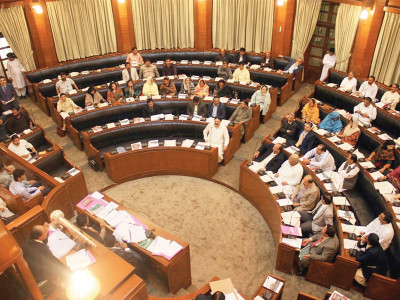
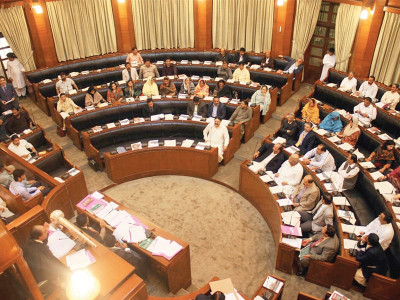
Sindh Assembly-photo-rashid-ajmeri The Sindh Assembly in session on Friday. PHOTO: RASHID AJMERI/EXPRESS 2
We apologise for the inconvenience Lyari, say MPAs http://tribune.com.pk/story/373742/we-apologise-for-the-inconvenience-lyari-say-mpas/ Fri, 04 May 2012 01:44:41 +0000 http://tribune.com.pk/?p=373742

KARACHI: 

The schizophrenic Pakistan Peoples Party put on a rather strange show in the Sindh Assembly on Thursday, alternating between the defiant and the beleaguered.

MPA Rafiq Engineer must inhabit a parallel universe if his statement on the situation in Lyari is any indicator.

While protesters in Lyari enthusiastically beat up, strangled and stomped on effigies of the president, MNA Nabeel Gabol and SSP Chaudhry Aslam on Wednesday, Engineer is still sticking to the stance that Lyari is very much a PPP stronghold and only a few misguided folks were responsible for the violence.

While a humanitarian crisis looms in the besieged neighbourhood – given the lack of food and water in the area – Engineer and PPP parliamentary leader Pir Mazharul Haq had little to offer by way of reassurance. “We ask the people of Lyari to be patient,” Haq said. “We apologise for the inconvenience.” The inconveniences, at last count, include intense exchanges of gunfire between the police forces and armed men, the shutdown of mobile service networks and the lack of electricity, gas, water and access to medical supplies. One wonders if Haq would call it an ‘inconvenience’ if he were marooned in a Kalakot house.

And thus, the PPP and its leadership do not seem to be on the same page. On one hand is PPP chairperson Bilawal Bhutto-Zardari, who appears to believe quite strongly in the rights of minorities, if his speeches are anything to go by. On the other hand are his party’s leaders. PPP MPA Saleem Khursheed Khokhar attempted to move an adjournment motion against a statement made by Mian Shabbir, an associate of MNA Mian Mithoo, one of the central characters in the recent cases of conversions of Hindu girls.

The statement, printed in the Urdu newspaper Ummat, quoted Shabbir as saying that legislators from religious minorities were using ‘CIA, R&AW and Mossad funds’. Speaker Nisar Khuhro said the motion was ‘out of order’ because it related to a matter of privilege after Law and Parliamentary Affairs Minister Ayaz Soomro spoke up on the technicalities. One of the grounds was that the motion cited a printed report which couldn’t be taken as the truth, yet the assembly routinely takes news reports as the last call, particularly when it is about opposition parties.

Political issues trump the state of minorities it seems, regardless of how strongly the legislators may feel. Women’s rights were about to meet the same fate, as the PPP abandoned the agenda to present a resolution reaffirming their support to Prime Minister Yousaf Raza Gilani.

Lo and behold, it was almost 2 pm and several MPAs were itching to leave the assembly. Law minister Ayaz Soomro was rather reluctant to stay on – even though the proceedings had barely lasted three hours – and sighed that “there is never a moment of peace” when asked whether they could fit in other agenda items.

It was only after legislators wouldn’t let up on their demand to present the scheduled resolutions did Speaker Khuhro allow them to go ahead with the scheduled agenda.

The female legislators – PPP’s Humera Alwani and the Muttahida Qaumi Movement’s Heer Ismail Soho – found an unlikely supporter in MPA Nadir Magsi, who announced that he had banned child marriages and the trade of women in his area. “You are right that our religion bans these things, but here we have a rivaaj (tradition),” he said. “We must decide whether we want to be Muslims or follow customs.”

Published in The Express Tribune, May 4th, 2012.


]]>
Sindh-Assembly- File “We ask the people of Lyari to be patient,” Pir Mazharul Haq said. “We apologise for the inconvenience.” PHOTO: FILE 0
The BackBencher: While Karachi burns, Sindh’s MPAs fiddle in the House http://tribune.com.pk/story/372258/the-backbencher-while-karachi-burns-sindhs-mpas-fiddle-in-the-house/ Mon, 30 Apr 2012 23:18:53 +0000 http://tribune.com.pk/?p=372258

KARACHI: 

“I am unable to do my job,” railed Pir Mazharul Haq, the senior education and literacy minister, as he explained his reasons for filing a privilege motion against Pakistan Muslim League-Functional MPA Marvi Rashdi.

Haq may be mistaken. He did manage to derail the entire proceedings of the Sindh Assembly on Monday as legislators devotedly followed the tennis match dialogue between PML-F parliamentary leader Jam Madad Ali, Sindh Finance Minister Murad Ali Shah, Sindh Law and Parliamentary Affairs Minister Ayaz Soomro and the woman behind the furore: Rashdi.

The city may be burning, the bodies may be piling up and the protests may be heating up. But in the carpeted opulence of the Sindh Assembly such issues are mere inconveniences, as matters of great importance – Haq’s wounded pride – dominated the discourse.

Jam Madad Ali was rather upset. His party has been accused quite often in the past few months of ‘enjoying’ the benefits of being in the government while acting like the opposition in the assembly. “You don’t like us,” Ali told the Pakistan Peoples Party (PPP) ministers.

Perhaps, Ali should have rephrased that. The PPP ministers don’t appear to like Rashdi, what with all her questioning about public interest issues and violence in Lyari and protests.

“At least you should not speak about our elders,” Ali said, referring to Sindh Information Minister Shazia Marri recalling Pir Pagaro VII’s self-proclaimed loyalty to the Pakistan Army. “The Pakistan Army is our army,” he said, by way of clarification.

But even Jam Madad Ali’s apology wasn’t enough to quieten Haq. “He has shown bravery,” Haq said, “but the member should be brave too.”

Good luck, Mr Haq. The defiant Rashdi has vowed to ‘never’ apologise, even if it costs her a Sindh Assembly seat. There was no attempt to move the conversation back to matters of public importance, even as people were pouring out into the streets to protests the police operation in Lyari.

PPP’s Jam Tamachi Unar woefully said they were “ashamed to call themselves MPAs” but there was little remorse in the house.

Other MPAs were piqued too – many had a complaint with the four-year performance report of the Sindh Assembly that was launched amid much self-congratulatory spirit over the weekend. One wondered why his name wasn’t listed properly; the other said he had asked a far larger number of questions than those listed in the report.

When Sindh Culture Minister Sassui Palijo announced that we have become “desensitised to violence” she could have easily been talking about the assembly. But perhaps the MPAs realise that their debate and discussion on law and order will be of little consequence. After all, as several people associated with the banned Peoples Amn Committee have alleged, power really lies in the hands of the president’s brother, Owais Muzaffar ‘Tappi’. “We called Taj Haider, he said talk to Tappi. We called Faisal Raza Abidi, he said talk to Tappi. No one can do anything, Tappi has all the power,” was the answer from a PPP loyalist and a former union council mayor in Lyari when asked who could help solve their problems and put an end to the violence.

Is the Sindh Assembly, then, just a grandiose show put on at great public expense? (It costs Rs0.5 million for a single sitting) Surprisingly enough, that is not true. The assembly is capable of greatness and has helped move legislation and the government to act on several issues. Several legislators are quite loved in their constituencies and speak to any MPA – and they’ll give you a rundown of exactly what is going right and wrong. As a collective force, however, they appear to be more interested in a war of egos than making the most of their last year. In any case, they’ll have plenty to ponder about on Tuesday, as the Sindh Assembly will not be in session so it can mark Labour Day. Monday must have tired them all out.

Published in The Express Tribune, May 1st, 2012.


]]>
marvi rashdi fight The defiant Rashdi has vowed to ‘never’ apologise, even if it costs her a Sindh Assembly seat. 1
The answer for a bullet cannot be a bullet, says MPA Sassui Palijo http://tribune.com.pk/story/372256/the-answer-for-a-bullet-cannot-be-a-bullet-says-mpa-sassui-palijo/ Mon, 30 Apr 2012 23:15:09 +0000 http://tribune.com.pk/?p=372256

KARACHI: While minister Pir Mazharul Haq’s wounded pride dominated the proceedings of the Sindh Assembly on Monday and inspired many a fiery speech, a scheduled discussion on the state of law and order in the province lacked any sense of urgency.

The discussion was originally scheduled to be with the chief minister in attendance, since he is currently in charge of the home ministry as well. However, Speaker Nisar Khuhro asked for the discussion to start and said the chief minister could be briefed on the points later.

Pakistan Peoples Party (PPP) MPAs Jam Tamachi Unar, Anwar Ahmed Khan Mahar and Sassui Palijo spoke briefly, followed by impassioned speeches from Muttahida Qaumi Movement (MQM) MPAs Manzar Imam and Tahir Qureshi. Unar pointed out the extent of politically influenced appointments in the police and the education services, and called for an end to political interferences in these departments. Palijo said there were “loopholes in the criminal justice system” and “it is as if we have become desensitised to violence”.

Palijo, who had been one of the backers for a discussion solely on Karachi, also said that there was a level of political backing for criminals as well, and there was a need for parties to correct this. “This is not just an issue of Malir and Lyari,” she said. “There are criminals there and it is our government that has initiated action against them but the answer for a bullet cannot be a bullet. We have to look at the demands of the people.”

Since the MQM had insisted on broadening the discussion to include law and order in the entire province, MPA Manzar Imam brought up the cases of honour killings and kidnappings in Sindh. There were also several jabs made at legislators “for whom it is very easy to raise adjournment motions and ask for discussions when they haven’t visited these areas.”

“There is no need to make impassioned speeches and rile people up,” he said. He also quoted party chief Altaf Hussain as saying that there was no such thing as ‘new’ and ‘old’ Sindhis and asked why certain ethnic groups were still being targeted. “What is the fault of our forefathers?” Qureshi, on the other hand, waxed lyrical about the days when Lyari was a peaceful place. There were 20 legislators listed to speak on law and order in Sindh, and the discussion is likely to continue on Thursday, when the next sitting of the Sindh Assembly is scheduled for.

Published in The Express Tribune, May 1st, 2012.


]]>
sassui-palijo-bhit-shah Palijo said there were “loopholes in the criminal justice system” and “it is as if we have become desensitised to violence”. PHOTO: NNI 0
False allegations: Pir Mazharul Haq files privilege motion against Marvi Rashdi http://tribune.com.pk/story/372085/false-allegations-pir-mazharul-haq-files-privilege-motion-against-marvi-rashdi/ Mon, 30 Apr 2012 09:35:50 +0000 http://tribune.com.pk/?p=372085

KARACHI: Senior Education and Literacy Minister Pir Mazharul Haq has filed a privilege motion against Pakistan Muslim League -Functional (PML-F) MPA Marvi Rashdi for leveling what he claims are false allegations regarding the appointment of his wife in the Sindh Education Department.

The issue sparked on April 27, when Rashdi spoke in the assembly on the appointment. At the time, Pakistan Peoples Party (PPP) legislators lashed out at Rashdi for her remarks. Haq is also the PPP parliamentary leader in the Sindh Assembly.

Earlier in the day, PML-F’s parliamentary leader in the Sindh Assembly Jam Madad Ali apologised for any hurt caused to Pir Mazharul Haq after PML-F MPA Rashdi raised the issue of Haq’s wife but Haq asked that Rashdi apologise as well.

PML-F’s Jam Madad Ali also asked that if the PPP did not want to deal with the PML-F anymore – “We know you don’t like us” – they should ask party co-chairperson and President Asif Ali Zardari to ask PML-F head Pir Pagaro VIII to abandon the policy of reconciliation.

He also condemned the criticism directed by Sindh Information Minister Shazia Marri for the late Pir Pagaro VII after the assembly session on Friday.


]]>
pir-mazharulhaq Issue sparked April 27, when Rashdi spoke in assembly on the appointment of Haq's wife in Sindh Education Department. PHOTO: NNI/FILE 6
Third degree http://tribune.com.pk/story/370212/third-degree/ Sun, 29 Apr 2012 05:23:34 +0000 http://tribune.com.pk/?p=370212

When it comes to interrogations in Pakistan, torture is not the last resort but the first.

“I wish I had died instead, because what I suffered was worse than death. They would hang me upside down and thrash me for hours. I wasn’t given food for days. I thought it would never end.” This is what Nauman, a young Christian man from Gojra had to say of the 14 days he spent in police custody.

Nauman was picked up in a sweep by security agencies after the 2009 Gojra riots. Even though he was not in the city when the riots took place, he was detained and tortured for two weeks as law enforcers tried to get him to confess to retaliating against attackers and causing the inadvertent death of a Christian man.

He was eventually released after a Christian organisation stepped in to help him in his defence. When he was finally freed, his closest friends couldn’t recognise him: Nauman was skin and bones, a shadow of his former self.

Scarred and scared by his experience, Nauman and his family members should nevertheless count themselves lucky, because unlike many who suffer such a fate, his period of torture lasted ‘only’ 14 days.

In February, seven men who were once ‘missing’ — a casual term that explains away how hundreds have become victims of enforced disappearances in Pakistan — were finally presented before the Supreme Court. They were a pale shadow of the men they had been when they were whisked away by the country’s intelligence agencies on suspicions that they were involved in terrorist activities. Four other men, who were also in custody, are now dead. The military has claimed that they died of natural causes, their families beg to differ.

But the men in court appeared to be knocking on death’s door in any case. Journalists described them as ‘ghastly’ and ‘bewildered’. One clutched a colostomy bag, another wept constantly and all seven have been diagnosed with various diseases. Detailing what the men had suffered, lawyers told the court that “during the confinement, which lasted for more than a year, the prisoners were not exposed to sunlight which worsened their health.”

The treatment of the men at the hands of the country’s security agencies was evident from their condition, invoking ire from the chief justice and horror from the families of those who are still missing.

The story of these seven men is just one of thousands of cases of maltreatment and torture that are covered daily in newspapers, broadcast live on television, and circulated on YouTube. A maniacally laughing man in army fatigues twists a man’s genitals. A man is tied to a tree outside a police station. A crowd lynches two young boys. Militants flog their victims. The list goes on and on.

The use of physical violence is prevalent throughout Pakistan, and the word torture is used so often that it has almost lost all meaning. ‘Lawyers once again torture journalists,’ screams a headline in a daily newspaper. ‘CJ takes notice of PPP MNA Waheeda Shah’s torture of polling staff,’ reads the copy on a news channel’s website. It is a disservice not only to the horrific reality of torture, but also to those people who suffered actual torture, the physical and psychological scars of which they bear to this day

People like former political prisoner Jabbar Khattak, who firsthand experienced what it is like to be at the receiving end of a torturer’s ministrations.

When General Ziaul Haq imposed martial law in 1977 Khattak, a student activist, believed that people would rise against the military regime. His student association regrouped and named itself the Democratic Students Federation. In 1980, Khattak went into hiding and was eventually arrested in Peshawar and taken to ‘Chowki Number Do’, an infamous detention spot in the Saddar cantonment area and then to Balahisar Fort.

This was the beginning of a four-year imprisonment, during which Khattak was interrogated and tortured. “They would beat me with fists everywhere, hang me upside down, and tie up parts of my body to cut off the blood supply. All the while they would hurl abuse at me and threaten me,” says Khattak when asked to recall those dark days.

“When I was at Warsak Dam, they hung me upside down and lowered me into the water with a pulley, making me feel as if they were going to drown me,” he continues. One beating in Peshawar almost killed him. “It [the beating] was so brutal that I began bleeding from both arms and legs. I was taken to the Lady Reading Hospital where doctors told my captors that I was on the verge of dying. They wanted to admit me into the hospital but the authorities would not allow it — they told the doctors to administer emergency treatment and then release me back into their custody.”

He was transferred to Peshawar central jail and then to Haripur, where fellow prisoners Imtiaz Alam (now secretary-general of the South Asian Free Media Association) and Khalil Qureshi had to help him with basic tasks — bathing, changing clothes, eating.

Khattak was eventually transferred to Karachi and released by a court. But despite then-prime minister Mohammad Khan Junejo’s announcement that all political prisoners would be released, Khattak was thrown back into jail in connection with the Pan Am hijacking, which had taken place while he was in jail. “BBC did a story on me — calling me Junejo’s ‘first political prisoner’. Because of the coverage and calls for my release I was cleared of that case.”

Khattak, who is now the editor of the Sindhi-language daily Awami Awaz, adds, “Sometimes I
feel like I should have done a more thorough investigation on this,” when asked how he feels knowing that the camps he was tortured in are used for the same purpose today.

During his detention, he also underwent psychological torture. Solitary confinement, he says, was not as feared as the actual physical torture, or simply the threat of being tortured. “The jail authorities would use many tricks — officers would sit outside the cell and brag loudly about the punishments they had meted out to other detainees. Often, detainees were taken to interrogation cells and made to witness the beatings of others.”

While Khattak says he was tortured by army and agency officials, 1971 War veteran and retired brigadier Tariq Khalil, who served in the Inter-Services Intelligence and led the anti-dacoit operation in Sindh in the early 1990s, says one needs to differentiate between the police and the intelligence when it comes to interrogation practices.

The police, he says, “start with torture”, while the intelligence apparatus works differently. According to Khalil, there are three categories of detainees: terrorists involved in acts of sabotage, anti-state elements — agents of the enemy or spies — and thirdly, those involved in combat, usually enemy soldiers. The kind of interrogation methods used depends on which category you fall into.

Khalil gives an example from his own experiences as a prisoner of war in Indian custody after the 1971 war. “They applied physical torture to high-ranking officials, such as those with operational knowledge. The rest were given passive punishments — they wouldn’t give us food for 24 to 36 hours, would keep us in the heat, would take away our clothes.”

Retired military officers say interrogation only turns into torture in the hands of inexperienced interrogators. Interrogation is a delicate job, and according to them, a six-month to one-year course is required to enter the field. “You need to confront the detainee from all angles. You need to have a complete history, comprising details about his family, friends, foes and activities, as well as his job,” says Brigadier (retd) Javed Hussain, a former Special Services Group officer who was trained to not only interrogate but also to resist interrogation.

Hussain and Khalil both agree that most captives eventually break under a combination of both psychological pressure and enhanced interrogation techniques — a euphemism for physical torture.

“What starts off as a ‘civilised’ interrogation eventually switches to other techniques,” says Hussain. “But before resorting to enhanced interrogation, interrogators must first plant a man masquerading as a prisoner. He then befriends the detainee and tries to extract as much information from him.” This then is the way that an interrogation is supposed to proceed, at least as far as the agencies are concerned. When it comes to the police, controls on torture are even more lax.

The use of torture is endemic at every level of the police system in Pakistan: from a moment a man is detained, kicked and dragged and shoved into a police van to a detention cell where he is beaten and undergoes physical abuse. Every so often, a grainy video of police brutality makes its way to the TV channels. Then there is outrage, impassioned analysis and finally silence as the breaking news cycle moves on.

Echoing Hussain and Khalil’s point about lack of training, a report on Pakistani prisons by the International Crisis Group states that the “lack of specialised training centres for prison personnel…is largely responsible for the failure to enforce the Jail Manual’s rules, particularly with regard to the rampant abuse in prisons.”

The report goes on to say that due to the lack of specialised training centres for prison personnel, jail personnel are instead sent to police training schools which are known to produce police who are brutal and “anti-suspect,” which is why prisoners are treated in an inhumane manner. However, “police officers insist that prison personnel ‘need no lessons in brutality’ from them and are ‘eminently capable of managing on their own’.”

That last part is borne out by the report, in which a particularly harrowing case is also highlighted in which prison staff in Toba Tek Singh “stripped three prisoners, taped their genitals to prevent them from urinating and forced each to drink three or four litres of water. The tape was removed four hours later, by which time all three had developed renal ailments.”

It is not just the state that has become adept at using torture tactics. Just as the writ of the state has degenerated over the years, militant wings linked to political parties have increasingly used these tactics to intimidate their opponents. In 2011, one of the worst years in Karachi’s recent history for targeted killings, footage emerged of kidnapped victims being physically and sexually abused, allegedly at a torture cell in Lyari. The violence in Karachi in the past few years has also seen an increase in bodies being found beheaded or with marks of torture, a pattern familiar to those who have witnessed armed groups battling it out in the streets in the 1990s. Given the state’s apathy towards ‘official’ torture, this cannot come as a surprise.

According to Mustafa Qadri, the Pakistan researcher at Amnesty International, “Although torture is a crime in Pakistan, it is widespread at every level of law enforcement, from ordinary police to paramilitary forces and the intelligence agencies. In contrast, the Pakistan government’s response to allegations to torture is either to deny them or claim that it does not reflect official policy. Yet torture represents one of the key failings of the justice system in Pakistan. Rather than investing in their personnel or relying on consistent interrogation techniques that are tried and tested, there is an assumption that torture is a necessary part of extracting information.”

Qadri goes on to say that “torture serves another purpose: namely to punish, humiliate or intimidate, to take revenge or to extract money from detainees or their families. Courts rarely question confessions obtained under torture and lawyers often lack even a basic understanding of what constitutes torture. This is a shameful situation that has serious repercussions for law and order in Pakistan.”

As a result, Qadri says that torture and other human rights violations have become synonymous with the police and other security forces. “Often victims of abuse who approach Amnesty assume the ISI or some other security force is responsible for their ordeal, even where there is no evidence to suggest that is the case. When citizens fear the very people who are meant to protect them what hope is there for justice?”

Published in The Express Tribune, Sunday Magazine. April 29th, 2012.


]]>
Hand with blood01 When it comes to interrogations in Pakistan, torture is not the last resort but the first. 19
Operation against gangsters: SHO among 11 killed as Lyari battles heat up http://tribune.com.pk/story/371591/operation-against-gangsters-sho-among-11-killed-as-lyari-battles-heat-up/ Sun, 29 Apr 2012 03:46:41 +0000 http://tribune.com.pk/?p=371591

KARACHI: 

At least 11 people, among them two police officials, were killed and scores more were wounded as police fought pitched battles with gangsters in the Lyari town of Karachi on Saturday.

Thirty-six people – including 28 civilians, four policemen and as many gangsters – have been killed since April 2 when the police moved into the infamous neighbourhood to take out gangsters blamed for a bloody gang war in the area.

On Saturday, gangsters lobbed hand grenades and fired rockets at the police and their vehicles who tried to enter the labyrinthine of Lyari’s streets. Over 20 grenades and rockets were fired, most of which missed their targets. At least two houses and a gas pipeline were destroyed.

Tuesday’s fatalities included the station house officer of Civil Line police station, a constable and gangster. The rest were all innocent civilians, mostly passersby.

Several armoured personnel carriers (APCs) have been destroyed in attacks from gangsters since the operation began. Police have got reinforcements from interior of Sindh.

The Express Tribune has learnt that local gangster groups, headed by Arshad Pappu and Ghaffar Zikri, with their 600 armed fighters, is aiding the police action against their rival Baba Ladla Group, or Peoples Amn Committee, which has been banned by the government.

Masked gangsters have been seen roaming with the police on Lyari’s streets where they fought gunbattles with gangsters.

Meanwhile, Uzair Jan Baloch, former chief of Peoples Amn Committee, announced on Saturday that he was quitting the Pakistan Peoples Party (PPP) in protest against the police action.

Anger at the PPP, which considers Lyari a stronghold and has consistently won elections from the area, has been simmering for years.

Finally Uzair Jan, PPP activist Habib Jan Baloch and former PAC leader, Zafar Baloch, announced their departure from the party. Lyari’s residents also burnt PPP flags and accused the party of victimisation.

Provincial police chief Mushtaq Shah said that the operation would continue until all criminals and gangsters were flushed out from Lyari. He added that the police would not allow gangsters to escape from the neighbourhood.

Scores of residents of Lyari, caught up in fighting between police and gangsters, have started shifting to safer places due to food shortages and suspension of gas, electricity and water supplies.

Published in The Express Tribune, April 29th, 2012.


]]>
Lyari-photo-mohammad saqib Policewomen take a breather during the operation against gangsters in Lyari. PHOTO: EXPRESS MUHAMMAD SAQIB 13
Freemasons in Karachi: A lodge called hope clings to history as saviour http://tribune.com.pk/story/371082/freemasons-in-karachi-a-lodge-called-hope-clings-to-history-as-saviour/ Sat, 28 Apr 2012 06:00:27 +0000 http://tribune.com.pk/?p=371082

KARACHI: 

In 1842, Dr James Burnes, the provincial grandmaster of the Scottish Freemasons, issued orders for the formation of the Hope Lodge in ‘Kurrachee’.

Nearly 170 years later, the Scottish Freemason Hope Lodge has been “ruined” by its current occupiers, the Sindh wildlife department, claims its former caretaker, Jeevan. “I don’t have anything to do with the place now, but we remember what it used to be like. It is sad,” he says.

Jeevan paints a delightful image of life under the Raj and evenings at the Hope Lodge. Its well-heeled members – Englishmen, Muslims, Parsis, Hindus – began to arrive at around 6pm, rolling up in their Austins or Victoria buggies. Some strolling in as the sun began to set.

Food for the British members came from the Boat Club, and in later years, the Metropole Hotel, while the ‘native’ members would often eat food prepared by the caretaker’s family. “The English liked the baked stuff or custards and puddings,” recalls Jeevan’s wife as his family has served the Lodge since it was built in 1842. Her mother-in-law, Ganga Bai, also cooked for the Lodge.

“The floors have the same tiles you see in the high court,” points out Jeevan. “We used to keep it shining. In my father’s time, the goras would check for dust by sliding a finger down the floor! Everything would be polished. If even a bulb went out, I would tell the secretary sahib and he would instantly ask to have it replaced.”

The neighbourhood – now home to journalists streaming in and out of the Karachi Press Club where there are always a few dozen protestors camped outside – wasn’t always like this, Jeevan says. At 11 pm, the roads would be washed because of the excrement left by the horses driving the Victoria buggies, checked for any breeding mosquitoes and then cleaned again. On weekends, he would go with his father to Elphinstone Street “which only had a few shops”. “The peppermints and other sweets in their big jars… I would often just stare at how they looked.”

The Hope Lodge was among the few ‘clubs’ in Karachi. The YMCA, Jeevan recalls, was where foreigners often stayed. “Food, alcohol… it was a very busy place.” The other establishments were Sind Club and the Union Jack Club, now known as the Services Club. The lane where the Karachi Press Club is now located used to be called the RA (Royal Airforce) Line, where government employees lived. Fawara Chowk, he says, used to have a statue. “As the years passed, all the old things went.”

Jeevan’s father, Prabhu, migrated to Karachi in 1905. After 45 years of service at the Hope Lodge, he suffered an attack of paralysis and the members offered his job to his eldest son. Jeevan took over from his brother and served until the closure of the Hope Lodge. Through these decades of service, Jeevan says the management treated them with respect. “These British knew that they would only be here for a couple of years, and then someone else would come. But we would continue to stay here. They never once pointed a finger while talking to us. We had free use of the place. They would allow us to put up a tent and hold wedding ceremonies here.”

After the partition of the subcontinent, the number of foreign Freemasons dwindled, and there were only a dozen or so left by the time the organisation was banned in Pakistan.

On July 19, 1973, according to Jeevan, some government officials took away all the documentation belonging to the Freemasons. Their accounts were frozen a month later – and so Jeevan’s dues were never cleared – and the building fell into disuse.

There is little left to remember the Freemasons by. The boundary has been damaged, the tiles are dusty and the renovation work appears to be going on in fits and starts. A building was erected on what used to be a garden with jaamun (jambo fruit) trees and rose bushes, which was later razed. The garden plot is now used for parking.

Inside the lodge, the plaques erected at the time of the Hope Lodge’s creation and consecration still exist. One states that it was “nearly destroyed in the monsoon of 1851” and “erected in 1852”. Others contain list of members, including the few ‘natives’ who were permitted to join – such as MMR Shirazi, Mir Ayub Khan JM, AF Kalyaniwalla, WF Bhojwani, KP Advani, Jamshed NF Mehta. According to the Encyclopedia of Freemasonry, “Natives of India joined the Craft, and Rising Star Lodge at Bombay and Saint Andrew’s Lodge at Poona were set up West and East in 1844 for that purpose and soon followed by others. Some prominent natives of India have become Freemasons. Among these are the son of the Nabob of Arcot, Umdat-ul-Umara, Prince Keyralla, Khan of Mysore, Prince Shadad Khan, the former Ameer of Scinde, Maharajah Duleep, and Maharajah Rundeer Sing.”

The caretaker’s family – who served the Hope Lodge their entire lives – is currently in litigation over their quarters on the property. Jeevan is reluctant to share details of who the existing Freemasons are, but says they did step up and offer help when his legal issues began.

Published in The Express Tribune, April 28th, 2012.


]]>
Free-PHOTOS COURTESY-CHRISTOPHE POLAK-THE ARCHITECTS POLAK AND SEPIA PHOTOS COURTESY ALIZEH RIZVI01 The Hope Lodge of the Freemasons dates to 1842 and currently houses the Sindh Wildlife Department. In its heyday, the lodge was frequented by its British members as well as the few rich Parsis, Hindus and Muslims that were given membership. The Freemasons were reportedly banned in Pakistan in 1973 and their properties and bank accounts were seized by the government. COLOUR PHOTOS COURTESY: CHRISTOPHE POLAK/THE ARCHITECTS POLAK AND SEPIA PHOTOS COURTESY ALIZEH RIZVI 28