<?xml version="1.0" encoding="UTF-8"?>
<rss version="2.0"
	xmlns:content="http://purl.org/rss/1.0/modules/content/"
	xmlns:wfw="http://wellformedweb.org/CommentAPI/"
	xmlns:dc="http://purl.org/dc/elements/1.1/"
	xmlns:atom="http://www.w3.org/2005/Atom"
	xmlns:sy="http://purl.org/rss/1.0/modules/syndication/"
	xmlns:slash="http://purl.org/rss/1.0/modules/slash/"
	xmlns:media="http://search.yahoo.com/mrss/"
	>

<channel>
	<title>The Express Tribune &#187; Taimur Arbab</title>
	<atom:link href="http://tribune.com.pk/author/2479/taimur-arbab/feed/" rel="self" type="application/rss+xml" />
	<link>http://tribune.com.pk</link>
	<description>Latest Breaking Pakistan News, Business, Life, Style, Cricket, Videos, Comments</description>
	<lastBuildDate>Fri, 24 May 2013 21:11:15 +0000</lastBuildDate>
	<language></language>
	<sy:updatePeriod>hourly</sy:updatePeriod>
	<sy:updateFrequency>1</sy:updateFrequency>
	<generator>http://wordpress.org/?v=3.5.1</generator>

		<item>
		<title>In search of the sacred</title>
		<link>http://tribune.com.pk/story/363618/in-search-of-the-sacred/</link>
		<pubDate>Sun, 15 Apr 2012 05:15:21 +0000</pubDate>

		<guid isPermaLink="false">http://tribune.com.pk/?p=363618</guid>

		<description>
		<![CDATA[
			<a href="http://tribune.com.pk/story/363618/in-search-of-the-sacred/">
				<img src="http://i1.tribune.com.pk/wp-content/uploads/2012/04/363618-bhati-1334239130-113-160x120.JPG" width="160" height="120" alt="" />
			</a>
			<p><p><strong>It is the second day of Eid and I am in my native town of Hala. Hala, of PPP, magnificent Kashi tiles and mango orchards fame, is also the nearest major town to Bhitt Shah and the shrine of the great Sindhi Sufi poet, Shah Abdul Latif Bhittai.</strong></p>
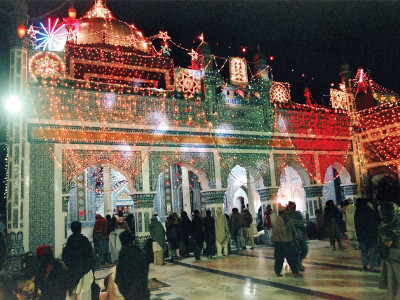
<p>It took me twenty minutes to drive over to the tomb of the resting sage, adjacent to the scenic Kiran Lake. Eid, undoubtedly, is special for the countless people who come to celebrate it in Bhitt Shah. The usual hustle and bustle was all the more electrifying with the prospect of the coming ‘<em>urs</em>’ and the long Eid holidays, swelling the ranks of the ‘<em>yatris</em>’ who had come to pay their respects to the Shah.</p>
<p>Flags belonging to the Jeay Sindh Qaumi Mahaz (JSQM) lined Tambura Chowk and the town seemed to be teeming with life, as the Fazal Abbas Hotel hawked its renowned ‘<em>doodh-pati</em>’ and Shah Abdul Latif Photo Studio’s <em>chotu </em>made periodic announcements for available slots for photo shoots. As the shrine resonated with laughter, it was a testament to the devotion of the ‘commoners’ — Shah Abdul Latif’s chosen ones and the subjects of most of his poetry, who have not forgotten him even after so many decades.</p>
<p>It was compelling to see so much life filling up the darbar. No one was the master here. Distinctions between wadera and hari were meaningless and men and women were equal as they danced to the other-worldly tunes of the Dhambura, oblivious to their surroundings. The principal lesson of Islam and Sufism was too pervasive to be ignored.</p>
<p>After climbing the two flights of steps to the dargah, I entered the main courtyard of the tomb. At the very cusp of the entrance to the inner courtyard where the mosque is located, lies the Kirk tree. The origins of this tree go back to the time of Bhittai himself and legend has it that he planted the tree himself but the tree only became famous after the saint’s death.</p>
<p>Today, the tree can be seen adorned with locks, amulets and all sorts of oddities. “I placed a lock here eight months ago, so that my child would be safely delivered as I already had three miscarriages,” explained Firdous as she unlocked one of the locks on the branches. She had also arranged for a <em>daig</em> at the local <em>langar</em> since her <em>mannat</em> had been fulfilled.</p>
<p>However, the tree today seems to have faded over time, as if granting so many wishes had weakened it from the inside. “Its branches are now extremely weak, saeein,” said one of the caretakers of the dargah, “We occasionally trim the leaves but its regenerative capability has really become limited.”</p>
<p>Pakistani dargahs have always been associated with drugs and shady goings-on, and Bhitt Shah is no exception in that regard. In my brief interlude from the main shrine, I saw many people sharing a chilum, smoking hashish and on a couple of occasions, having a go at heroin too. “What harm am I doing to society if I am high for a little while? It is malangi dhuaan after all,” says Jahangir Bhagio, a fruit seller.</p>
<p>When I inquired as to the source of his drug supplies, he exchanged a nervous glance with his partner. “Saeein, it is easily available here. So much so, that people share it on the basis of ‘charity.’ I got my share today for just exchanging a bunch of bananas.” His “share” is more than 100 grams of lower grade hashish.</p>
<p>Similarly, people have always wondered about the shady ‘musafirkhanas’ which adorn the top of the bazaar outside the dargah. Everybody was tightlipped on what went on in the musafirkhannas. “We are never told as to what happens there. Who comes to these places in night time and for what purpose?” said Rehman, a fruit vendor.</p>
<p>When questioned as to what he thought it was, he said that these might be safe places for sexual encounters rather than being permanent brothels. “Saeein, I think prostitutes are also settled in some of these, pretending to be permanent musafirs,” quips his friend Rashid.</p>
<p>Although exorcisms usually take place as the need arises, their numbers multiply during specific times of the year such as during Eid and Muharram. Qader Buksh Khaskeli, the Kunjidar (key-keeper) of the dargah, has been handling such cases for more than two decades now.</p>
<p>“He is the master of his art. When the tamburas (long-necked plucked lute) are plucked and Lateef Saeein’s bayts are sung coupled with invocations of Solomon, the djinn has to abandon the human,” asserts one close aide. Khaskeli, himself, however takes no credit for that and claims that it is the ‘karamat’ of Bhittai himself.</p>
<p>“In night time, we treat people who have come from all across the interior. Tambura is the instrument of the saints and yogis. Shah is the sanctuary for everyone, even for djinns,” said Khaskeli adding that after separating the djinn from the human, the former are allowed to play within the dargah vicinity for a month. They leave of their own accord.</p>
<p>“Everybody comes here with hopes. None return empty-handed,” explains a Mutawalli at the exit of the shrine. The Bhitt is eternal in that sense. It is one set of glorious traditions and values which has proved resolute in the face of changing times.</p>
<p><em>Published in The Express Tribune, Sunday Magazine, April 15<sup>th</sup>, 2012.</em></p>
</p>
			<br clear="all"/>
		]]>
		</description>

		<media:content width="424" height="318"
							isDefault="true" medium="image" url="http://i1.tribune.com.pk/wp-content/uploads/2012/04/363618-bhati-1334239130-113-640x480.JPG">
			<media:title>bhati</media:title>
			<media:description>Go not far, Sasui, nor give up the quest,
walk not with your feet, yet sit not quite content,
All connection with joys of life snap,
Walk with your heart, that the journey may soon end. (Sur Sasui). PHOTO : ARIF SOOMRO
</media:description>
			<media:thumbnail url="http://i1.tribune.com.pk/wp-content/uploads/2012/04/363618-bhati-1334239130-113-160x120.JPG" width="160" height="120" />
      </media:content>

		<wfw:commentRss></wfw:commentRss>
		<slash:comments>5</slash:comments>
	</item>
		<item>
		<title>Informed citizenry: ‘Shehris’ advocate people’s right to information</title>
		<link>http://tribune.com.pk/story/268430/informed-citizenry-shehris-advocate-peoples-right-to-information/</link>
		<pubDate>Thu, 06 Oct 2011 23:29:33 +0000</pubDate>

		<guid isPermaLink="false">http://tribune.com.pk/?p=268430</guid>

		<description>
		<![CDATA[
			<a href="http://tribune.com.pk/story/268430/informed-citizenry-shehris-advocate-peoples-right-to-information/">
				<img src="http://i1.tribune.com.pk/wp-content/uploads/2011/10/268430-Informationtechnology-1317941445-999-160x120.jpg" width="160" height="120" alt="" />
			</a>
			<p><div><strong class='location'>KARACHI:&nbsp;</strong>
<p><strong>The government might be made up of public servants but the real ‘owners’ of this country are the citizens of Pakistan, asserted Roland deSouza, an electrical engineer by profession, and a member of Shehri-Citizens for a Better Environment (CBE) initiative.</strong></p>
</div>
<p>He was speaking at a workshop on the “<a href="http://pakistanconstitution-law.org/article-19a-right-to-information/">Right to Information &#8211; Article 19-A</a>”, held at Regent Plaza on Thursday.</p>
<p>A lack of awareness about laws relating to the ‘access to information’ are one of the major reasons why citizens fail to hold the government accountable for its actions, according to Shehri-CBE members who spoke at the workshop.</p>
<p>The participants came from all walks of life, including businessmen, government representatives, ombudsmen, university students and journalists from the city.</p>
<p>Giving a presentation on Article 19-A, introduced in the constitution’s 18th amendment in 2010, de’Souza highlighted the fact that “<a href="http://tribune.com.pk/story/265024/access-to-information-a-step-closer-to-a-more-open-government/">disclosure of information which affects the citizenry</a> is a common practice worldwide, whereas secrecy is taken to be a narrow exception &#8211; to be precisely and clearly defined.”</p>
<p>Although Freedom of Information (FOI) might have become the new buzzword amongst Pakistan’s educated class, the importance of Article 19-A still needs to be advocated to its people.</p>
<p>Defining the term, the general secretary of Shehri, Amber Alibhai, emphasised that the right of information according to law entails that “every citizen shall have the right to have access to information in all matters of public importance, subject to regulation related to matters of national security.”</p>
<p>Briefing the participants on the evolution of RTI, starting from the 1990’s Freedom of Information Ordinance (FIO) introduced by a professor of the Jamaat-e-Islami, Khurshid Ahmed, the legislation has come a long way forward resulting in the culmination of Article 19-A.</p>
<p>The vice chairperson, Samir Dodhy, also talked to the participants on the actual process of filing an inquiry under the law with the authorities to obtain information about issues which impact their lives.</p>
<p>Dodhy said that that the law might have some deficiencies in its present form but the citizens must try to use the law to their advantage. He also mentioned that Sherry Rehman’s Right to Information Bill tried to get rid of some of the deficiencies in 19-A suggesting that the public record should include municipalities while information and accounts of government expenditure shall be made available on websites.</p>
<p>Dodhy mentioned a few cases that Shehri took in recent years, which alluded that the NGO met with bitter-sweet success so far, mainly due to reluctance by the authorities to cooperate with them.</p>
<p>In the last session of the workshop, there was a group activity where the participants were taught to file real-life inquiries depending on the cases each group was assigned.</p>
<p>The exercise helped engage the participants in the seminar enabling them to envisage the ‘power’ of the RTI law.</p>
<p>The occasion concluded with the showing of a mini-documentary from India where in common people were using street performances to communicate the importance of RTI in New Delhi’s lower class areas.</p>
<p><em>Published in The Express Tribune, October 7<sup>th</sup>, 2011.</em></p>
</p>
			<br clear="all"/>
		]]>
		</description>

		<media:content width="424" height="318"
							isDefault="true" medium="image" url="http://i1.tribune.com.pk/wp-content/uploads/2011/10/268430-Informationtechnology-1317941445-999-640x480.jpg">
			<media:title>Information technology</media:title>
			<media:description>A lack of awareness about laws relating to the ‘access to information’ are one of the major reasons why citizens fail to hold the government accountable for its actions.</media:description>
			<media:thumbnail url="http://i1.tribune.com.pk/wp-content/uploads/2011/10/268430-Informationtechnology-1317941445-999-160x120.jpg" width="160" height="120" />
      </media:content>

		<wfw:commentRss></wfw:commentRss>
		<slash:comments>0</slash:comments>
	</item>
	
</channel>
</rss>
<!-- Performance optimized by W3 Total Cache. Learn more: http://www.w3-edge.com/wordpress-plugins/

Page Caching using apc
Database Caching 5/19 queries in 3.101 seconds using memcached
Object Caching 536/574 objects using apc

 Served from: tribune.com.pk @ 2013-05-25 02:12:17 by W3 Total Cache -->