<?xml version="1.0" encoding="UTF-8"?>
<rss version="2.0"
	xmlns:content="http://purl.org/rss/1.0/modules/content/"
	xmlns:wfw="http://wellformedweb.org/CommentAPI/"
	xmlns:dc="http://purl.org/dc/elements/1.1/"
	xmlns:atom="http://www.w3.org/2005/Atom"
	xmlns:sy="http://purl.org/rss/1.0/modules/syndication/"
	xmlns:slash="http://purl.org/rss/1.0/modules/slash/"
	xmlns:media="http://search.yahoo.com/mrss/"
	>

<channel>
	<title>The Express Tribune &#187; Tooba Masood</title>
	<atom:link href="http://tribune.com.pk/author/2268/tooba-masood/feed/" rel="self" type="application/rss+xml" />
	<link>http://tribune.com.pk</link>
	<description>Latest Breaking Pakistan News, Business, Life, Style, Cricket, Videos, Comments</description>
	<lastBuildDate>Wed, 19 Jun 2013 16:38:45 +0000</lastBuildDate>
	<language></language>
	<sy:updatePeriod>hourly</sy:updatePeriod>
	<sy:updateFrequency>1</sy:updateFrequency>
	<generator>http://wordpress.org/?v=3.5.1</generator>

		<item>
		<title>Reading Gatsby in Pakistan    </title>
		<link>http://tribune.com.pk/story/559140/reading-gatsby-in-pakistan/</link>
		<pubDate>Sun, 09 Jun 2013 07:32:06 +0000</pubDate>

		<guid isPermaLink="false">http://tribune.com.pk/?p=559140</guid>

		<description>
		<![CDATA[
			<a href="http://tribune.com.pk/story/559140/reading-gatsby-in-pakistan/">
				<img src="http://i1.tribune.com.pk/wp-content/uploads/2013/06/559140-GreatGatsby-1370607142-301-160x120.jpg" width="160" height="120" alt="" />
			</a>
			<p><p><strong>The nouveau riche, the valley of ashes</strong></p>
<p><em>Girls from good families must marry by the rules in Pakistan as well</em></p>
<p><strong>By Dr Ishrat Lindblad</strong></p>
<p>“Daisy, Daisy, give me your answer do/I’m half crazy, all for the love of you/It won’t be a stylish marriage/For I can’t afford a carriage&#8230;”: the familiar words of this children’s rhyme neatly encapsulate one of the main themes in <i>The Great Gatsby</i>; the conflict between an idealised love and a crassly materialistic world.</p>
<p>Baz Luhrmann’s recent film version of Scott Fitzgerald’s classic story of the corruption of the “American Dream” has hit the headlines as one of the most-talked about movies this year, but what does this story have to do with us? A great deal, it would seem, for classic works can outlive their original contexts and make us see our own world afresh.</p>
<p><img alt="" src="http://pullquotesandexcerpts.files.wordpress.com/2013/06/014.jpg" /></p>
<blockquote>
<p align="left">Leonardo DiCaprio as Jay Gatsby, Joel Edgerton as Daisy Buchanan’s husband Tom and Elizabeth Debicki as Jordan Baker. Photos: Bazmark Film III Pty Limited</p>
</blockquote>
<p>First of all take Daisy, who like our well-brought up girls from “good families”, is the aristocratic Southern belle in Fitzgerald’s novel who has to abide by the rules of her “East Egg” family. She has to marry a wealthy, aristocratic, top university-educated man who has won their approval. She is not capable of giving a “true answer” like the innocent Daisy in the above-mentioned rhyme. She cannot say: “We’ll run away on a summer’s day/On a bicycle made for two”. Why should her parents care that their daughter is weeping before the wedding with Tom Buchanan as she reads a letter from her beloved Gatsby, telling her that he has devoted his life to deserving her?</p>
<p>Even the contrast between the landed East Egg families with their elegance, good taste and leisure and the newly rich families who have had to work hard to amass their wealth is too easily identified in our own society and the way the people who consider themselves to have “good breeding” look down upon the nouveau riche: “Who on <i>earth</i> do <i>they </i>think they <i>are</i>?”</p>
<p>Then we have the “Valley of Ashes” in the book — a veritable industrial wasteland where the poor people try to make a living for themselves while millionaires drive by at a crazy speed through the dirt and the litter in their super-luxury cars, showing no awareness whatsoever of the men and women whom they ruthlessly exploit.</p>
<p>In our world today, it is only too easy to find frustrated poor men like the garage mechanic, George Wilson, and his wife Myrtle… people of whose deaths we read in our newspapers every day and try to forget as fast as we can. Are we so different from Tom Buchanan and Daisy who solve problems by refusing to get involved and simply moving away to another neighbourhood?</p>
<p>And Gatsby himself? The extravagant drunken parties that he throws and the criminal means he has embraced in order to amass the wealth he knows he needs to be able to woo Daisy, is all too easily recognised.</p>
<p>Especially ironic is the fact that prohibition in the 1920s could not stop the American elite from becoming drunk any more than it can stop us from indulging in similar excesses. Gatsby’s dream leads to corruption — a symbol perhaps for the shattered dream of the founding fathers of America. This country was also established in the name of a dream, but where are we today? Are we not becoming as decadent as the characters in Fitzgerald’s novel?</p>
<p>A few honest observers who believe in moral values and try to keep a distance, like Nick Carraway, the narrator of Gatsby’s story, often become disillusioned with what they see and decide to opt out and like him, go west!</p>
<p>Finally we have the compelling symbol of the eyes of Dr TJ Eckleburg: in reality a derelict billboard, but for poor mechanic George Wilson the all-seeing eyes of a transcendent power. George uses the language of the fundamentalists, telling his unfaithful wife, Myrtle, that God sees her sin and will punish her. When she runs out of their home in desperation and is driven over and dies, Wilson convinces himself he is God’s instrument and goes out to seek vengeance on her lover. Daisy’s husband Tom Buchanan has lied to George in order to protect himself and believing this, the mechanic goes out to first shoot Gatsby and then himself.</p>
<p>And, to end on a frivolous note, consider the hellish heat that drives the characters into a frenzy as they confront each other in the climactic scene in a luxury hotel. Haven’t we all felt desperate when the temperature hits 40 degrees in the shade and the electricity fails yet again?</p>
<p><i>Author Dr Ishrat Lindblad is settled in Sweden but visits Pakistan on a regular basis. She taught English literature at the Department of English, Stockholm University, from 1976 until her retirement in 2007. During a period of sabbatical leave in the 1990s and after her retirement she has worked part-time as principal at The Lyceum in Karachi.</i></p>
<p><strong>F Scott Fitzgerald, Munir Niazi, and the illusion of progress</strong></p>
<p><em>The last line of The Great Gatsby resonates vividly with a Munir Niazi couplet</em></p>
<p><strong>By Amir Jafri</strong></p>
<p>Pakistani poet Munir Niazi was born about the time American novelist F Scott Fitzgerald died. And while the two men shared little in terms of geography and culture, they had in common, in my view, a certain aesthetic, a bleak worldview, a romantic notion, and a precocious talent for creating vivid imagery with a few words.</p>
<p>Fitzgerald’s novel, <i>The Great Gatsby</i>, has received renewed interest with Baz Luhrmann’s film and it is perhaps worth highlighting the loaded last line of the book because it bears similarities to something written closer to home. Consider:</p>
<p><i>So, we beat on, boats against the current, borne back ceaselessly into the past</i>.</p>
<p>This is about as heartbreaking a coda as has ever been delivered at the culmination of a tale about a man’s driving material ambition in the service of his unrequited love. In this case, that character is Jay Gatsby.</p>
<p><img alt="" src="http://pullquotesandexcerpts.files.wordpress.com/2013/06/f-scott.jpg?w=625" /></p>
<p>The fundamental existential paradox of toil without redemptive hope, the human predicament of hovering between the badlands of predestination and freewill, the ultimate existential morass, all hang timorously in the alliterative resonance of that summing up.</p>
<p>For our existence as individuals, F Scott Fitzgerald uses the metaphor of the illusion of progress, the futility of motion, of our life as nothing but toil on the tireless tread-machine of time which, like a bad dream, moves a bit faster than our efforts to gain distance. Inevitably and poignantly it throws us back constantly, and reduces life to little more than a vapid, almost nauseous chore.</p>
<p>It is an instance of curious serendipity that Munir Niazi uses in one of his <i>maqtaas</i> (the last couplet of the Urdu ghazal) an idea similar to this one employed by Fitzgerald in the last line of <i>The Great Gatsby</i>.</p>
<p><i>Munir is mulk par aasaib kaa saaya hai ya kiya hai</i></p>
<p><i>Kay harkat taiz-tar hai, aur safar aahista aahista</i></p>
<p>Fitzgerald gives us the image of individual lives as boats thrown back by tsunamic waves as a symbol of the futile struggles of the individual. On the other hand, Niazi chooses an otherworldly image and frames it in a broader, national context. Niazi uses the disturbing supernatural images of shadows and phantoms under whose spell his beloved country has fallen. (He wrote umpteen love poems for Pakistan).</p>
<p>Fitzgerald’s individual, in spite of his grueling drudge, is persistently thrown back in the course of his life’s journey. The journey of Niazi’s dear country is more of a trance-like stupor. The words <i>aahista aahista</i> give us the eerie sense that we are constantly on the move, but really on our way to nowhere.</p>
<p><img alt="" src="http://pullquotesandexcerpts.files.wordpress.com/2013/06/are-we.jpg?w=625" /></p>
<p>While Fitzgerald’s expression is beautified by the thudding alliteration of “beat,” “boat,” “borne back,” Niazi’s couplet draws its aesthetic mojo from the hissing conspiratorial alliteration of <i>is</i>, <i>aasaib, saaya, safar, aashista aahista</i>, not to mention the venomous zing of <i>tez</i>.</p>
<p>As the excitement of our 2013 election ebbs so does — <i>aahista aahista</i> — the exhilaration that fleetingly touched the nation. The all-too familiar <i>aasaib</i> of nepotism, greed, corruption, thievery, wild spendings, abject poverty start to rear their heads again with the news of million-dollar coat with which the prime minister of one of the poorest nations in the world will adorn himself on his coronation, the scandal at the milk plant in Lahore, the shameless bargaining for parliamentary seats and other cushy jobs, the jostling for lucrative situations, the all-too depressing quid pro quos, the endless blame game.</p>
<p>So, we vote on, desperately hoping against devastating hypocrisy, returning wearily into the lap of the same — as Jalib put it — Zardaris, Mazaris, Madaaris, Jatois, Chaudrys, Pagaarhas, Qureshis, Makhdooms, Khattaks, Khans, Shahs, Sharifs, and not so shareefs, on and on goes the circus.</p>
<p><i>After completing his doctoral work in Rhetoric at The University of Oklahoma, author Amir H. Jafri has taught at various universities in the US and Pakistan. Currently, he teaches at COMSATS in Islamabad. His book </i>Honour Killing: Ritual; Dilemma; Understanding <i>was published by Oxford University Press.</i></p>
<p><strong>Beautiful losers</strong></p>
<p><i>Baz Luhrmann’s cinematic interpretation of </i><i>The Great Gatsby </i><i>is beautiful but perhaps too perfect</i><i></i></p>
<p><strong>By Tooba Masood</strong></p>
<p>We loved Baz Luhrmann’s <i>Moulin Rouge </i>not just because of its jeweled tones and the chemistry between Nicole Kidman and Ewan McGregor but because it was an unpredictable delight. In his latest cinematic offering, director Luhrmann delivers another lush, bejeweled spectacular with his attempt to interpret F Scott Fitzgerald’s <i>The Great Gastby</i>. But something isn’t quite right.</p>
<p>The plot is simple enough but it is Fitzgerald’s exposé of the reckless rich and the portrait of a time that drives it forward.</p>
<p>It opens with Nick Carraway (Tobey Maguire) moving into a cottage next to the mysterious palatial home that Jay Gatsby (Leonardo DiCaprio) has bought to be opposite his long-lost love Daisy (Carey Mulligan). He hopes to win her back but she is a married woman now. Gatsby’s formula is to throw mad parties in the hope that Daisy will turn up one day. Nick accepts an invitation to attend one of these soirees where he (and we) meet Gatsby (around half an hour into the film and worth the wait).</p>
<p>Gatsby was rumoured to be a German spy, an assassin, a millionaire bootlegger. He was made of new money, something Daisy’s husband, a nasty, brutish old money Ivy-league graduate, Tom Buchanan (Joel Edgerton), detested. What Buchanan was unaware of was that Gatsby had courted Daisy as an officer in the First World War. But he was unable to marry her then because he was penniless. Gatsby gets Nick to help him reconnect with Daisy. He wants to recreate the past. And is where the story starts to fall apart.</p>
<p>Don’t get me wrong, it is still a pleasure to watch this film and worth the money. DiCaprio carries off the Brooks Brothers suits with aplomb. No one else can give pink linen such machismo. The fountains of Moët &amp; Chandon delight. The pulse quickens, we are drawn into the party scene by the systolic thump of Jay-Z’s <i>No Church in the Wild</i>. And where did that lighting come from? Why aren’t<i> our </i>lives bathed in <i>that</i> light?</p>
<p>Pace and literal interpretation are the two major pitfalls Luhrmann has been unable to sidestep. Unless you are a blind Gatsby fan who wanted the film to be exactly like the book which you re-read before watching the movie, you might be a little irritated with the tempo. It moves a tad slow because every scene is covered <i>as is</i>.</p>
<p>It doesn’t help that the romance between DiCaprio’s Gatsby and Mulligan’s Daisy feels like a limp towelette. Oh, she looks at him all misty-eyed and his gaze is piercing — but when it came to connecting, these two characters would have been closer standing on the opposite shores of the lake that separated their mansions. Their individual performances shone — in isolation.</p>
<p>You will not mind this disappointment, however, as DiCaprio’s performance more than compensates. He is the consummate Gatsby, insecure, inscrutable, blinded by his inexplicable love for Daisy. His golden-jowled grimace is only as perfected as the blonde cowl that strays from his Adonic helmet as he stifles his frustration.</p>
<p>Special mention must be given to Elizabeth Debicki who plays Daisy’s friend Jordan Baker in all her imperious leggy hauteur. She, more than Mulligan, captures the sashay, flip of the wrist, frenetic flip-flopping and lanky larking around of the socialites of the 1920s. Tobey Maguire plays a whiny Nick Carraway, the story’s watchful narrator. But he does manage to summon our sympathies. I forgot to mention Amitabh Bachchan. He was there for all of 15 minutes as a Jewish gambler who has lunch with Nick and Gatsby at a barber shop. Yes, that was it.</p>
<p>The film’s triumph, though, is its dirty, nasty, brilliant soundtrack in which popular contemporary tracks have been re-spun, shot through with Jazz and gashed with Goth. Techno is laced with trumpet and rebels the likes of Jack White have been given free rein to beat out ballads such as <i>Love is Blindness</i>. You will keep coming back.</p>
<p><i>Published in The Express Tribune, Sunday Magazine, June 9<sup>th</sup>, 2013.</i></p>
<p><i>Like </i><a href="https://www.facebook.com/ETribuneMag"><i>Express Tribune Magazine on Facebook</i></a><i>, follow </i><a href="https://twitter.com/ETribuneMag"><i>@ETribuneMag </i></a><i>on Twitter to stay informed and join the conversation.</i></p>
</p>
			<br clear="all"/>
		]]>
		</description>

		<media:content width="424" height="318"
							isDefault="true" medium="image" url="http://i1.tribune.com.pk/wp-content/uploads/2013/06/559140-GreatGatsby-1370607142-301-640x480.jpg">
			<media:title>Great-Gatsby</media:title>
			<media:description>Leonardo DiCaprio as Jay Gatsby, Joel Edgerton as Daisy Buchanan’s husband Tom and Elizabeth Debicki as Jordan Baker. PHOTO: BAZMARK FILM III PTY LIMITED </media:description>
			<media:thumbnail url="http://i1.tribune.com.pk/wp-content/uploads/2013/06/559140-GreatGatsby-1370607142-301-160x120.jpg" width="160" height="120" />
      </media:content>

		<wfw:commentRss></wfw:commentRss>
		<slash:comments>6</slash:comments>
	</item>
		<item>
		<title>Student Visas: What you need to know </title>
		<link>http://tribune.com.pk/story/552841/student-visas-what-you-need-to-know/</link>
		<pubDate>Sun, 26 May 2013 07:50:44 +0000</pubDate>

		<guid isPermaLink="false">http://tribune.com.pk/?p=552841</guid>

		<description>
		<![CDATA[
			<a href="http://tribune.com.pk/story/552841/student-visas-what-you-need-to-know/">
				<img src="http://i1.tribune.com.pk/wp-content/uploads/2013/05/552841-Student-1369234360-670-160x120.jpg" width="160" height="120" alt="" />
			</a>
			<p><p><strong>You’ve finally received the offer from your dream college. You couldn’t stop babbling about it at the dinner table until someone’s threatened to shove roti down your throat. Haters can hate, you’re still happy.  But don’t take it easy, you still have to get a visa. We’ve focused on the US and UK even though Pakistani students travel the world. We scoured embassy websites, pestered officials and asked those who’ve already received that treasured thappa on their passports for words of advice — but the best advice is to keep abreast of all the rules as they can change any time.</strong></p>
<p><strong>How to apply for a student visa for the US</strong></p>
<p><strong>Part(l)y in the USA</strong></p>
<p>Some Pakistani students turn the same shade as the colour of their passports when they start thinking about getting a US visa. But the truth is that horror stories are actually few and far in between. “My entire visa process took two-and-a-half weeks and I didn’t apply particularly early either,” says Rabail Habib, who is studying film at Northwestern University, “I got an interview date for the week after I applied. They told me my visa was approved at the interview and I picked it up just three days later.”</p>
<p>The only irritant in her experience was getting roasted in the sweltering heat as she waited in line outside the US Embassy in Islamabad. “But the people at the embassy were great,” she says.</p>
<p><strong>Yours form-ally</strong></p>
<p>The process of applying for a visa is a fairly simple one: there are several visa categories and the first thing you need to do is pick the right one. Students enrolled in an undergraduate, Master’s or PhD programme usually need an F-1 visa to set foot on US soil. Exchange students and those planning to embark on a short vocational course must apply for other categories. Here we’ll discuss how to apply for an F-1 visa.</p>
<p>Once you accept the admission offer made to you by a university, their international office should send you what is known as the I-20 form. This is perhaps the most important piece of the visa puzzle. The form is proof that you have indeed been offered a spot at a US university. It also includes how much cash is required for the duration of your studies and the amount you told the university was in your bank.</p>
<p>You don’t need to fill this form — this will be done by the university. The most important item in this document is the SEVIS number, a unique pin through which the Office of Visa Service can access all your university information on an online database.</p>
<p>Once you have your I-20 and the SEVIS number, you can begin filling out the main form called DS-160, the link for which can be found on the US consulate’s website. Tree-huggers rejoice — there are no paper forms. At the login page, you will be issued an application ID number: save this, as it is needed to access your online application later.</p>
<p>Once you hit the submit button, you will have to pay $160 and print out the confirmation. Next, head over to your local American Express office with the items mentioned in our checklist (see Checklist) and schedule an appointment for an interview. They are conducted at the US Consulate in Karachi and the US Embassy in Islamabad.</p>
<p><strong>If you don’t have a clue, no visa for you</strong></p>
<p>Quite a few students underestimate how important it is to be able to explain your study plans at the visa interview. “My experience was quite embarrassing. I went in there and must have sounded like I was high,” says a girl who was denied a visa in 2010, “When the interviewer asked me why I had chosen to study economics, I just didn’t know what to say. I told them it’s because I want to ‘take on the reins of my family business’ or something lame like that. I could have sworn the interviewer rolled her eyes. I didn’t get the visa in the end.”</p>
<p>The bottom line is that you must be ready to explain your study plans and the reason why you applied to your particular university.</p>
<p><strong>How to apply for a student visa for the UK</strong><b></b></p>
<p><strong>Beware of the Tier 4</strong></p>
<p>Do not think of the tier 4 — the name of the category to which students must apply — as your enemy. Embrace it like an old friend. The documents available on the UK Border Agency (UKBA) website are daunting. After reading the first couple of pages it gets confusing but just remember to take a deep breath and keep going.</p>
<p>A UK visa application works on a point-based system and you get points for submitting certain documents.You need a total of 40 points to show that you are a genuine student — these include the 30 points you get by submitting the Confirmation of Acceptance for Studies (CAS) letter from your university. You can get the remaining 10 points by proving that you have enough money in the bank.</p>
<p>Once you get your acceptance letter, apply immediately. Do not waste time. The first thing you need to do is to make an appointment at the International Organistaion for Migration (IOM) for the TB test. The website will suggest that you call and make an appointment but it is better to email. You will end up spending a couple of hours at IOM but will get the test results the same day.</p>
<p>Next you need to fill out an online application available on the UKBA website. This will contain questions such as name, date of birth, where you will study, if you have a criminal record, if you’ve ever been rejected for a visa etc. After you submit this, you will be able to make an appointment to submit supporting documents.</p>
<p>Don’t forget to fill out the Appendix 8 application. You will need to submit that with your supporting documents. This will also be available on the UKBA website. Remember to keep your current passport and previous passports along with photocopies. You’ll also need one passport photo, but just keep two to be on the safe side.</p>
<p>Make sure your university sends the CAS letter on time. This has their sponsorship number and other details — which you will need for Appendix 8.</p>
<p>The bank statement should be your biggest concern. The UKBA is not interested in the entire year’s statement; they just want to know that you have the money in your account and have had it 30 days before you applied for the visa. Make sure you have enough money in the account to cover fees, rent and living expenditure. This could be a minimum of £25,000 if you will be living in London.</p>
<p>The day before you have to submit your papers, remember to take a bank draft of the exact amount for the visa fees, cash is also acceptable.  Remember additional supporting documents will always help your case. Previous school transcripts are necessary. If your family has any property or extra income, do include the papers just to show that you are financially sound.</p>
<p>After the visa officer checks all your documents and puts them in a black plastic bag, they will direct you to the biometrics section. With that done, the officer will hand you a receipt and tell you to wait for a call.</p>
<p><strong>Words of wisdom</strong></p>
<p>Despite the simplicity of it all, there can be snags, so you need to apply well in advance. “Applying for a student visa was stressful and annoying,” says Alai Naseer, who is studying film in London, “I didn’t receive it until after my first term had ended. And that’s despite applying from London.”</p>
<p><strong>Tips and advice</strong></p>
<ul>
<li>Apply three months before the start date of your course — typical processing times span up to 60 days.</li>
<li>Book your ticket once you have the visa in hand to avoid cancellation charges which may arise if there are any administrative delays in visa processing.</li>
<li>One student’s experience shows that applying for programmes such as systems security and nuclear engineering could lead to delays. The student had to ask a professor whom he had done research work to write a special note to the embassy, assuring that the only reason he wanted to enroll in that programme was purely academic. This eventually helped the student get a visa.</li>
<li>If at the end of the interview you are told that your visa requires further administrative processing, ask your university’s admissions office to write to the US Embassy or the consulate. One applicant claims this helped expedite the process.</li>
<li>You can’t appeal a visa denial. So if rejected, have to apply again, which costs more time and money. So make sure you submit a complete application in the first go and can explain why you’re planning to study a specific course at a particular university.</li>
<li>Some students have been caught off-guard, assuming that old visa rules were in place. Make sure you are familiar with the latest rules.</li>
</ul>
<p><strong>Mythbusters</strong></p>
<ul>
<li>Are you worried that your high school is too obscure? Officials at the US consulate in Karachi deny this matters. “Visas are always based on an individual’s eligibility — and not on the school the applicant attends here in Pakistan,” says an official from the consulate. One of the key factors that help a student with their visa process is an actual plan of study.</li>
<li>Another myth is that certain names, such as ‘Osama’ or ‘Khan’ might be on some sort of blacklist and applicants with such names will be scrutinised more. “There are no ‘blacklisted names’,” say consular officials in Karachi. “Some visa applications require further administrative processing, which takes additional time after the visa applicant’s interview.”</li>
<li>One myth surrounds the length of the interview. In the corporate world, job interviews that are short and end abruptly are taken as bad news. This rule does not apply for US visa interviews. Most of the successful applicants who shared their experiences said they were stunned how quickly it went by. You’ll spend more time in the waiting lounge than in the interview.</li>
</ul>
<p><strong>US Visa Checklist</strong><b></b></p>
<p>At the American Express office, you must submit:</p>
<ul>
<li>Your confirmation of the submission of the DS-160 form.</li>
<li>A passport photo with a white background.</li>
<li>A photocopy of the passport valid for the length of the trip to the US and photocopies of the passports held during the last 15 years</li>
<li>Your complete travel history for the past 10 years</li>
<li>The full names of your siblings, and if you’re a Master’s or PhD applicant with children, their names are required too</li>
<li>Take the following documents with you to the interview:</li>
<li>Your interview appointment packet with one copy of the interview letter</li>
<li>Your current passport as well as any old ones you’ve travelled on</li>
<li>A completed DS-160 form with a printout of the confirmation of submission page</li>
<li>Original school report cards, Matric and FSc documents, O’ and A’ Level certificates, university transcripts and university degree</li>
<li>Four 2&#215;2 passport photos</li>
<li>Financial documents such as bank statements and tax return forms to show that you have enough money to cover the expenses stated on the I-20 form</li>
</ul>
<p><strong>UK Visa Checklist</strong><b></b></p>
<ul>
<li>Make an appointment to be tested for TB at the International Organisation for Migration (http://www.bia.homeoffice.gov.uk/countries/pakistan/applying/tb-testing/).</li>
<li>Fill out the online application (http://www.ukba.homeoffice.gov.uk/visas-immigration/studying/) and keep a printout as proof. Once you submit the application you can make an appointment to submit your papers.</li>
<li>Remember to fill out Appendix 8 (http://www.ukba.homeoffice.gov.uk/sitecontent/applicationforms/visas/vaf9-app81.pdf)</li>
<li>Current and previous passports.</li>
<li>Two passport photos.</li>
<li>Acceptance letter and a letter from the university for visa purposes.</li>
<li>Bank statements. Make sure they are up to date. Do not give entire year’s account, just 30 days prior to applying for the visa.</li>
<li>Visa application fees.</li>
<li>CNIC</li>
<li>Keep photocopies of all original documents</li>
<li>If you need supporting documents, take family financial/property papers, A’ and O’ level and other school transcripts</li>
<li>One copy of the interview letter</li>
<li>Your current passport as well as any old ones you’ve travelled on</li>
<li>A completed DS-160 form with a printout of the confirmation of submission page</li>
<li>Original school report cards, Matric and FSc documents, O’ and A’ Level certificates, university transcripts with all courses taken with grades obtained and a university degree</li>
<li>Four 2&#215;2 passport photos</li>
<li>Financial documents such as bank statements and tax return forms to show that you have enough money to cover the expenses stated on the I-20 form</li>
</ul>
<p><i>Published in The Express Tribune, Sunday Magazine, May 26<sup>th</sup>, 2013.</i></p>
<p><i>Like </i><a href="https://www.facebook.com/ETribuneMag"><i>Express Tribune Magazine on Facebook</i></a><i> to stay informed and join the conversation. </i></p>
</p>
			<br clear="all"/>
		]]>
		</description>

		<media:content width="424" height="318"
							isDefault="true" medium="image" url="http://i1.tribune.com.pk/wp-content/uploads/2013/05/552841-Student-1369234360-670-640x480.jpg">
			<media:title>Student</media:title>
			<media:description>You’ve finally received the offer from your dream college. You couldn’t stop babbling about it at the dinner table until someone’s threatened to shove roti down your throat. Haters can hate, you’re still happy.  But don’t take it easy, you still have to get a visa. We’ve focused on the US and UK even though Pakistani students travel the world. We scoured embassy websites, pestered officials and asked those who’ve already received that treasured thappa on their passports for words of advice — but the best advice is to keep abreast of all the rules as they can change any time .</media:description>
			<media:thumbnail url="http://i1.tribune.com.pk/wp-content/uploads/2013/05/552841-Student-1369234360-670-160x120.jpg" width="160" height="120" />
      </media:content>

		<wfw:commentRss></wfw:commentRss>
		<slash:comments>10</slash:comments>
	</item>
		<item>
		<title>Movie review: Ironed out and flat</title>
		<link>http://tribune.com.pk/story/545573/movie-review-ironed-out-and-flat/</link>
		<pubDate>Sun, 12 May 2013 11:31:51 +0000</pubDate>

		<guid isPermaLink="false">http://tribune.com.pk/?p=545573</guid>

		<description>
		<![CDATA[
			<a href="http://tribune.com.pk/story/545573/movie-review-ironed-out-and-flat/">
				<img src="http://i1.tribune.com.pk/wp-content/uploads/2013/05/545573-iranman-1367935619-222-160x120.jpg" width="160" height="120" alt="" />
			</a>
			<p><p align="left"><strong>Let’s cut to the chase. <i>Iron Man 3</i> did not strike a nerve. Maybe my expectations were too high.</strong></p>
<p align="left">The only save was the action sequences. Billionaire playboy Tony Stark’s (Iron Man) Malibu pad is blown to smithereens. There is a great rescue scene for 13 people thrown out of Air Force One mid-air. Robert Downey Jr is an amazing super hero, as always, but the story falls flat for most of the two and a half hours. In the third edition we see our hero still trying to come to terms with the invasion of Earth by Loki to subjugate Earth. Nick Fury, the director of an international peacekeeping agency, cobbles together The Avengers (Stark aka the Iron Man, Captain America, The Hulk, Thor, Black Widow, Hawkeye) as a team to save the world from the powerful Loki.</p>
<p align="left"><img alt="" src="http://pullquotesandexcerpts.files.wordpress.com/2013/05/iran-man.jpg" /></p>
<p align="left">In <i>Iron Man 3</i> our hero is shown still trying to come to terms with the New York invasion. For Stark, the success of The Avengers was a big deal. But he has since become a recluse because of his reliance on the Iron Man suit. His anxiety levels have escalated. He can’t sleep and this leads to problems with his girlfriend, Pepper Pots (Gwyneth Paltrow). At this point, new villain Mandarin (Ben Kingsley) enters. Kingsley’s character is a cross between Osama bin Laden and a warlord from <i>Game of Thrones</i>. However, he is just the face of evil — the real bad guy being Aldrich Killian (Guy Pearce), a stark raving mad scientist who our playboy slighted at a science convention in Switzerland years ago. Yes, the terrorist isn’t the bad guy for once. It is Killian who has a serum that can turn people into living bombs.</p>
<p align="left">The tongue-in-cheek humour helps defuses the tension built up by Kingsley’s character. There are jokes about Croydon, British football and <i>Downton Abbey</i> — but I don’t think many people outside the UK would appreciate them.</p>
<p align="left">There are some parts that the censor boards might bleep/blank out. No, not the making-out scenes but the ones in which Pakistan is mentioned with links to terrorism. The Mandarin is thought to have been in Pakistan (but they later find out that he’s in Miami). In another scene Tony Stark’s best friend Col James Rhodes (Don Cheadle) is shown making friends in a hostile Pakistan. I don’t know what part of the country they were trying to show, but it looked like a scene out of <i>Aladdin</i>.</p>
<blockquote><p><strong><em>Top 3 Robert Downey Jr movies</em></strong></p></blockquote>
<p align="left"><strong>1. Less than Zero</strong></p>
<p align="left"><img alt="" src="http://pullquotesandexcerpts.files.wordpress.com/2013/05/m-02.jpg" /></p>
<p align="left">You will barely recognise Downey Jr in <i>Less than Zero</i>, the 1987 movie based on a Bret Easton Ellis novel. He delivers to perfection the hopelessness and depths of despair of a young man who is sucked in by a heroin addiction. Not a movie to watch if you’re down but do get the soundtrack.<i></i></p>
<p align="left"><strong>2. Fur: An Imaginary Portrait of Diane Arbus</strong></p>
<p align="left"><img alt="" src="http://pullquotesandexcerpts.files.wordpress.com/2013/05/m-01.jpg" /></p>
<p align="left">What could have been a tragic freak show ends up with Downey giving a moving performance as a man who suffers from hypertrichosis (extreme hairiness) in <i>Fur: An Imaginary Portrait of Diane Arbus</i>. Although Downey wasn’t nominated for this movie, his performance as Arbus’s hirsute neighbour received great acclaim from all movie critics.</p>
<p align="left"><strong>3. Chaplin</strong></p>
<p align="left"><img alt="" src="http://pullquotesandexcerpts.files.wordpress.com/2013/05/m-03.jpg" /></p>
<p align="left">Downey once again pulls off a challenging character in this David Attenborough film. But his performance did not save the work which was criticised for being too formulaic as a biopic. Still recommended for Charlie Chaplin fans.</p>
<p><i>Published in The Express Tribune, Sunday Magazine, May 12<sup>th</sup>, 2013.</i></p>
<p><i>Like </i><a href="https://www.facebook.com/ETribuneMag"><i>Express Tribune Magazine on Facebook</i></a><i> to stay informed and join the conversation. </i></p>
</p>
			<br clear="all"/>
		]]>
		</description>

		<media:content width="424" height="318"
							isDefault="true" medium="image" url="http://i1.tribune.com.pk/wp-content/uploads/2013/05/545573-iranman-1367935619-222-640x480.jpg">
			<media:title>iran man</media:title>
			<media:description>The third installment in the Iron Man trilogy will hopefully be the last.</media:description>
			<media:thumbnail url="http://i1.tribune.com.pk/wp-content/uploads/2013/05/545573-iranman-1367935619-222-160x120.jpg" width="160" height="120" />
      </media:content>

		<wfw:commentRss></wfw:commentRss>
		<slash:comments>2</slash:comments>
	</item>
		<item>
		<title>Karachi, go get your gun  </title>
		<link>http://tribune.com.pk/story/517981/karachi-go-get-your-gun/</link>
		<pubDate>Sat, 09 Mar 2013 05:30:52 +0000</pubDate>

		<guid isPermaLink="false">http://tribune.com.pk/?p=517981</guid>

		<description>
		<![CDATA[
			<a href="http://tribune.com.pk/story/517981/karachi-go-get-your-gun/">
				<img src="http://i1.tribune.com.pk/wp-content/uploads/2013/03/517981-_-1362806887-732-160x120.jpg" width="160" height="120" alt="" />
			</a>
			<p><div>
<p><strong>To buy a gun you need two passport photographs, a copy of your CNIC, a NADRA verification letter of your CNIC, a police certificate, salary slip, a copy of your electricity or telephone bill and Rs4,530 for the fee. </strong></p>
<p>The minimum age was 18 years, but it has been bumped up to 25. Still, many people buy them illegally. “Most people in the 18 to 21 age bracket buy TT pistols,” says Shehzi Khan, an arms and ammunition dealer who runs shops in Saddar and DHA. “The weapon costs around Rs21,000 and an extra Rs35 per bullet.” Before they hand the weapon over they note down the buyers details, including thumb prints, address and CNIC number. Khan’s family has been in the business for 40 years. They get most of their supplies from Turkey, China, Yugoslavia and Russia. “We sell a TT almost every day, just last week we sold around 13 pistols,” he told <i>The Express Tribune</i> in December. “Some people are genuine gun collectors but most of these young boys buy guns to show ‘bharam’ [attitude] or fight.”</p>
</div>
<p><i>Published in The Express Tribune, March </i><i>9<sup>th</sup>, 2013.</i></p>
</p>
			<br clear="all"/>
		]]>
		</description>

		<media:content width="424" height="318"
							isDefault="true" medium="image" url="http://i1.tribune.com.pk/wp-content/uploads/2013/03/517981-_-1362806887-732-640x480.jpg">
			<media:title>Gun-killed-murder-shoot</media:title>
			<media:description>Many people buy guns illegally. PHOTO: FILE</media:description>
			<media:thumbnail url="http://i1.tribune.com.pk/wp-content/uploads/2013/03/517981-_-1362806887-732-160x120.jpg" width="160" height="120" />
      </media:content>

		<wfw:commentRss></wfw:commentRss>
		<slash:comments>2</slash:comments>
	</item>
		<item>
		<title>Like mother, like son: Bilawal will be successful, says Mark Siegel</title>
		<link>http://tribune.com.pk/story/485735/like-mother-like-son-bilawal-will-be-successful-says-mark-siegel/</link>
		<pubDate>Fri, 28 Dec 2012 05:01:08 +0000</pubDate>

		<guid isPermaLink="false">http://tribune.com.pk/?p=485735</guid>

		<description>
		<![CDATA[
			<a href="http://tribune.com.pk/story/485735/like-mother-like-son-bilawal-will-be-successful-says-mark-siegel/">
				<img src="http://i1.tribune.com.pk/wp-content/uploads/2012/12/485735-BenazirBhuttoFile-1356670822-908-160x120.jpg" width="160" height="120" alt="" />
			</a>
			<p><div><strong class='location'>KARACHI:&nbsp;</strong>
<p><strong>For Mark Siegel December 27 is always going to be a difficult day to get through. This year, on his friend Benazir Bhutto’s fifth death anniversary, however, he felt a sense of pride as he saw her son make his first major political speech.</strong></p>
</div>
<p>“I believe there is going to be a shift in politics now,” he told <em>The Express Tribune</em> over the phone from Washington. “Bilawal is an emerging politician and will be successful.”</p>
<p>Siegel is an American lobbyist who was the former prime minister’s speech writer for two decades and helped her update her autobiography ‘Daughter of Destiny’. “It’s been five years, and I still don’t believe it,” he said. “The term ‘jeay Bhutto’ means a lot to us, it means that she is still alive.”</p>
<p>Siegel, who caught snippets of Bilawal’s speech which was in Urdu, has known him since he was a child. It is a little strange for him to call him a man now, he remarked, adding, however that the speech should not be seen as the ‘launch’ of his public career as Bilawal has been participating in politics since his mother was assassinated.</p>
<p><img src="http://pullquotesandexcerpts.files.wordpress.com/2012/12/mark-siegel1.jpg?w=625" alt="Mark Siegel," /></p>
<p>Siegel did not comment about his relationship with the young politician but said that Benazir always wanted Bilawal to be happy and have choices. “His happiness was her first priority,” he said. “If he wanted to go into the civil services, she would have supported him with her whole heart. This is why in her handwritten will she left the chairmanship of the party to her husband and not Bilawal – because she wanted him to have choices.”</p>
<p>Siegel also knows Bakhtawar and Aseefa. “I am proud of all three of them &#8211; with their father in jail and their mother running a party alone and watching her die in front of their eyes &#8211; I cannot imagine a more traumatic childhood. But they survived and flourished into kind and compassionate human beings. I see a lot of their mother in them. All three of them are devoted to make sure that she did not die in vain. They want to fight for what she believed in and stood for.”</p>
<p>Siegel, a partner at Locke Lord Strategies has worked with former American President Jimmy Carter and Vice President Hubert H Humphrey. He collaborated with Benazir on Reconciliation: Islam, Democracy and the West, which was published after her assassination.</p>
<p><em>Published in The Express Tribune, December 28<sup>th</sup>, 2012.</em></p>
</p>
			<br clear="all"/>
		]]>
		</description>

		<media:content width="424" height="318"
							isDefault="true" medium="image" url="http://i1.tribune.com.pk/wp-content/uploads/2012/12/485735-BenazirBhuttoFile-1356670822-908-640x480.jpg">
			<media:title>Benazir Bhutto-File</media:title>
			<media:description>Benazir’s close friend and speech writer feels sad and proud.</media:description>
			<media:thumbnail url="http://i1.tribune.com.pk/wp-content/uploads/2012/12/485735-BenazirBhuttoFile-1356670822-908-160x120.jpg" width="160" height="120" />
      </media:content>

		<wfw:commentRss></wfw:commentRss>
		<slash:comments>14</slash:comments>
	</item>
		<item>
		<title>Postcards from the edge bring Karachi a little closer to those abroad  </title>
		<link>http://tribune.com.pk/story/430266/postcards-from-the-edge-bring-karachi-a-little-closer-to-those-abroad/</link>
		<pubDate>Sun, 02 Sep 2012 22:56:23 +0000</pubDate>

		<guid isPermaLink="false">http://tribune.com.pk/?p=430266</guid>

		<description>
		<![CDATA[
			<a href="http://tribune.com.pk/story/430266/postcards-from-the-edge-bring-karachi-a-little-closer-to-those-abroad/">
				<img src="http://i1.tribune.com.pk/wp-content/uploads/2012/09/430266-Image-1346612953-879-160x120.jpg" width="160" height="120" alt="" />
			</a>
			<p><p><strong><strong class='location'>KARACHI:&nbsp;</strong>It doesn’t matter if you’ve spent 50 years or 15 days in Karachi, it has a way of getting under your skin. The target killings, Altaf Hussain’s face on every sidewalk, graffiti about urination in public, Sea View&#8230; the list is endless.</strong></p>
<p>So when Indus Valley School of Art and Architecture graduate, Khaula Jamil, came up with the idea for an online postcard project, ‘Take me to Karachi’, it didn’t take long for it to go viral on social media. Now any Karachi’ite, whether they are in Berlin or Ulaan Baatar, can place an order on Jamil’s Facebook page and pay her PayPal account (this includes shipment).</p>
<p>The name ‘Take me to Karachi’ was inspired by graffiti saying ‘Chalo chalo, Karachi chalo’ that Jamil photographed in October 2007 near Sea View the week Benazir Bhutto was returning. “Everyone said it had the Karachi vibe,” she explained. “It also reminded me of when you’re abroad and you hail a cab and tell the driver to take you somewhere.”</p>
<p><strong>Country roads, take me home</strong></p>
<p>When Jamil moved back to Karachi after completing her Masters in Fine Arts and Photography at Parsons, The New School for Design, her iPhone became her new best friend. Using Instagram, Pixlr O’matic and other camera applications she captured a bit of Karachi wherever she went.</p>
<p>It certainly helped to land a job heading the Citizens Archive of Pakistan photography and video department, which gave her access to areas she wouldn’t normally visit. “I just started taking regular photos with my phone and started playing around with them,” she said while talking to <em>The Express Tribune</em> on Friday. “I didn’t plan on doing anything with them.” She was fascinated by the layers and complexity and wanted to add different textures. “I wanted to interpret Karachi in the funky way I saw it.”</p>
<p>A few people saw the photos and asked for prints to send to their friends abroad. There was no looking back after that.</p>
<p>The process of making a postcard is pretty simple. Jamil takes a photograph with her iPhone, adds the layers, edits them, adds general description or location and prints them using 100-gram or heavier printing paper. The postcards are laminated with a matt finish. She is considering framed prints as well.</p>
<p>So far the response has been “overwhelming”. Overnight the page had over 200 fans, 90 were her friends. “Pretty soon people started asking me how they could place orders. I did not plan a business, I still haven’t. People place orders and I try to accommodate. I get a lot of orders from Karachi, but also send many to Dubai, Singapore, the US and Germany.” She is in talks with a place to house the postcards.</p>
<p>Jamil admits to being a voyeur. “I’m watching people going around their daily routine. It is very fast paced. I just go around catching anything that fascinates me,” she said. “There is a certain beauty and charm about it. In my other project which I started three months ago, ‘Humans of Karachi’ I have to go up to people explain the project and take photos.”</p>
<p>Humans of Karachi, is a project Jamil is working on with the Citizens Archive of Pakistan. It puts forward a positive image of the city. It is based on Brandon Stanton’s Humans of New York project.</p>
<p><strong>Mission statement</strong></p>
<p><strong>Karachi, dekho magar pyaar se</strong></p>
<p>- To show off all that is Karachi &#8211; one area at a time</p>
<p>- Sets consist of five 4”x6” postcards each</p>
<p>- All sets are final</p>
<p>- No custom orders or mixing it up</p>
<p>- To place an order, the client has to get in touch through Facebook, place an order and pay via PayPal (Rs1,000 per set of 5 and includes shipping, prices to be revised)</p>
<p><em>Correction: An earlier version of this article incorrectly stated that Benazir Bhutto came back in October 2008. The correction has been made.</em></p>
<p><em>Published in The Express Tribune, September 3<sup>rd</sup>, 2012.</em></p>
</p>
			<br clear="all"/>
		]]>
		</description>

		<media:content width="424" height="318"
							isDefault="true" medium="image" url="http://i1.tribune.com.pk/wp-content/uploads/2012/09/430266-Image-1346612953-879-640x480.jpg">
			<media:title>Image 02</media:title>
			<media:description>Khaula Jamil’s online postcard project is based on street photography where she uses iPhone applications to make the product look funky and chic. PHOTO COURTESY: KHAULA JAMIL &amp; DESIGN: ESSA MALIK
</media:description>
			<media:thumbnail url="http://i1.tribune.com.pk/wp-content/uploads/2012/09/430266-Image-1346612953-879-160x120.jpg" width="160" height="120" />
      </media:content>

		<wfw:commentRss></wfw:commentRss>
		<slash:comments>2</slash:comments>
	</item>
		<item>
		<title>Karachi’s O’ Level students brace for Cambridge results expected August 13  </title>
		<link>http://tribune.com.pk/story/418779/karachis-o-level-students-brace-for-cambridge-results-expected-august-13/</link>
		<pubDate>Tue, 07 Aug 2012 19:35:58 +0000</pubDate>

		<guid isPermaLink="false">http://tribune.com.pk/?p=418779</guid>

		<description>
		<![CDATA[
			<a href="http://tribune.com.pk/story/418779/karachis-o-level-students-brace-for-cambridge-results-expected-august-13/">
				<img src="http://i1.tribune.com.pk/wp-content/uploads/2012/08/418779-exams-1344368010-661-160x120.jpg" width="160" height="120" alt="" />
			</a>
			<p><p><strong><strong class='location'>KARACHI:&nbsp;</strong>For 17-year-old Waqar Ali, this summer was all about going to the beach and chilling out at his friend’s house playing video games. He sat his last O’ Level exam in June and had not thought about the results till August 6.</strong></p>
<p>“I was having iftar with my family when my older sister had to ruin it by reminding me that the result would be out in a couple of days,” he said. “I texted my friends, who had spoken to teachers at their schools, and they confirmed my worst fear. They said the result should be out on Monday, August 13.” After biting his nails for a good four hours, Waqar says he sat down with his parents and discussed the POA (plan of action) on where to apply for his A’ Levels. His father came up with a simple solution – 10 As or more and Waqar would apply to Karachi Grammar School, 9As and below and he would apply to The Lyceum School or Nixor College. As a backup, Waqar also kept his options open for Southshore School for A’ Level Studies, Foundation Public School and if all else failed, he is also prepared to sit his A’ Levels privately.</p>
<p>In Gulistan-e-Jauhar, Rumana’s mother has been praying her daughter did well this year. “I am more anxious about my daughter’s result this time around than last year, as her final O’ Level grades will determine which A’ Level school she will go to,” said Nafisa Mehdi. “This, in turn, will play a pivotal role in her further academic and professional life.”</p>
<p>According to Rumana, when you step out of the examination hall, you feel that everything went well. “However, at this stage [right before the results], all you can remember is the mistakes you probably made in the exams.”</p>
<p>While talking to <em>The Express Tribune</em>, the principal of AES School for Girls said that their job was to prepare their students for their examinations. “The rest depends on their hard work and God,” said Mohammad Amin Ahmedani. “I wish all of my students, and others awaiting their O’ Levels results, the very best.”</p>
<p>A’ Level schools, including The Lyceum School, KGS and Nixor College, start their admissions process before the O’ Level exams start. They call in students for interviews and sometimes tests. Many students wait till the results are out and then start the admissions procedure.</p>
<p><strong>A’ Levels or Inter?</strong></p>
<p>For some students and their parents, it becomes quite difficult to decide what to do after the O’ Levels – should they automatically move on to the A’ Levels (grades 12 and 13) or switch to the local education board or Intermediate. The intermediate stream definitely works for students who want to later take up medicine or engineering at public-sector universities such as NED or Dow because they will not have to convert their marks sheets. A’ Level students have to undergo a conversion and it is argued that they lose points in the process. “In general, students who do their intermediate score higher and secure a spot at the public universities,” said Dr Iftikhar Kazim, whose daughter Areeba had to switch to the intermediate after sitting her O’ Levels at The City School.</p>
<p>But Muniza Waseem, who has been associated with The City School for the last 16 years and is the headmistress of the Gulshan-e-Iqbal junior campus, did not agree with this approach. “This trend started to gain momentum a few years ago,” she said. “But parents realised that it was better to continue with the Cambridge International Examination instead.”</p>
<p>At the Happy Home School, more than half of the students continue with the CIE into the A’ Levels, said Farah Imam, the head of the O’ Level campus. But as the school allows them to take a maximum of six subjects, many have to make up for one more by sitting it privately if the A’ Level school of the choice requires a minimum of seven subjects such as KGS. “Here most of the students prefer to apply to KGS but for that they have to sit a few exams as a private candidate,” explained Imam.</p>
<p>Given the number of students across Karachi who wish to do their A’ Levels there is a shortage of schools. In fact, this year, The City School has launched three more A’ Level campuses – DHA, North Nazimabad and PECHS, according to the school’s regional director Nudrat Sajid Khan.</p>
<p><em>Published in The Express Tribune, August 8<sup>th</sup>, 2012.</em></p>
</p>
			<br clear="all"/>
		]]>
		</description>

		<media:content width="424" height="318"
							isDefault="true" medium="image" url="http://i1.tribune.com.pk/wp-content/uploads/2012/08/418779-exams-1344368010-661-640x480.jpg">
			<media:title>exams</media:title>
			<media:description>For some students and their parents, it becomes quite difficult to decide what to do after the O’ Levels. PHOTO: FILE</media:description>
			<media:thumbnail url="http://i1.tribune.com.pk/wp-content/uploads/2012/08/418779-exams-1344368010-661-160x120.jpg" width="160" height="120" />
      </media:content>

		<wfw:commentRss></wfw:commentRss>
		<slash:comments>9</slash:comments>
	</item>
		<item>
		<title>From Australia, with love: Father McCulloch finds his true calling in Pakistan    </title>
		<link>http://tribune.com.pk/story/400801/from-australia-with-love-father-mcculloch-finds-his-true-calling-in-pakistan/</link>
		<pubDate>Fri, 29 Jun 2012 02:33:21 +0000</pubDate>

		<guid isPermaLink="false">http://tribune.com.pk/?p=400801</guid>

		<description>
		<![CDATA[
			<a href="http://tribune.com.pk/story/400801/from-australia-with-love-father-mcculloch-finds-his-true-calling-in-pakistan/">
				<img src="http://i1.tribune.com.pk/wp-content/uploads/2012/06/400801-McCullochPHOTOAYESHAMIREXPRESS-1340911404-923-160x120.jpg" width="160" height="120" alt="" />
			</a>
			<p><div><strong class='location'>KARACHI:&nbsp;</strong>
<p><strong>Father Robert McCulloch likes maash ki daal and Lata Mangeshkar’s melodious voice. For the Australian priest, a chance trip to Pakistan turned into a lifetime of serving the impoverished in Sindh.</strong></p>
</div>
<p>On February 5, Father McCulloch received a phone call from Sindh Governor Dr Ishratul Ebad, informing him that he was being awarded the Sitara-e-Quaid-e-Azam for services to the country’s health and education sectors. “I sat back in my chair and pinched myself. I’ve spent more than half my life here. At that moment I truly felt as if this was my home,” he says.</p>
<p>“I volunteered to come to Pakistan,” he told <em>The Express Tribune</em>. “I could have had an academic career but the religious group [Columban Brothers] I worked with was invited for a visit.”</p>
<p>That trip was in 1978, but the priest ended up spending more than half of his life in the country, making his way from Lahore’s Old City to impoverished villages in Sindh.</p>
<p>He says Pakistan was less complicated, but at the age of 32, the priest was witness to one of the most tumultuous times in its history.</p>
<p>“At that time Pakistan was just 30 years old, in the middle of an identity crisis. I remember sitting in Lahore and listening to the BBC about what was supposed to happen,” shared Father McCulloch. “It totally changed the heart of the country. I will always remember with horror how people were being flogged in public.”</p>
<p><strong>Changing attitudes</strong></p>
<p>After Father McCulloch learnt Urdu, he travelled to smaller towns and villages on a motorcycle. “The citywalas really miss out on rural life.”</p>
<p>After a spell in Badin, he started working with the semi-nomadic Hindu tribe of Parkari Kohli in Tharparkar district.  “There were no roads,” he said. “It was just a tiny sleepy village. Working there was physically demanding and time consuming. These people were and still are slaves to the feudal system. We were trying to secure their futures, provide them with medical care and education.”</p>
<p>Father McCulloch said health was one of their main concerns. “The villagers and their babies were dying of measles, tuberculosis and the whooping cough,” he said. The immunisation programme set up by the priest was run with the district authorities, and helped win over people.</p>
<p>He also helped start a school which has grown to a 400-student strong high school.</p>
<p>“People who were shunned from society noticed a change,” he said. “Muslim families opened their homes and this is what shifted cultural attitudes. This was what Mohammad Ali Jinnah had in mind when he wanted a separate country.”</p>
<p>As the priest and nuns gained the villagers’ trust, they also noticed how the better health and education facilities were impacting the youth. Father McCulloch recalled an anecdote: a farmer who was going over accounts with a landlord took his son along to double-check the calculations done by the landlord’s manager.</p>
<p><strong>Save a language, save a culture</strong></p>
<p>Father McCulloch also helped the tribe design a script for their language and called on two linguists for their help. “The villagers opted for the Sindhi script. It was all done with a few minor changes. People gathered proverbs and sayings and we launched the first Parkari Kohli newspaper, Prem Paracha. Helping save a language and culture is one of the things the Catholic Church has contributed to Sindh.”</p>
<p>During the floods, the priest made sure people had drinking water and a roof over their heads. “I saw people from different backgrounds and faith working together, it was beautiful,” he said. “We built 820 homes, provided solar energy and even helped some people find work.”</p>
<p>Since moving to Rome as Procurator-General of the Columban Brothers, Father McCulloch has visited Karachi twice and can’t wait to come back again.</p>
<p>“When my colleagues ask me how I felt about coming back, I said <em>asmaan se nikla, khajoor ke darkhat mein atka</em>, I was dropped out of heaven and now I’m stuck in a date tree.”</p>
<p><strong>Get to know Father McCulloch</strong></p>
<p>Born in Australia in 1946, Father Robert McCulloch was educated by the La Salle Brothers, a religious order that also taught former prime minister Yousaf Raza Gilani. He wanted to become a priest after reading an article in eighth grade. “I was very mature for my age,” he said. “Even then I knew what I wanted to do for the rest of my life.” His parents encouraged him to follow his heart and after 11 years of training, he was ordained a Catholic priest in 1970 in Melbourne. From 1970 to 1973, he worked in Southern Philippines. The next two years were spent in Rome for higher theological studies. From 1976 to 1978, Father McCulloch was in Washington DC earning a MA in Church History. He came to work in Pakistan in 1978 and stayed here for 34 years. He used to visit Karachi every month and taught Latin and Theology at the Catholic Christ the King Seminary, where priests spent the last four years of their training. He taught there for 27 years and in 2002 became the academic dean.</p>
<p>Father McCulloch went back to Rome in 1998 and was there till 2000 for a Doctorate in Theology. After he returned to Pakistan, he was asked to take over as chairperson of Hyderabad’s St Elizabeth Hospital.</p>
<p>Since November 2011, he has been working with the Vatican as Procurator-General of the Columban Brothers.</p>
<p><em>Published in The Express Tribune, June 29<sup>th</sup>, 2012.</em></p>
</p>
			<br clear="all"/>
		]]>
		</description>

		<media:content width="424" height="318"
							isDefault="true" medium="image" url="http://i1.tribune.com.pk/wp-content/uploads/2012/06/400801-McCullochPHOTOAYESHAMIREXPRESS-1340911404-923-640x480.jpg">
			<media:title>McCulloch-PHOTO-AYESHA MIR-EXPRESS</media:title>
			<media:description>Talking about his time in Lahore, Father McCulloch says at that time, the country was just 30 years old and in the middle of an identity crisis. PHOTO: AYESHA MIR/ EXPRESS
</media:description>
			<media:thumbnail url="http://i1.tribune.com.pk/wp-content/uploads/2012/06/400801-McCullochPHOTOAYESHAMIREXPRESS-1340911404-923-160x120.jpg" width="160" height="120" />
      </media:content>

		<wfw:commentRss></wfw:commentRss>
		<slash:comments>13</slash:comments>
	</item>
		<item>
		<title>Shershah, the go-to place for all the missing pieces</title>
		<link>http://tribune.com.pk/story/391806/shershah-the-go-to-place-for-all-the-missing-pieces/</link>
		<pubDate>Mon, 11 Jun 2012 04:24:07 +0000</pubDate>

		<guid isPermaLink="false">http://tribune.com.pk/?p=391806</guid>

		<description>
		<![CDATA[
			<a href="http://tribune.com.pk/story/391806/shershah-the-go-to-place-for-all-the-missing-pieces/">
				<img src="http://i1.tribune.com.pk/wp-content/uploads/2012/06/391806-lahour-1339355525-240-160x120.jpg" width="160" height="120" alt="" />
			</a>
			<p><p><strong><strong class='location'>KARACHI:&nbsp;</strong>There is more to Shershah than the reported killings, firing and robberies. What most people forget is that it has one of the largest industrial areas of the city that stretches from Mauripur Road all the way to SITE.</strong></p>
<p>Spare parts, tyres, rear view mirrors, coal, life jackets – you name it, they got it.</p>
<p>For Rs70, a truck driver can get his truck and cargo weighed before he hits the highway.</p>
<p>Abdul Rasheed, who has been working with trucks and weighing trucks for over 10 years, said that the truck weighing or kanta system is a computerised process where the truck and the load on it was weighed separately. “It started in 1992 and I think it is quite useful,” he said. “You can see these weighing stations along the highway as well, right after the toll plaza. The highway authorities use them to check a truck’s load and to check if they’re staying within the limits. We weigh about 100 to 150 truck daily.” He added that the businessmen and government introduced the weighing system to decrease smuggling.</p>
<p>While explaining how the trucks were weighed, Rasheed said that he had three employees who worked eight-hour shifts. “They basically sit in a room with the computer and when a truck drives up to the ramp, we make the driver park in a way that it covers four spots,” he explained. “The sensors tell us the weight of the truck and the items on it within minutes.”</p>
<p><strong>Recharge your battery</strong></p>
<p>A bit further down the same road is Khan Baba. He has been in the recycling car battery business for the last nine years. “We don’t do much. I get the labour, they sit in front of the shop to dismantle the batteries and reassemble them,” he said. “I hire five men for a daily wage of Rs150. They work for eight to 10 hours a day with breaks in between.” Khan Baba added that he bought used batteries for Rs180 per four kilogrammes and sold them to battery manufacturers for twice the price.</p>
<p><strong>Turning scraps to business</strong></p>
<p>In one of the many narrow lanes of Shershah is Rashid, also known as Molvi. He goes to the beach every day. Not only does he like the fresh air, but he likes the scraps he can pick up at the ship breaking yard.</p>
<p>“I have been going there for eight years or so,” he said. “It is a wonderland. There are so many things to pick. Life jackets, lanterns, ropes, boots, clocks, chairs and loudspeakers.” He added that he sold life jackets for Rs300 and other items for over Rs450 depending on their condition.</p>
<p>“Most of my customers are men who like to go fishing,” he said with a chuckle. “Sometimes these seth sahib also come here. They buy loudspeakers by the dozen. They claim it helps them keep their employees in check.”</p>
<p>As you drive out of the maze of Shershah’s narrow lanes, you come across a plot with over 40,000 sacks of coal. Two men stand outside night and day to keep an eye out for trespassers as Ali and his brother load their truck to make deliveries for their father. “We get orders from hotels and restaurant owners. They call us three or four days in advance to place an order,” said Shahzaib. “My father and his brother get the coal from rural Sindh, mostly Badin. The rates differ but at the moment we are selling 40 kilogrammes of coal for Rs850.”</p>
<p><em>Published in The Express Tribune, June 11<sup>th</sup>, 2012.</em></p>
</p>
			<br clear="all"/>
		]]>
		</description>

		<media:content width="424" height="318"
							isDefault="true" medium="image" url="http://i1.tribune.com.pk/wp-content/uploads/2012/06/391806-lahour-1339355525-240-640x480.jpg">
			<media:title>lahour 02</media:title>
			<media:description>Shahbaz, who owns a tyre store, said that the smallest tyre he has costs Rs1,000 while the largest which is seven and a half foot high costs Rs300,000. [Pictured left] is one of the men hired by Khan Baba to dismantle batteries for a daily wage. PHOTO: AYESHA MIR/EXPRESS
</media:description>
			<media:thumbnail url="http://i1.tribune.com.pk/wp-content/uploads/2012/06/391806-lahour-1339355525-240-160x120.jpg" width="160" height="120" />
      </media:content>

		<wfw:commentRss></wfw:commentRss>
		<slash:comments>0</slash:comments>
	</item>
		<item>
		<title>At Teen Hatti, more than three roads meet to create a neighbourhood</title>
		<link>http://tribune.com.pk/story/384980/at-teen-hatti-more-than-three-roads-meet-to-create-a-neighbourhood/</link>
		<pubDate>Mon, 28 May 2012 05:18:09 +0000</pubDate>

		<guid isPermaLink="false">http://tribune.com.pk/?p=384980</guid>

		<description>
		<![CDATA[
			<a href="http://tribune.com.pk/story/384980/at-teen-hatti-more-than-three-roads-meet-to-create-a-neighbourhood/">
				<img src="http://i1.tribune.com.pk/wp-content/uploads/2012/05/384980-flowerPHOTOSAYESHAMIREXPRESS-1338144631-875-160x120.jpg" width="160" height="120" alt="" />
			</a>
			<p><p><strong><strong class='location'>KARACHI:&nbsp;</strong>A stone’s throw from Gurumandir is the neighbourhood of Teen Hatti where some things have changed and others remained constant. For example, it was named Teen Hatti because three or teen roads met at the intersection, or hit. Hatti is the Hindi word for hit. Today, there are four roads that intersect here.</strong></p>
<p>What has not changed is the business of the neighbourhood, which is home to the largest wholesale flower market in the country.</p>
<p>Haji Sahib, who has been in the business for over 30 years, said that they bring in flowers from Hyderabad every day. “Some of the flowers are grown on the outskirts of the city,” he said. “But for some we have to go to Hyderabad or Punjab. It all depends.” This business has daily ups and downs. “You never know how much you’re going to make at the end of the day.”</p>
<p>The market is open from 10am to 1pm every day.</p>
<p>While pointing at the fresh roses behind him, Haji Sahib said that a bunch could cost anything from Rs20 to Rs35, depending on the quality. “These hotels and flower shop owners buy from us in bulk and then sell them for four times the cost,” he said. “For example, they sell 12 tuberoses for Rs300 in Gizri, here we sell them for Rs75 or Rs100.”</p>
<p>Arshad, who runs his father’s flower shop, said that the good quality flowers were gone within minutes. “People usually inform us about what they want the night before,” he said. “The flowers, the quantity and other things are sorted before we leave work so when we place an order, it gets in on time. It is wonderful to smell the roses in the morning. It is one of my favourite things about this business. There is so much pollution and dread in the atmosphere of this city, a dozen roses in your house can help you get through the day.”</p>
<p>Besides the sweet-smelling flower market, Teen Hatti also has its very own Kaffan wala, not to be mistaken for a coffin wala. Abdul Qadir’s son, who has been running the shop for six years, claimed that his father has been in the business for over 50 years. “He opened this shop soon after Partition,” he said. “For 80 rupees we give people everything they need to bury the dead. From cotton, cloth, salt, sandal, soap and a chattai, we pack it all and also deliver it when needed.” The shop has no fixed timings and even receives calls at 3am.</p>
<p>“People don’t have a specific time to die,” he said, while brushing his daughter’s hair. His children have been working with him at the shop since they could walk. “This is the family business and it is good for them to learn these things now, rather than later.” While talking about how much he made in a day, he said it varied. “Sometimes the target killings go through the roof,” he said. “If the victim is from the neighbourhood then it becomes my responsibility, otherwise people rely on rescue services.”</p>
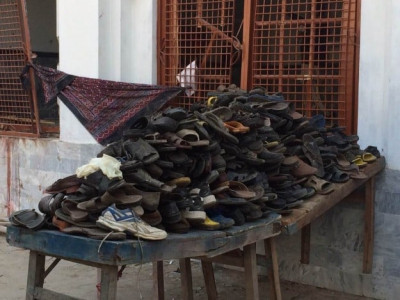
<p>For spiritual guidance, many residents flock to the Syed Noor Ali Shaheed Mazaar just five minutes away from the flower market. The saint, who the mazaar was built for, came to Karachi with Muhammad Bin Qasim. The man who manages shoes at the mazaar said that the saint was a shaheed and drew believers from Oman and Africa. “The urs is usually held in Muharram,” said the Gaddi Nasheen. “We don’t have much security, just ask the police station down the street to help out.” A qawwali is held at the mazaar every Thursday.</p>
<p><em>Published in The Express Tribune, May 28<sup>th</sup>, 2012.</em></p>
</p>
			<br clear="all"/>
		]]>
		</description>

		<media:content width="424" height="318"
							isDefault="true" medium="image" url="http://i1.tribune.com.pk/wp-content/uploads/2012/05/384980-flowerPHOTOSAYESHAMIREXPRESS-1338144631-875-640x480.jpg">
			<media:title>flower-PHOTOS-AYESHA MIR-EXPRESS1</media:title>
			<media:description>From 10am to 1pm, Teen Hatti’s flower market in bustling with activity. Most wholesale retailers sell flowers at half the cost. For ecample, a dozen tuberoses are sold for Rs300 in the market, but here you can buy them for Rs100 or less. The area also has its very own mazaar, which is named after a shaheed who came to Sindh with Muhammad bin Qasim. He has many followers all over the country and across the world, especially Oman and Africa. PHOTO: AYESHA MIR/EXPRESS
</media:description>
			<media:thumbnail url="http://i1.tribune.com.pk/wp-content/uploads/2012/05/384980-flowerPHOTOSAYESHAMIREXPRESS-1338144631-875-160x120.jpg" width="160" height="120" />
      </media:content>

		<wfw:commentRss></wfw:commentRss>
		<slash:comments>2</slash:comments>
	</item>
	
</channel>
</rss>
<!-- Performance optimized by W3 Total Cache. Learn more: http://www.w3-edge.com/wordpress-plugins/

Page Caching using apc
Database Caching 13/39 queries in 0.024 seconds using memcached
Object Caching 1430/1587 objects using apc

 Served from: tribune.com.pk @ 2013-06-19 21:39:18 by W3 Total Cache -->