
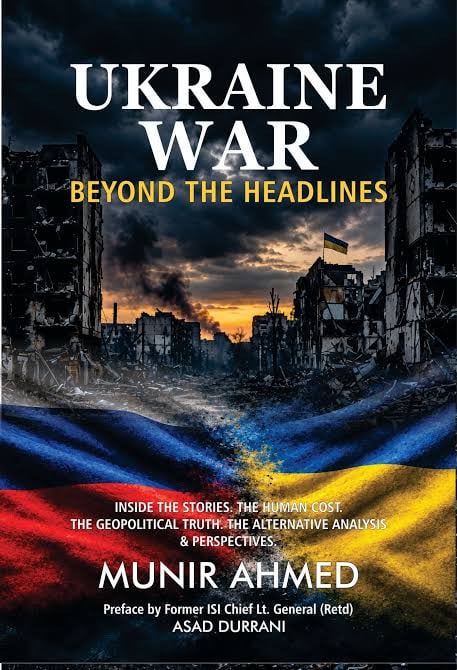
The Russia–Ukraine war has generated an extraordinary volume of political commentary, military analysis and international media coverage. Yet much of the prevailing discourse remains confined to competing accusations, battlefield developments and the geopolitical positions of major powers. In Ukraine War – Beyond the Headlines: An Alternative Narrative on the Crisis, Pakistani journalist and geopolitical analyst Munir Ahmed attempts to widen this conversation by examining the historical circumstances, strategic calculations and diplomatic failures that preceded the conflict, alongside its far-reaching consequences for the international order.
The book's central proposition is that the Ukraine war cannot be adequately understood through the events of February 2022 alone. Rather, the author situates the conflict within a longer history of post-Cold War geopolitical restructuring, NATO's eastward expansion, Russia's evolving security perceptions and the increasingly contentious relationship between Moscow and Western capitals.
This approach distinguishes the book from conventional battlefield narratives. Instead of concentrating primarily on military operations, Ahmed explores the political environment in which confrontation became increasingly likely. He raises questions about whether European security arrangements following the Soviet Union's dissolution sufficiently accommodated the concerns of all major stakeholders, and whether diplomatic opportunities were neglected before hostilities escalated.
A particularly significant dimension of the book is its examination of the events surrounding Ukraine's political upheaval in 2014, the subsequent confrontation in eastern Ukraine and the deterioration of relations between Russia and the West. These developments are presented as essential historical reference points for understanding the conflict's origins. Such an interpretation invites scrutiny, however, because explaining Russia's security concerns does not, in itself, justify its invasion of Ukraine or diminish Ukraine's sovereignty and right to determine its political future.
Ahmed's treatment of international power politics extends beyond Russia and Ukraine. The US, EU, NATO and China feature in his broader assessment of strategic competition and the emergence of an increasingly fragmented international system. The conflict is considered not merely as a regional war but as a manifestation of changing global power relationships, with implications for international institutions, economic alliances and the future balance of influence.
One of the book's more compelling themes is the economic and humanitarian cost of prolonged warfare. The destruction of infrastructure, displacement of millions of people, disruption of agricultural production and pressure on global energy markets demonstrate how a conflict concentrated geographically in Eastern Europe has affected societies far beyond the battlefield.
Particularly relevant for developing countries is the discussion of food insecurity, inflation and rising energy costs. Ukraine and Russia have historically occupied important positions in international grain and commodity markets. Disruptions associated with the conflict have therefore created serious challenges for import-dependent economies, illustrating the vulnerability of global supply chains to geopolitical confrontation.
The environmental consequences of warfare provide another noteworthy perspective. Damage to industrial facilities, agricultural land, water resources and energy infrastructure raises questions about the long-term ecological legacy of armed conflict. By incorporating environmental destruction into the geopolitical discussion, Ahmed draws attention to costs that often receive less consideration than territorial changes and military expenditures.
The book also examines the limitations of international diplomacy and the role of the military-industrial complex in sustaining global security competition. Its discussion of negotiations, competing strategic interests and the difficulties of achieving a durable settlement encourages readers to consider whether continued militarisation can deliver the security that political dialogue has failed to establish.
The preface by Lt Gen (Retd) Muhammad Asad Durrani, Pakistan's former intelligence chief and an established author on strategic affairs, adds a distinctive security-policy perspective to the publication. It also places the work within a wider tradition of critical examination of international power politics.
As an alternative geopolitical interpretation, the book's strength lies in challenging readers to examine assumptions and consider perspectives that may be underrepresented in dominant Western narratives. Its analytical approach nevertheless demands careful distinction between documented historical developments, contested political claims and interpretations of strategic intentions. An alternative narrative becomes most persuasive when it subjects all competing accounts, including those advanced by Moscow, to equally rigorous scrutiny.
Ultimately, Ukraine War – Beyond the Headlines, offers a thought-provoking contribution to discussions about one of the 21st century's most consequential conflicts. Its principal value lies not in providing a definitive explanation of the war, but in encouraging a broader examination of its origins, international dimensions and enduring consequences.
For students of international relations, journalists, policymakers and readers interested in geopolitics, the book offers an opportunity to reconsider the conflict beyond immediate headlines and to reflect on a fundamental question: can sustainable peace emerge from military confrontation, or must it ultimately rest upon diplomacy, mutual security arrangements and respect for international law?
All facts and information are the sole responsibility of the writer