
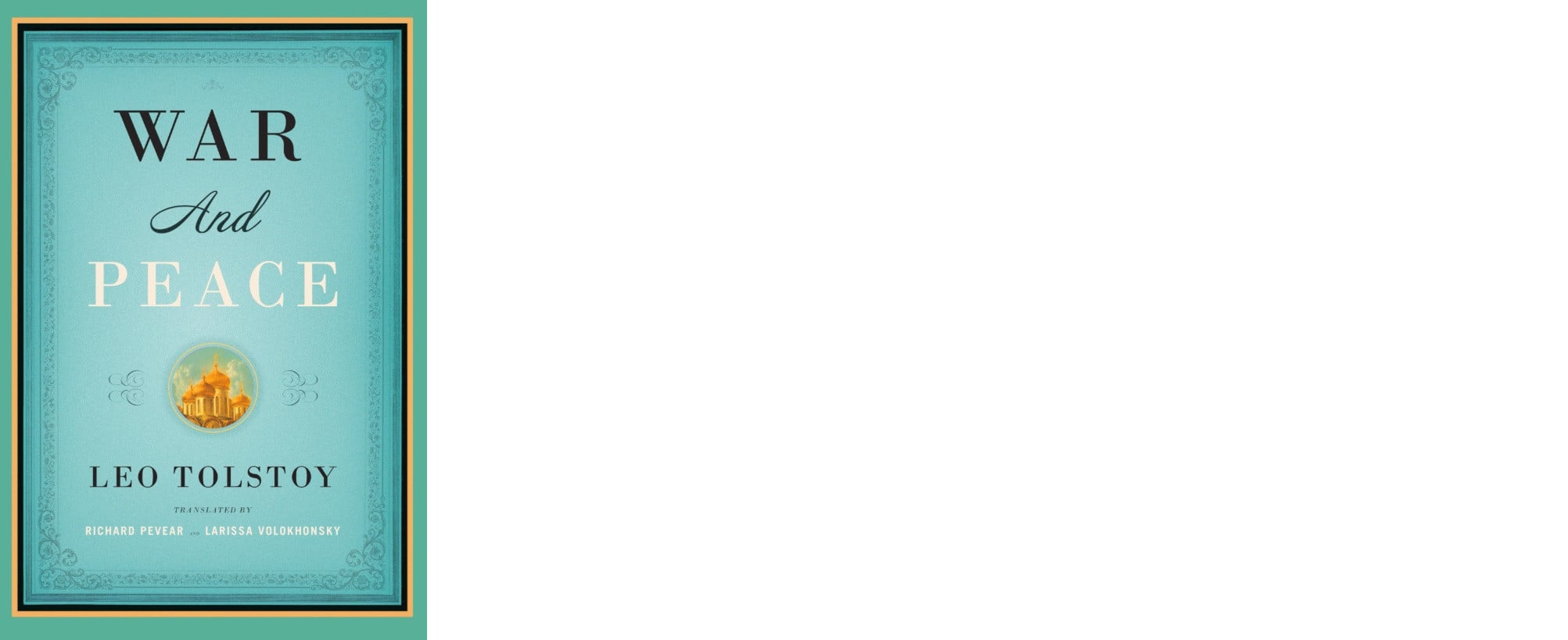
Leo Tolstoy, a Russian writer, produced War and Peace in 1867, a voluminous fictional narrative of the Napoleonic Wars. Tolstoy weaves history and philosophy into his imagination, with the predominant thought built around the premise that human history is carved by millions of unknown and unrecognised ordinary people. It is not shaped by kings, queens, monarchs, generals or politicians. Leadership, in Tolstoy's vein of thought, has to be representative and in full consonance with the collective spirit of the people.
In his book, Tolstoy gives a deep meaning to the need for human enrichment. He says, "We can know only that we know nothing. And that is the highest degree of human wisdom." Wisdom, it follows, is humble: to recognise that what is known to man is but a drop in the ocean of knowledge. At one point, attention is drawn towards the virtues of patience and greatness. He says, "The strongest of all warriors are these two... time and patience." About greatness, he says, "There is no greatness, where there is no simplicity, goodness, and truth."
Tolstoy was essentially anti-war. In a life organised by destruction, it is inevitable that reason and empathy will get totally refuted. Mankind's obsession with war has repeatedly produced the very opposite of what its leaders claim to seek: security, stability and a better future.
In 1950, John Foster Dulles wrote a differently titled book, War or Peace. Unlike Tolstoy's War and Peace, Dulles's book was meant as a blueprint and a way forward for setting the direction of US foreign policy during the intense Cold War. The difference in the titles is significant. Tolstoy's title suggests that war and peace can coexist within the sweep of history; Dulles's suggests choosing between the two.
Dulles evaluated how catastrophic a conflict with the Soviet Union could be. He argued that societies must be mobilised for achieving peace rather than saving all their moral and spiritual resources for engaging in war. He also emphasised tolerance and peaceful coexistence, and the importance of what the then nascent United Nations could do to avoid wars and conflicts.
The question remains: why does humanity repeatedly choose war when it knows what war costs?
War does not determine who is right — only who is left. Neither does it give victory in the face of human loss. H.G. Wells wrote, "If we don't end war, war will end us." Emerson's idea was that "Peace cannot be achieved through violence, it can only be attained through understanding."
Great empires have upon them a heap of sand of time. In their heyday they defeated all enemies, real and perceived. They killed ruthlessly for a transitory glory. They rejoiced at the spill of blood of the innocent, the weak and the oppressed. Yet time, in its natural and regular fury, obliterates the high and mighty alike. No unjust or cruel state has survived the vicissitudes of furious time.
History recalls that all empires were built upon the shifting sands of fleeting time. The funeral of nations and civilisations fails to teach the current powerful states that this too shall pass. The majestic jubilations of victory over the underprivileged will meet no different fate than what history tells us about arrogant warring nations. The sickle of time shall mow down the powers of today. It is inevitable.
War at one time in history was essentially a profession. People had to go to war to keep the coffers going and brimming. War is an expensive game. It leads to heavy and higher taxation, and its negative economic outcomes take a long time to be corrected. Europe, ravaged by the First and Second World Wars, took four decades to regain its economic foothold.
But the cost of war is not measured only in damaged economies or ruined cities. People forget that the cost of war is always the young.
King Baudouin of Belgium, in a speech to the US Congress in 1959, made an apt observation: "Youth is the first victim of war; the first fruit of peace. It takes twenty years or more of peace to make a man; it takes twenty seconds of war to destroy him."
One man killed is a murder, while killings by hundreds and thousands create war heroes. A human malady. Unfortunately, war loves to seek only the young as its victims. Warfare can never remain within the realm of civilised behaviour. Civility remains silent when war drums are beating at their highest decibel levels.
Abraham Lincoln is not remembered because he waged a battle or started a war. Instead, history recognises him for bringing harmony between Blacks and Whites. He abolished slavery. His going to war wasn't motivated by his ego to seek personal glory, but by the solidly noble purpose of equality of men.
The distinction matters. War may be presented as an instrument of history, national pride or political necessity, but those who pay its price are rarely the people who make the decision to begin it.
The famous American writer Ernest Hemingway stated: "They wrote in the old days that it is sweet and fitting to die for one's country. But in modern warfare there is nothing sweet nor fitting in your dying. You will die like a dog for no good reason."
The killing fields of Gaza are a perfect picture of what the writer said. The innocent and the young are being butchered on the streets while the leadership resides in lofty mansions, oblivious or, more appropriately, callous to the plight of displaced men, women and children. The horrors of war stare at us. We continue to twiddle our thumbs.
Currently, the world is witnessing with pain three active theatres of war: the ongoing war in the Middle East, which threatens not only global peace but also has serious economic repercussions as the movement of oil is seriously impaired; the continuing conflict in Gaza; and the war in Ukraine, which threatens peace in Europe.
The war has been brought to Iran, the Persian Gulf, Saudi Arabia and adjoining countries. The consequences of conflict are no longer confined to the battlefield. They travel through economies, energy supplies, borders and ordinary lives.
Russia was provoked by Ukraine. Parking NATO forces at its doorstep wasn't a fair and good decision. The US reaction wouldn't have been different if Russia were to park its missiles in the Atlantic. It was hence inevitable that Russia wouldn't sit and twiddle its thumbs at the prospect of NATO forces staring at them. They had to react and they did.
In today's warfare, there is hardly any military victory. The surrender at Dhaka happened fifty years back. The end to a war is through negotiated settlement. "Better a lean peace than a fat victory," Thomas Fuller wrote.
And yet war continues to be manufactured, supplied and sold.
"Once the weapons were manufactured to fight wars. Now wars are manufactured to sell weapons," writes Arundhati Roy. Almost two score years ago, when I read Anthony Sampson's The Arms Bazaar, I thought I was reading fiction. But, on hindsight, I realise I was reading what was to come. The toys of warfare are manufactured by those who are not at direct war, but these are tested for their killing and destructive accuracy in different parts of the world.
John Foster Dulles had written in War or Peace: "The world will never have lasting peace so long as men reserve for war the finest human qualities. Peace, no less than war, requires idealism and self-sacrifice and a righteous and dynamic faith."
The words are worth remembering because peace does not simply happen when war stops. It requires effort, patience, negotiation and, above all, the willingness to see the enemy as human.
Nelson Mandela wrote: "If you want to make peace with your enemy, you have to work with your enemy. Then he becomes your partner."
War and peace cannot coexist as permanent alternatives. War or peace is not merely a matter of selecting one option over another. Peace, and only peace, has to be the solution to conflicts.
An old woman, a mother to her only son, lamented that if, after giving martyrdom to someone who was her flesh and blood, the warring parties were ultimately going to sit at a table to negotiate peace, why couldn't they do the same before firing the first bullet, dropping the first bomb or launching the first missile?
Her plea is the plea of all mothers, all siblings, all spouses and all citizens of the world.
Perhaps that is where the argument finally comes back to Tolstoy. History is not made only by those who order armies into battle. It is also made by the millions of ordinary people who endure the consequences.
The world leadership must move beyond War and Peace and War or Peace. It must submit to just peace.
The writer is a senior banker and freelance contributor
All facts and information are the sole responsibility of the writer