
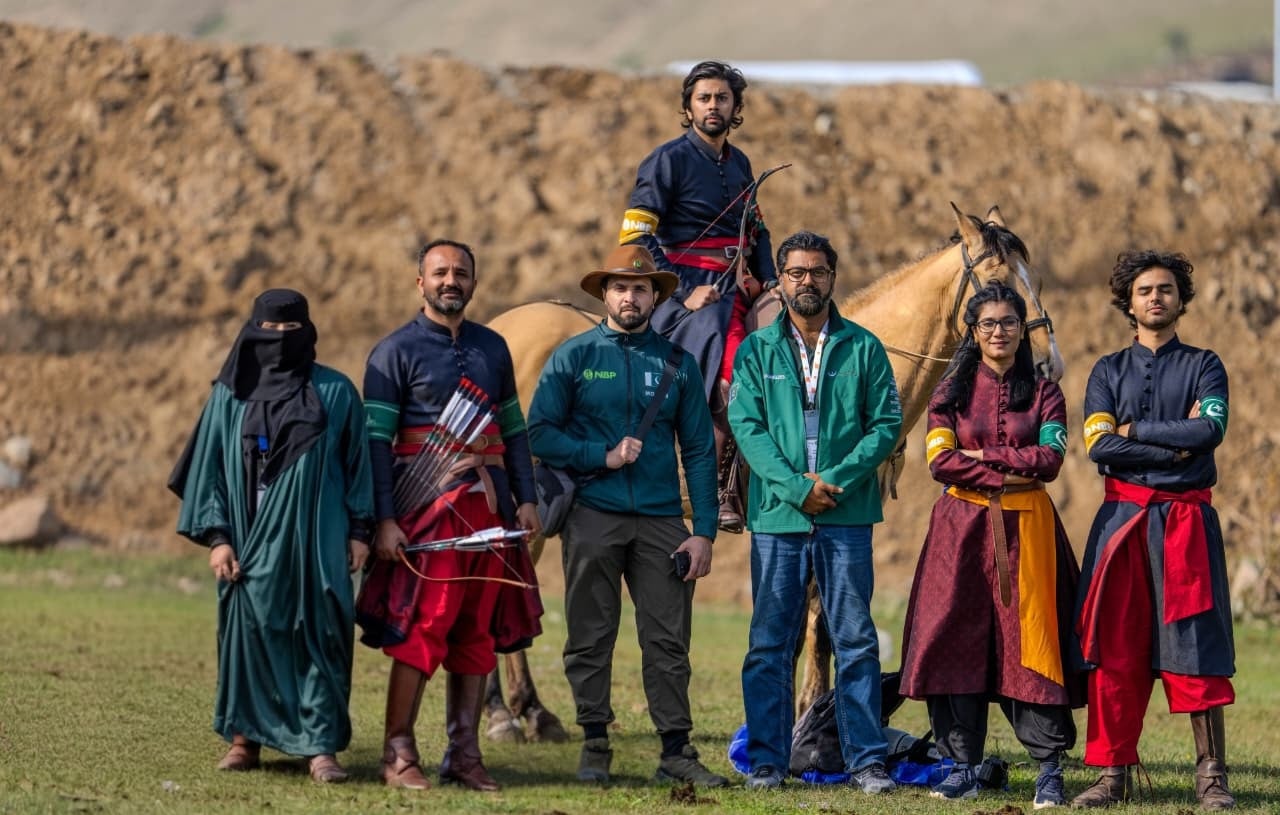
The night before Pakistan’s horseback archery team was due to compete at the World Nomad Games, Arshaq Naeem was carrying more than the pressure of hitting a target from a moving horse.
There were expectations, doubts and, as he puts it, a “cocktail of emotions”. Wearing Pakistan’s colours on a world stage was a privilege, but for the captain of the horseback archery team, it also brought what he describes as a considerable mental toll.
Training had prepared him for the physical challenge. Horseback archery demands balance and stamina while keeping an eye on the target as the horse strides forward, leaving the rider only seconds to aim and release the arrow. But training could not entirely recreate what awaited him on competition day.
“In training, when there is no external pressure or audience, nerves are relatively calm,” says Naeem. “But the match-day experience is quite different. On match day you have just one chance. Your every move counts towards your final score.”
That difference had troubled him before. Until the World Nomad Games, Naeem had never worked with a sports psychologist. He had relied on his coach and his own understanding to build what he calls his “psychological stamina”. What he found particularly difficult was the sudden strain that could arrive on competition day, something he says he did not know how to manage.
It returned on the first day of the Nomad Games.
As athletes prepared to compete, Naeem felt a sudden surge of self-doubt. This time, however, sports psychologist Mohsin Nawaz was with the Pakistani contingent. He reminded Naeem of the hours he had spent practising. Together, they mentally rehearsed what could go wrong while he was shooting and considered how he might respond to different situations. Naeem also used positive self-talk and box breathing before mounting his horse.
A sports psychologist's presence at the World Nomad Games itself was unusual. The Traditional Sports and Games Pakistan Association had, for the first time, formally appointed a sports psychologist to work with its national contingent. For a support role that has long sat alongside coaches, physiotherapists and conditioning staff in elite sport elsewhere in the world, sports psychology remains far less routinely embedded across Pakistan's sporting structure.
When training meets pressure
For Nawaz, the difference between practice and competition is not simply the presence of a scoreboard. An athlete can spend months repeating the same movement in training, know the technique and possess the physical ability to execute it, yet find that the body responds differently when the same movement has to be performed with an audience watching and a result depending on it.
“There are a number of psychophysiological changes that take place when suddenly an athlete has to perform under pressure,” says Nawaz. “This pressure cannot be copied in practice. It is exclusive to match day.”
He recalls working with an athlete who possessed considerable physical strength, consistently performed well in practice and knew the techniques required of him. Yet when the final selection came, he failed to make the team.
“It was quite unexpected for me that such an excellent athlete would fail the final selection test,” says Nawaz. When the two sat down for a mental assessment, he says they discovered a deeper fear: the athlete had convinced himself that something would go wrong at the last moment and he would not be selected.
“This belief triggered an uncontrollable amount of anxiety in him, and he could not deliver what he had learnt in practice,” says Nawaz. They worked on reconstructing that belief and, according to Nawaz, when the athlete next appeared for selection, he made the team.
Naeem knew the difference between training and competition. “It happens quite often that while shooting the arrow, all of a sudden the nerves get triggered,” he says. “It happens rarely in training when there is no external pressure or audience and the nerves are relatively calm. But the match-day experience is quite different. Simply saying ‘Do not take pressure’ does not work at all,” he says. Mental toughness, he argues, has to be practised rather than demanded.
For Naeem, part of the training for mental grit involved examining the conversation taking place inside his own head. When Naeem began analysing those thoughts, he recognised a negative internal dialogue that was contributing to sudden bursts of anxiety. Before mounting, at the Nomad Games, he used positive self-talk and box breathing. He and Nawaz also mentally rehearsed possible problems he could encounter while shooting and considered alternative responses.
The objective was not to make the pressure disappear. It was to prepare Naeem for what to do when it arrived.
When should the mind be trained?
The World Nomad Games did more than introduce Naeem to a different way of handling competition pressure. They also made him question why that training had come so late.
Before reaching the international stage, he had never had access to a sports psychologist through an academy, club or domestic competition. Until then, he says, he had largely relied on his coach and his own experiences to work out how to handle the mental side of the sport.
“Now that I have met a sports psychologist, I believe I was missing out on a major valuable part of performance,” says Naeem. “I had little idea how to deal with the cocktail of mental challenges that I had previously experienced.”
Looking back, he no longer sees psychological preparation as something an athlete should encounter only when an international competition is approaching.
“Access to a sports psychologist is not an option, but in fact is as important as physical training,” he says. “Mental training starts much before the actual competition, or even before the start of your sports career.”
It is an argument Professor Dr Ejaz Asghar, Dean of the School of Sports, Rehabilitation and Allied Sciences at the Health Services Academy in Islamabad, makes even more strongly. Asghar believes psychological preparation should begin alongside an athlete’s technical and physical development, rather than being introduced once a player has already reached a national camp. “Mental preparation is needed from the beginning of the practice sessions,” he says. “Unless you practise these mental rehearsals, you can’t excel.”
The distinction is important because sports psychology, Asghar says, is still sometimes misunderstood as something an athlete needs only when there is a mental health problem. “It’s a misconception,” he says. Athletes practise physical, technical and tactical skills repeatedly until they become familiar with them; he argues psychological skills should be approached in much the same way. “You should prepare yourself mentally with regard to your mental toughness, and it must be a part of your regular daily training.”
That means the question of access cannot begin and end with Pakistan’s national teams. An athlete may spend years moving through academies, clubs and domestic competitions before reaching a national camp. By then, Asghar argues, much of the athlete’s behaviour under pressure has already been shaped.
Even if a sports psychologist is introduced at national level, he says, there is still work that can be done. During a national camp, Asghar suggests a series of sessions could introduce athletes to techniques such as deep breathing, imagery, visualisation and progressive muscular relaxation. But he sees that as an intervention rather than a substitute for years of preparation.
“Sports psychologists should be part of your team, just like coaches, trainers, fitness trainers and conditioning coaches,” says the sports psychologist who is currently with the Chess team in Uzbekistan. “That’s the way we can enhance regular performance and build teamwork as well.”
Nawaz makes a similar argument about where that support should exist. He wants access to sports psychologists not only in national federations, but in sports academies, clubs and universities.
“It is a mental support system that is necessary before the game, during the game and after the game,” says Nawaz, because the psychological demands on an athlete do not suddenly begin when they walk into an international arena.
A place in the team
Asghar is currently working as a mental trainer with Pakistan’s national rifle shooting team. He says he has been holding regular sessions with the shooters, including during their preparation for the Asian Games.
“They are practising regularly. They are taking advice and guidelines regarding this on a regular basis,” says Asghar, who believes the arrangement should not be unusual. “Sports psychologists should be part of your team, just like coaches, trainers, fitness trainers and conditioning coaches.”
For Olympian shooter Kishmala Talat, the support comes after years in which mental preparation was present, but was not a separate, structured part of her training. As a young shooter, she says, much of her understanding of pressure and nervousness came through competing, making mistakes and learning from experience.
That has changed ahead of the Asian Games. Talat says the National Rifle Association of Pakistan and Army Marksmanship Unit have provided the shooters with access to a qualified sports psychologist and structured mental-performance training.
The need for it is particularly apparent in a sport where even a change in breathing, heartbeat or concentration can affect the execution of a shot. Talat says nervousness can make her heartbeat more noticeable and alter her breathing and concentration. The challenge is not necessarily to eliminate those nerves, but to prevent them from affecting what comes next. “If I carry one bad shot into the next shot, then one mistake can become two, three or more,” she says.
Looking back at her progression from domestic competition to the Olympics, Talat believes this kind of preparation should begin much earlier. “I definitely think mental performance should be developed alongside technical and physical skills from the academy level,” she says.
The contrast within the same Asian Games contingent illustrates how uneven access can be. Shooting has incorporated mental-performance support into its preparation, while no sports psychologist has been identified with the wider Pakistan contingent.
Elsewhere, psychological support is appearing more explicitly in preparations for the same Games. India is travelling with a large sports-science support setup, with mental-health experts included alongside doctors and physiotherapists. Oman’s men’s hockey team, which will face Pakistan in the group stage, has psychologist Abdullah al Noufali listed among its support staff, while Qatar’s shooting team has also been preparing with a specialist sports psychologist as part of its technical and mental preparation for major competitions, including the Asian Games.
Pakistan is not entirely outside this shift. Nawaz’s appointment for the World Nomad Games gave traditional-sports athletes access to structured psychological preparation, while Pakistan cricket has introduced psychological assessment and mental-skills work at youth level. Hockey, too, has moved towards incorporating sports psychology into its high-performance setup.
For Nawaz, though, these individual appointments do not yet amount to consistent access across Pakistani sport. “Pakistani athletes are still struggling with their access to a sports psychologist domestically and internationally,” he says, arguing that representation remains limited.
That perhaps leaves Pakistan somewhere between recognition and routine. Sports psychology is no longer entirely absent from the system: a horseback archer can work with Nawaz, shooters can receive structured mental-performance support and younger cricketers can be introduced to mental-performance work. The question is whether an athlete receives that support because it is considered a normal part of development, or simply because they happen to belong to a team that has decided to provide it.
Beyond the finish line
For Naeem, the value of psychological preparation became clearer only after he had experienced both sides of it. For much of his career, pressure was something he had learnt to deal with largely through experience, his coach and whatever methods he could develop himself. At the World Nomad Games, for the first time, there was someone specifically responsible for helping him understand what was happening when those nerves arrived.
The difference was not that he stopped feeling them.
On the first day of competition, the self-doubt still came. There was still anxiety before mounting the horse, still the knowledge that one mistake could affect his score. What had changed was his response. He could slow his breathing, recognise the negative conversation beginning inside his head and return to the situations he and Nawaz had already rehearsed.
It is a relatively small change in the machinery surrounding an athlete: another specialist alongside the people responsible for technique, fitness, conditioning and recovery. But for Naeem, it changed how he understood preparation itself.
“Access to the sports psychologist is not an option,” he says. “It is as important as physical training, because mental training starts much before the actual competition.”
For Pakistan, perhaps that is where the larger question now sits. There are signs that the mind is beginning to find a place in the country's sporting setup, from shooters receiving structured mental-performance training ahead of the Asian Games to young cricketers being introduced to such work earlier in their development. But Kishmala’s and Naeem’s experiences also show how much athletes can learn through competition before that structured support arrives. The question remains not whether they can learn to handle pressure, but how far they must travel in their careers before someone teaches them how.