
In the summer of 2020, Supriya Sharma was working from home when a fellow journalist called and asked her a question she had not been expecting. “Is there an FIR against you?” Yes, there was.
The police complaint accused Sharma, executive editor of Scroll, of misrepresenting the words of a woman from a marginalised community and making a false claim about her experience during the Covid lockdown. From the onset, Sharma knew the allegation was false. She had a recording of the interview that showed she had quoted the woman accurately. Still, an FIR meant the possibility of arrest. Her editor, Naresh Fernandes, called and suggested she leave her house in case the police were on their way. When Sharma refused, a lawyer involved in the case called her. “Why make it easy for them? At least let them look for you,” she told her. So, before dawn, Sharma left home. She did not know when she would be able to return. In the meantime, she began thinking about what she would need if she ended up in prison: a toothbrush, sanitary napkins, and books. She would spend the next two months living with the possibility of arrest before her lawyers secured protection from it.
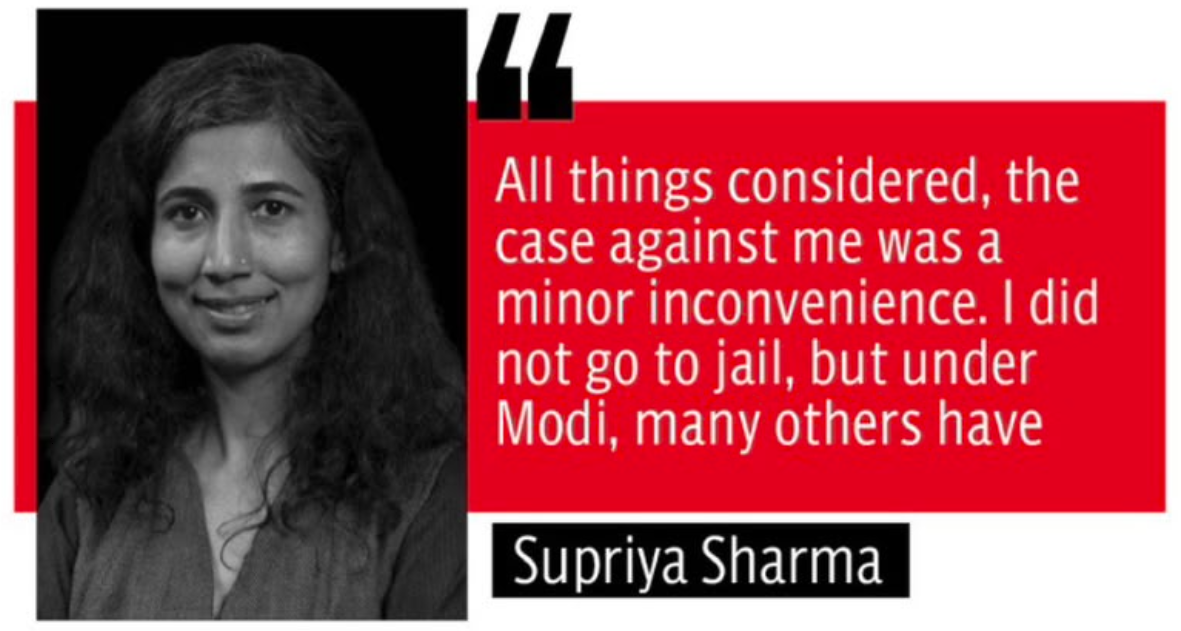
The case eventually became, in Sharma’s telling, a relatively minor inconvenience. She did not go to prison. But the fact that she had started packing for one stayed with her. At the Oslo Freedom Forum, organised by the Human Rights Foundation, this year, Sharma used the episode to explain what it means to be an independent journalist in Narendra Modi’s India. The problem, she suggested, is not only that journalists can face arrest or legal action, but that after years of watching colleagues and activists go through it, the possibility begins to enter the ordinary calculations of newsroom life.
Sharma had evidence that her reporting was accurate, but that did not prevent a police case from being registered against her. For other journalists, the consequences have been much more serious. She referred to Siddique Kappan, who was arrested in Uttar Pradesh while travelling to report on protests following the alleged rape and killing of a young Dalit woman. He was later charged under India’s anti-terror law, the Unlawful Activities (Prevention) Act, and spent 28 months in prison. She also mentioned Mohammad Zubair, the fact-checker and co-founder of Alt News, who was arrested over a social-media post that authorities said offended Hindu religious sentiments.
For Sharma, however, these cases are not simply examples from the news. They form part of the professional environment in which a generation of Indian journalists now works. Their cases were different from Sharma’s, and each involved its own legal proceedings and allegations. But to journalists watching them, they formed part of a pattern in which reporting, political criticism and social-media activity could bring consequences far beyond an angry response from a politician.
Sharma entered the profession in 2002, travelling around a country she describes as almost impossibly diverse. She encountered different languages, religions and political traditions and found that reporting gave her a way to understand a society that was much more complicated than the political arguments made about it. At the time, she said, journalists could question the government relatively freely. In the run-up to the 2014 election, she and other reporters scrutinised the Congress government and its record. The Congress lost that year. The Bharatiya Janata Party, or BJP, came to power, with Modi as its leader. Modi’s political background was already closely tied to the question of Hindu nationalism, she noted.
In 1992, Sharma recalled being 12 when Hindu nationalist activists demolished the Babri Masjid in Ayodhya. The mosque’s destruction was followed by communal violence across India. For Sharma, who grew up in a Hindu family, the episode was an early introduction to the tension between the idea of India as a secular, plural country and the vision of India promoted by Hindu nationalists. As a journalist, she later watched Hindu nationalist politics move from the margins of Indian political life to the centre of national government.
Modi had been chief minister of Gujarat during the 2002 communal violence, in which more than 1,000 people were killed, most of them Muslims. His government faced sustained criticism over its handling of the violence, allegations Modi has denied. When he became prime minister in 2014, Sharma argues, the relationship between the government and the media began changing in ways that went beyond the usual political hostility towards journalists.
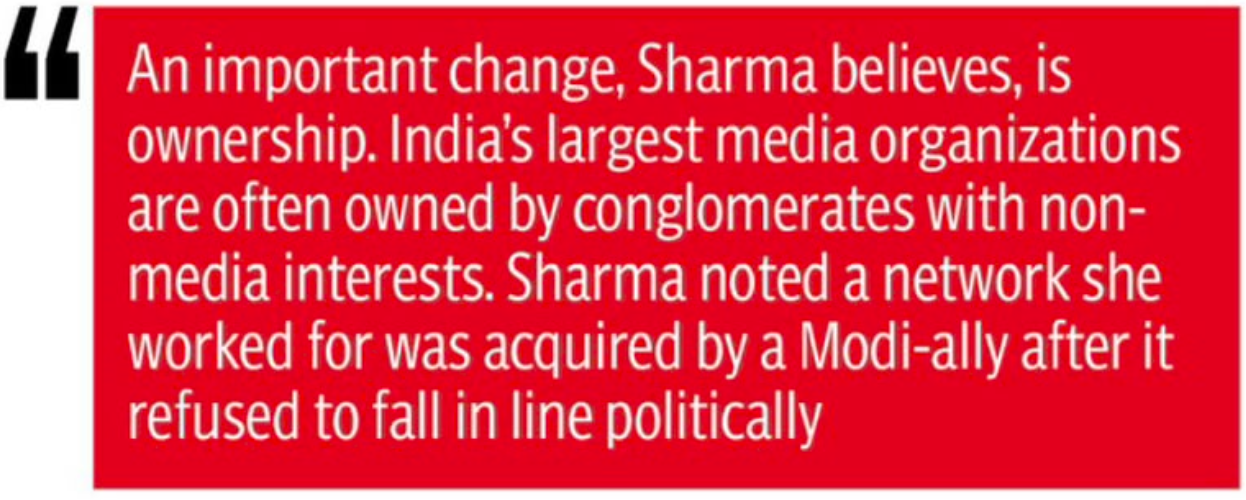
One of the most important changes, she believes, has been ownership. India has some of the world’s largest media organisations, but many are owned by large business groups whose interests extend well beyond news. Sharma pointed to the takeover of NDTV, a network where she had worked early in her career, after it failed to fall in line with the political establishment. She said it was subsequently acquired by billionaire Gautam Adani, an industrialist close to Modi. The importance of the owner, Sharma’s account suggests, is that political influence does not always arrive as a government order. It can work through the business interests surrounding a newsroom. “A paper does not have to be shut down for its journalism to become harder. An owner can change its priorities, advertising can dry up, legal notices can start arriving and reporters can find themselves spending more time dealing with harassment and less time reporting. The publication may still appear every day. But the kind of journalism it can afford to do begins to change.”
Speaking about her own newsroom, Sharma said Scroll is now roughly a third of the size it was a decade ago. That number says something about the state of independent journalism that a discussion about censorship often misses. Investigative reporting is expensive and reporters need time to travel, find documents and persuade people to talk. Editors need time to check complicated claims and organisations need lawyers when reporting angers powerful people. A smaller newsroom, she noted, has less capacity to do all of that, regardless of how committed its journalists may be.
Sharma has a theory about why some independent outlets are still able to operate. Perhaps, she suggested, the Indian government does not mind having a small number of them around. Their survival helps preserve the impression that India remains a country with a free and pluralistic press. It is a provocative argument, and one that is difficult to establish as fact. But the contradiction she describes is real enough: independent journalism can continue to exist while becoming progressively weaker. The question is therefore not simply whether journalists are allowed to publish; it is whether they have the resources and freedom to do the kind of journalism that makes powerful people uncomfortable.
There is another measure of the changing relationship between India’s government and its press. Since becoming prime minister in 2014, Modi has largely avoided the kind of open, unscripted press conferences in which journalists can freely question him. He gives speeches and interviews, but opportunities for journalists to ask him unscripted questions have been limited. Speaking before a global audience of media practitioners and activists at the Oslo Freedom Forum, Sharma mentioned Modi’s recent visit to Norway, when a journalist tried to ask him why he does not take questions from the press. According to Sharma, the question went unanswered, while the journalist was subsequently subjected to online abuse and doxxing.
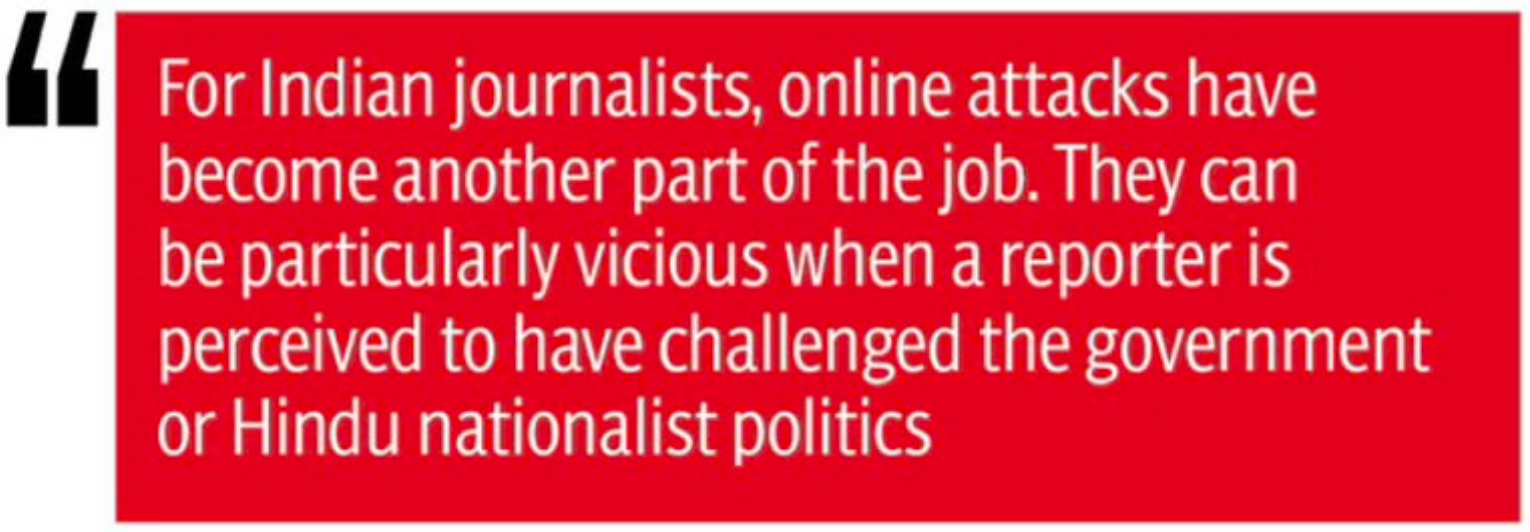
For Indian journalists, online attacks have become another part of the job. They can be particularly vicious when a reporter is perceived to have challenged the government or Hindu nationalist politics. Women journalists, Sharma noted, are frequently targeted with threats and abuse that are personal as well as political. The harassment does not have to result in physical violence to affect the work. It takes time to deal with. It follows journalists outside the newsroom and it tells other reporters what may happen if they attract the same attention.
But Sharma does not describe the journalists at Scroll as frightened. She describes them as tired. That may be the most revealing word in her entire talk. The political environment is more hostile in India. The legal risks are higher and the public has become accustomed to a steady stream of stories about journalists, activists and critics facing police cases or online attacks. After a while, she said, it becomes difficult to summon the same reaction every time. Sharma called this numbness one of the biggest challenges facing her newsroom.
It is an unusual problem for journalists because the work itself depends on paying attention. A reporter has to notice what other people have stopped noticing: a family going hungry in a village that was supposed to be a model of development; a prisoner who has spent years awaiting trial; a government decision that receives little scrutiny; a law that changes what citizens are allowed to say.
Sharma’s own FIR came from a story about Mala Devi, a woman with five children who struggled to feed her family during India’s Covid lockdown. Millions of Indians faced hunger during those months. What made Devi’s situation worth reporting was the village where she lived. It had been adopted by Modi as part of a programme intended to develop model villages.
The contradiction was the story. A village connected to one of India’s most powerful political leaders still had a family struggling to find enough food. Sharma went on to report it and the police case followed. Devi herself, Sharma said, could not read the story. She was unlikely to have been the person offended by it. The episode nevertheless raised a larger question: what, exactly, was the FIR protecting?
Sharma does not pretend to know who was offended. What she does know is that the case changed her life for two months. And it changed the way she thought about the distance between doing journalism and being punished for doing it.
India remains a democracy with competitive elections, opposition parties, an independent civil society and a media landscape far too large and diverse to be described simply as controlled by the government. There are still reporters who investigate, courts that intervene and citizens who challenge those in power. That is precisely why Sharma’s argument is more complicated than a claim that journalism has disappeared. It has not. Independent journalists are still working. The question is how much space they have to work in, how many of them can afford to keep doing it and what happens to a society when the cost of independent reporting continues to rise.
For Scroll, Sharma said, there are two problems: money and numbness. The first is straightforward. Independent journalism needs financial resources, and those resources are increasingly difficult to find. The second, she said, is harder. How do journalists continue to care when every new arrest, threat or attack begins to resemble the last one?
Sharma’s own answer seems to lie in continuing to report. The morning she left her home in 2020, she did not know whether she would be arrested. She packed the things she might need and left anyway. Two months later, she came back and she has continued working.
That is not a story about a journalist who was fearless. Sharma’s account suggests something more ordinary and, in some ways, more difficult: she was frightened enough to prepare for prison and determined enough to keep reporting afterwards. At the Oslo Freedom Forum, she ended with a commitment to continue bearing witness and speaking truth to power, even when power is not listening.
The phrase can sound grand when separated from the details, but it is those details that make it convincing: a woman struggling to feed five children, a recording kept by a journalist because she knew what she had actually reported, a phone call before dawn, and a toothbrush packed for a prison cell she never had to enter. There is also the newsroom itself, now a third of the size it once was, still trying to find the money and the energy to keep asking questions. For Sharma, that is what fighting numbness means: continuing to notice what is happening around you, even after you have seen it happen many times before.