
Long before most Pakistanis knew the Bahá'í Faith existed here, its prayers were already being sung in Urdu, quietly weaving a global religion into the country's cultural fabric.
I came to this subject almost entirely by chance, as so many good stories begin. A friend, Darren Sabet, first told me about the Baha'i Faith, over two days, at a wellbeing retreat in the Abu Dhabi desert, and kept teaching me, gently, every time we met after. He played me Baha'i songs in Urdu, Arabic and English. I didn't know, until then, that there were Baha'is in Pakistan at all, let alone that they had been setting their prayers to music in my own language for the better part of a century. That gap in my own knowledge is the reason this piece exists.
There is no priest in a Baha'i gathering. There is no pulpit, no ordained voice deciding how a prayer should sound, and no institution anywhere in the world empowered to declare one melody correct and another mistaken. Its affairs are run by elected bodies, Local and National Spiritual Assemblies, and at the top, the Universal House of Justice in Haifa, re-elected by secret ballot without campaigning or nomination.
This absence of clergy is not incidental to the music question; it is the reason the music question has no single answer. There is no bishop or ayatollah anywhere in the Baha'i world empowered to declare a correct tune. There is no one whose job is to stand between a believer and the sacred text, to interpret it on the spot, or to certify how it should be performed. Strip away clergy, and you strip away the thing that, in most traditions, freezes a liturgy into a fixed form.
Most religious music traditions we write about come with an institution attached, a maqam system taught in a khanqah, a qawwali lineage passed from ustad to shagird, a raag discipline governed by a gharana. The Baha'i Faith has none of that architecture, by design, precisely because nobody was ever handed a script for what "Baha'i music" should sound like. Every Baha'i community on earth had to answer that question for itself, using whatever musical language was already in its ears.
The Baha'i Faith tells its followers that music matters, and then declines to tell them what it should sound like. That is an unusual thing for a religion to do, and it has an unusual consequence, "Baha'i liturgical music," as a single fixed tradition, does not exist anywhere in the world. What exists instead is a pattern repeated differently in every community, a body of universal, untranslatable in spirit prayer texts, and a local musical vocabulary reaching out to carry them.
Baha'i communities in the American South are documented as having folded their devotional music into a gospel inflected style, the call-and-response and vocal fervour of Black church tradition carrying Baha'i prayer the way it carries every other kind of Southern devotional text.
Communities in India, sharing a devotional and linguistic inheritance close to Pakistan's own, have set prayers to raags, or local folk tunes and to bhajan form. Communities across parts of Africa have developed choral settings rooted in local a cappella and call-and-response singing. And in Iran, where the faith originated, the chanting of scripture has long drawn on the melismatic character of Persian classical music.
The Baha'i Faith emerged from 19th century Persia, out of an earlier messianic movement called Bábism. Its central figure, Bahá'u'lláh (1817–1892), spent much of his life in exile and imprisonment, moved by Ottoman and Persian authorities from Tehran to Baghdad, Istanbul, and finally Palestine, and it was from that exile that he wrote the body of scripture Baha'is hold sacred. His core teaching, repeated across his writings, is the oneness of humanity that all the major religions descend from a single unfolding revelation, and that the next stage of that revelation calls for the unification of the human race into one global society.
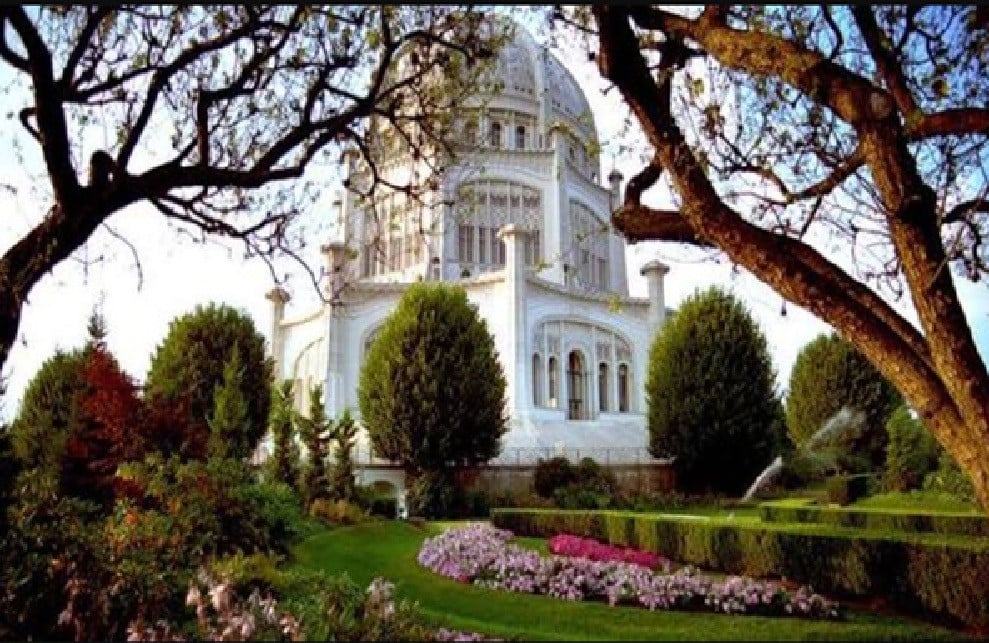
Bahá'u'lláh addressed music directly in his central book of laws, the Kitáb-i-Aqdas: "We have made it lawful for you to listen to music and sing. We have made music a ladder by which souls may ascend to the realm on high. Change it not into wings for self and passion."
Abdu'l-Bahá, his successor, went further, calling music "spiritual food for soul and heart," and specifically instructed believers to "set to music the verses and the divine words so that they may be sung with soul stirring melody in the assemblies and gatherings." Neither man, notably, specified what that melody should sound like.
In the 1840s, according to the community's own historical record, one of the earliest followers of the Báb, a figure named Shaykh Sa'id-i-Hindi, was from Multan, and was personally instructed by the Báb to carry the new religion back to his homeland. In 1875 more organised missionary efforts came several decades later when Jamal Effendi, sent by Bahá'u'lláh, visited Karachi and went on to Lahore, Sialkot, Jammu, Kashmir, and Ladakh.
In 1904, on the instruction of Bahá'u'lláh's successor Abdu'l-Bahá, a follower named Mirza Mahmood Zarghani spent most of a year based in Lahore, where, notably, he became acquainted with a young Muhammad Iqbal – decades before Iqbal's own poetry would help shape the idea of Pakistan. In 1921, Karachi's Baha'is elected their first Local Spiritual Assembly, while the city was still part of British India, and acquired a Baha'i Centre before independence. By the 1940s and 1950s assemblies followed in Quetta, Sukkur, Rawalpindi, Sialkot, Multan, Faisalabad, and elsewhere. By 1957, Baha'is in the territory that had become West and East Pakistan elected their own National Spiritual Assembly, separate from India's, the same administrative shape the community holds today.
Pakistan's 1973 constitution formally recognised the Baha'i Faith as a religious minority and, in 1981, granting the community the right to hold public meetings, run its own institutions, and elect its administrative councils, though the government does not permit Baha'is to travel to Israel for pilgrimage to the faith's holiest sites, which lie within Haifa and Akka.
Pakistan's national identity database recorded 33,734 registered Baha'is in 2012 and 31,543 Baha'i voters in 2018 figures that sit well below older international estimates from the 1980s and 1990s – a gap the sources themselves don't fully explain. The community today runs, among other institutions, the New Day Montessori and Secondary School in Karachi– founded in 1978, with three students and enrolling more than 700 by 2015.
Baha'i communal life is built around a recurring gathering called the Nineteen Day Feast, held once every 19-day month of the faith's own calendar. It has three parts, and the order matters for understanding where music fits. First comes a devotional portion, in which prayers and scripture are read or chanted aloud. Then an administrative portion, in which the community consults on its affairs the way a small cooperative might, plainly, without ceremony. Finally, a social portion, tea and conversation, where the formality drops entirely.
There is no fixed programme for any of it. Whoever is hosting decides what gets read, and if a community has developed devotional songs, this is where they surface most naturally in the devotional opening, sometimes carrying into the social close. Holy Days function the same way, gatherings built around scripture and prayer, with music. Compare this to a tradition where the sequence of a service is fixed by canon law, and the difference is immediate. A Baha'i gathering's musical content is closer to what a family decides to sing at its own table than to what a congregation is led through by an officiant.
The National Spiritual Assembly of Pakistan's own public website carries a small, plainly presented archive of prayer recordings and songs in Urdu, made available to the wider Baha'i community and public. Prayer recordings are titled things like, "Dua-e-Subh" (Morning Prayer), "Dua-e-Shifa" (Prayer of Healing — almost certainly the widely used Baha'i healing prayer, translated), and "Aye Malik-e-Asma" (O Lord of Names), Urdu renderings of standard Baha'i devotional texts, chanted rather than read flatly.
The songs carry titles of their own, "Yeh Deen-e-Abha" (This Faith of Abhá — "Abhá" being an honorific title of Bahá'u'lláh), "Naya Soor Duniya Mein" (A New Trumpet Call in the World), "Hum Hain Bahá'í" (We Are Bahá'ís), "Hum Ek Shajar" (We Are One Tree — a direct echo of Bahá'u'lláh's own image, "Ye are the fruits of one tree and the leaves of one branch"), and "Roz-e-Mahshar Áyá Hai" (The Day of Resurrection Has Come).
What that naming tells us, even without hearing the recordings, is genuinely revealing. These are not translated Persian or Arabic hymns performed in a foreign register. They are composed, or at minimum titled, in the vocabulary of Urdu devotional song "Deen" (faith/religion), "Mahshar" (the Day of Judgment), the very cadence of a nazm or hamd, the same register that would sit comfortably in Sufi devotional or Islamic devotional song traditions across Pakistan. A faith with no fixed hymnal, arriving in Urdu-speaking Punjab and Sindh, appears to have reached for the nearest available vessel, the region's own devotional song vocabulary, poured full of different theological content.
What Pakistani Baha'is reached for, by the evidence available, was the ghazal or more precisely, the wider Urdu devotional song register that also produces hamd and naat, and that borrows its performance manner from qawwali without adopting qawwali's full ecstatic apparatus. The architecture is recognisable to anyone who has read a ghazal or sat through a mehfil. Community recorded Urdu devotional titles associated with Pakistan's Baha'i repertoire show exactly this shape, refrain anchored couplets, a repeated closing phrase doing the work that the ghazal's radíf does in secular poetry, built around themes of praise and of a promised day arriving.
One such title translates roughly as "the promised Day of Gathering has come". Eschatological language lifted straight from the same devotional vocabulary that makes a naat, repointed toward a different theological claim. The performance manner, where it has been described, follows the same borrowing, voice-forward, closer to the semi-classical delivery of a devotional mehfil than to Western hymnody's four-part harmony and fixed hymnal.
What it does not borrow is qawwali's saint veneration or its licensed improvisation around the text because in Baha'i devotional practice the sanctity of the written prayer constrains how freely a performer can play with it. The Word or the prayer itself is meant to remain intact even when it is sung. So the result sits in an interesting middle place, ghazal or modern fusion genre shaped in its poetics, hamd like in its theme, more restrained than qawwali in its delivery, a genuinely local invention, not a copy of any single existing form.
Who specifically composed these songs, and when, is not something the available record settles with confidence, and I am not going to pretend otherwise. What can be said with confidence is, why, a community given prayer texts in Urdu and no instructions about music did what devotional communities in this part of the world have always done with new sacred text, they reached for the couplet, the refrain, because that is the devotional grammar already living in the ear.
A country's musicology reveals its priorities as clearly as its silences do. What gets recorded, catalogued, and taught in a department somewhere is rarely a complete map of what is actually being sung; it is a map of what someone, at some point, found worth the trouble. Every devotional tradition too small, too private, or too unfamiliar to attract that attention simply doesn't appear on the map at all, not erased, just never drawn. A small, century-old, still singing tradition sits quietly archived on a community website.
The writer is a music enthusiast and cultural critic. He writes about the intersection of music, society, and the human condition. He can be reached at brian.bassanio@gmail.com
All facts and information are the sole responsibility of the writer