
As the monsoon rains begin, water levels in the Ravi River are rising once again, reviving fears among thousands of families living along its banks. Many residents who lost their homes, belongings and livelihoods in last year’s floods still live in the same low-lying settlements that government agencies themselves have classified as highly vulnerable to flooding. While the government says flood protection embankments are being built and affordable housing programmes being expanded, the question of permanently relocating these communities to safer ground remains unresolved.
Last year’s flooding along the Ravi caused widespread destruction in Shahdara, Farrukhabad, Millat Park, Qaim Theme Park and other low-lying neighbourhoods. Floodwaters inundated hundreds of homes, collapsed walls, swept away livestock and destroyed small businesses. Residents say they received emergency assistance, but many have yet to recover financially a year later.
Standing beside the flood marks still visible on the walls of his home, Muhammad Iqbal, a resident of Farrukhabad, recalls how the water reached the neighbourhood within hours. His family had to move their children to the roof while their refrigerator, furniture, bedding and other household belongings were ruined. He said they are still repairing the house with borrowed money and that the financial assistance they received covered only a fraction of their losses.
For Shamim Bibi, a resident of Millat Park, the night of last year’s flood remains a source of trauma. She said her children’s books, clothes and dowry items were destroyed by floodwater. Although relief supplies and food assistance arrived, they were not enough to rebuild the household. Every monsoon, she said, her family relives the fear that floodwaters will once again reach their doorstep and inundate their belongings and lives.
Residents acknowledge that their neighbourhoods face recurring flood risks, but say they simply cannot afford to move elsewhere. Many have rebuilt their homes by taking loans, selling jewellery or exhausting years of savings, making another relocation financially impossible.
Muhammad Ashraf, another resident of Farrukhabad, said floodwaters rose several feet last year, destroying almost everything inside his home. While authorities organised temporary evacuations, he said no meaningful arrangements were made for permanent resettlement, forcing families to return within days.
Nasreen Bibi, who lives near Theme Park, said many families are already burdened with debt and would struggle to absorb another disaster.
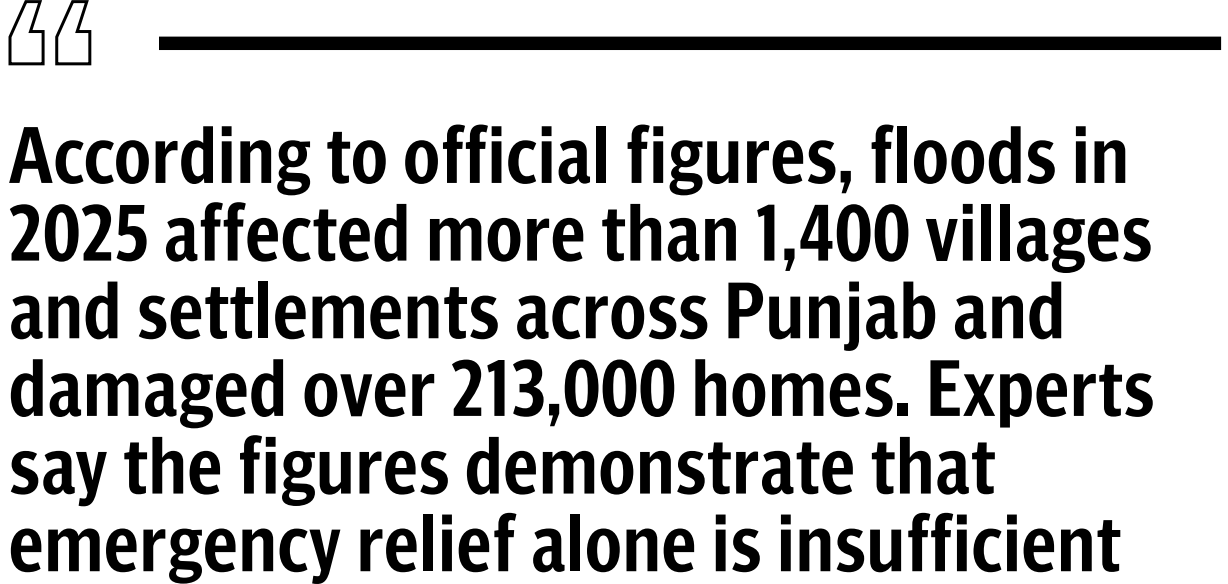
According to official figures, floods in 2025 affected more than 1,400 villages and settlements across Punjab and damaged over 213,000 homes. Experts say the figures demonstrate that emergency relief alone is insufficient. Long-term recovery requires sustained investment in livelihoods, safe housing, psychological support and disaster-risk reduction.
Following the floods, several government agencies also raised concerns about development along the Ravi. The Ravi Urban Development Authority (RUDA) declared 44 housing schemes along the river illegal, while Pakistan’s National Flood Protection Plan recommended discouraging permanent construction on floodplains and in high-risk areas through stronger legislation.
Yet the situation on the ground tells a different story. A visit to the affected communities found that not only have damaged homes been rebuilt, but new construction is in process at some locations. More than a year after the floods, no major flood-affected settlement has been permanently relocated.
According to official sources, the government initially considered relocating vulnerable communities living on both sides of the river. However, the plan was shelved because of its multibillion-rupee cost. Instead, authorities shifted their focus to constructing protective embankments and removing encroachments within the river corridor.
As part of this effort, RUDA is building embankments on both sides of the Ravi under its river channelisation project. Project Director Rao Intizar Ali said a 46-kilometre embankment stretching from Ravi Siphon to Mohlanwal is being built in three phases. The first phase, covering 15 kilometres from Ravi Siphon to the railway bridge, is largely complete, with 13 kilometres already finished. The remaining phases will extend the embankment towards the motorway and Mohlanwal.
Ali said the project was launched to protect areas including Millat Park, Theme Park and nearby settlements that were badly affected last year. He added that the construction of a permanent embankment near Bakkanwal village has already shifted the river’s course by about 500 metres. The redesigned channel, he said, will be capable of carrying around 580,000 cusecs of water, compared with the peak flow of roughly 230,000 cusecs recorded during last year’s floods.
Meanwhile, the Provincial Disaster Management Authority (PDMA) has accelerated preparations for the monsoon by identifying vulnerable locations, pre-positioning relief supplies, deploying rescue boats and preparing evacuation plans. Officials say that in recent years, Rs50 billion has been distributed among flood-affected families, while a separate Rs48 billion programme is funding projects to reduce urban flooding and riverbank erosion. Satellite mapping of settlements along rivers is also underway to improve future land-use planning in high-risk areas.
Urban planning expert Sani Zahra said the return of people to flood-prone settlements reflects not only economic hardship but also policy failures. She argued that the government must provide safe, affordable housing for low-income families while protecting natural waterways and floodplains from development. She suggested that public land could be used for affordable housing schemes, following successful models adopted in other countries.
Urban planner Erum Ashfaq said Pakistan’s lack of a comprehensive national urban policy has allowed housing developments to spread into river corridors and environmentally sensitive areas for decades, increasing disaster losses. She said stronger urban planning and stricter enforcement against construction in high-risk zones could substantially reduce future damage.
At the same time, the Punjab government is expanding housing initiatives for low-income and homeless families. According to official figures, more than 180,000 interest-free housing loans have been approved under the Apni Chhat, Apna Ghar and Apni Zameen, Apna Ghar programmes launched on the instructions of Chief Minister Maryam Nawaz, while more than 170,000 families have already received loan disbursements.
The government says the schemes have so far provided more than Rs217.8 billion in financial assistance, resulting in the completion of 134,343 homes, while another 27,500 houses are in the final stages of construction. More than 1.278 million applications have been received.
Under the first phase of the Apni Zameen, Apna Ghar programme, 2,000 eligible families in 23 districts have also received free three-marla residential plots. Interest-free loans are being offered to help beneficiaries build homes on those plots.
Although officials describe these initiatives as a significant step towards addressing Punjab’s housing shortage, residents living along the Ravi say their immediate priority is permanent relocation to safe ground. They argue that unless vulnerable communities are moved out of high-risk areas, alternative housing is provided and illegal construction is effectively curbed, every monsoon will continue to bring renewed uncertainty.
The visible scars of last year’s floods may have faded from the walls of homes along the Ravi, but the economic hardship, anxiety and uncertainty remain. As another monsoon gathers strength, families living beside the river are asking the same question they faced a year ago: if the water rises again, will their homes survive this time?