
Publishers have long dismissed the novella as an awkward, unmarketable form. In fact, many of them have even lost their enthusiasm for short story collections, albeit to a lesser degree. Possessed by the crippling fear of dwindling readerships, many well-meaning agents and editors now seem to be urging writers to stick to the novel. Remaining within the safe parameters of longer fiction spares them from the disappointment of professional failure and also ensures that publishers don’t lose money.
For many years, the aversion to the novella has been justified through an intriguing, if not entirely flawed, logic. It is believed that the slender spines of novellas struggle to stand out amid the sea of books on a store’s shelves. At first glance, this appears to be a strange pretext to downplay the creative potential of the novella. No one is stopping bookstore owners from stacking novellas in an upright position on a display table so they can be seen by more customers.
Burdened by these expectations, some writers have become sticklers for conformity. Quite a few of them have been diddled into accepting the death of the novella. In this case, pronouncing a death sentence seems premature. Some deaths, after all, can only be confirmed through the presence of a tombstone.
It is difficult to gauge whether the growing opposition to the novella seems fair in an inherently digital age when attention spans have diminished significantly. Time has become a precious commodity and few among us are willing to fritter it away on reading weighty volumes. Faced with these new obstacles, readers seem to be gravitating towards slim texts rather than heavy tomes. The novella, therefore, has witnessed a striking resurgence. That said, the sales of novels haven’t decreased and they still remain a popular form.
However, the so-called rebirth of the novella isn’t a development we should rejoice over as it hasn’t miraculously addressed people’s concerns about its shortcomings. It is a truth, universally acknowledged, that the novella can only be appreciated if readers embrace the constraints associated with it.
Conventional wisdom would have us believe that a novel spanning over 200 pages has ample space to bring a powerful story to life. Owing to its rather limited length, a novella may not have adequate room to flesh out the intricacies of a narrative. This could result in a series of creative compromises.
Few readers can wholeheartedly acknowledge that a novella is enriched by its compressed scope. Most of them view its brevity as an outcome of an author’s waning interest in the story they sought to tell. The dearth of meandering sub-plots and backstories isn’t perceived as a focused approach to the storytelling. Instead, it is seen as a gaping chasm – a silence that should have been filled with words.
In any case, the conventions associated with the novella cannot be altered to cater to the whims of a fickle readership. If the novella is to undergo a revival, modern readers will need to accept it with all its warts, flaws and idiosyncrasies.
David Flusfeder, the New Jersey-born author of numerous works of fiction, seems to be familiar with the complexities involved in writing and reading a novella. Yet, he seems to challenge readers to take a leap of faith with a story that lasts for a few pages, but lingers in their memories for an eternity.
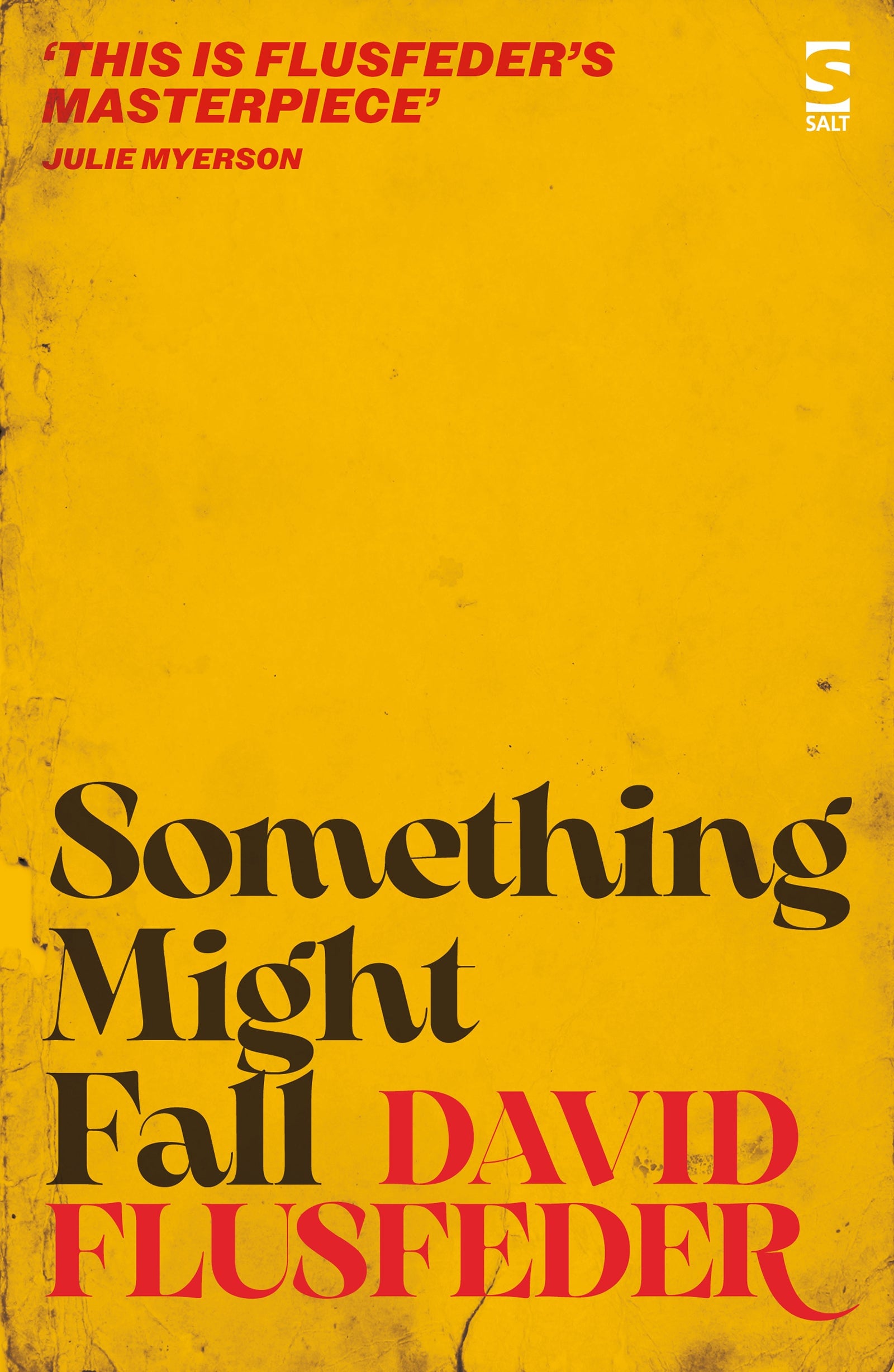
Something Might Fall, his most recent work of fiction, stands out for its sharp, minimalistic focus as well as its intriguing premise. Set against the backdrop of New York’s Upper West Side in the late 1960s and the early 1970s, the novella explores how quietly oppressive surroundings can break us in slow, unpredictable ways. Flusfeder’s protagonist Emma Sawyer (née Hoffman) laments the “emptiness at the heart” of this elite milieu, viewing it as an emotional and psychological prison. For Emma, the Upper West Side isn’t just any ordinary neighbourhood; it is a playground where the crème de la crème enact the petty pretences of their glamourous lives. The parties thrown at affluent homes by picture-perfect couples are vital in consolidating their social standing. Attendance, as well as absence, at these swanky affairs becomes the subject of gossip and controversy. Quite frankly, the turf wars depicted in West Side Story seem tame in comparison to the silent yet insidious chaos surrounding these social gatherings.
Trapped in this endless spiral of glitz and glamour, Emma finds herself in desperate need of an escape as she is convinced that “at any moment something might fall, perhaps herself.” However, she isn’t the stereotypical housewife that readers will expect to see at the centre of such narratives. Emma is an accomplished author and one of her bestselling novels has also been adapted for the screen amid “notoriety as well as fame.” At the same time, her forays into fiction haven’t yielded timid, tentative accounts that disguise the startling truths of her life. On the contrary, she is a fearless writer who borrows freely from her life, occasionally exaggerating for dramatic effect, but never prevaricating details. “Nothing is written in a vacuum,” the narrator states in the opening pages, “energy cannot be manufactured or destroyed, only transformed, and she had always been an autobiographical writer, turning the stuff and discontents and, on occasion, the magic of her own life into books.”
While professional success hasn’t eluded Emma, the complex negotiations required in her private life have relegated her to the status of an “unfulfilled, unsatisfied hostess wife.” Emma concentrates her energies on the seasonal parties she hosts with her “fussy doctor husband”, Nicholas Sawyer, who is far from being a “paragon of virtue.”

These parties, which have become a predictable and inconvenient norm in their marriage, evoke a heady mix of exhilaration and toxicity. On one level, they are Nicholas and Emma’s collective attempt to woo their social circuit and gain validation. On a more personal footing, these events – dictated by a restrictive network of social etiquettes – are slowly depleting Emma. As a woman, she is expected to take the lead in organising these soirees, even if they are gnawing at her independence.
Even so, Emma’s approach towards them remains, at best, ambivalent. Immersed in the whirlwind of high-society neuroses, Emma can sharply detect any subtle shifts in the banal lives of those whom she calls her friends. She even responds to these developments with an almost robotic ease. Writing, though, is her only elixir, which stands the danger of slipping away owing to the sacrifices she has to make to keep up appearances.
Many readers who harbour a passion for writing will relate to Emma’s predicament. Not many people understand that writing is an all-consuming beast that splits the author’s lives into two misshapen, and often, overlapping halves. As they navigate the pressures of their personal and professional lives, writers regularly have to make occasional trade-offs between priorities. The constant need to juggle conflicting commitments and make sacrifices may come at a steep cost, especially for women.
Emma, too, stands at a mental and emotional crossroads where she can either reclaim her lost identity or leap off a precipice. The turning point arrives one fateful day when she decides to assume charge of her situation through a step that prevents her from dipping further into oblivion. Sceptics would view it as a cravenly act, but it is, for Emma, a move towards self-preservation.
It is difficult to reveal the choices she makes without giving spoilers to what is, undoubtedly, a breathtaking tale about internal chaos and the need to uphold one’s individuality despite societal pressures. Needless to say, the twist will surprise even the most jaded of readers.
The structure of the novella is arguably one of its key strengths. Divided into two chapters – set in 1970 and 1974, respectively – Something Might Fall doesn’t confine itself to a linear arc to document the mundane occurrences in the protagonist’s life. Instead, readers are offered a selective glimpse into the dynamics of her stifling world. Cynical readers will possibly dismiss this as an incomplete portrait of Emma’s plight. Only discerning readers will be able to use these carefully chosen fragments to build an entire emotional architecture of Emma’s story.
The first chapter features the protagonist’s struggles as she balances the intense demands of her marriage and the chaotic rhythms of her inner life. The opening sentence establishes her as a keen yet troubled observer who is on the brink of an epiphany and is prepared to take a life-changing step. In those tense, adrenaline-fuelled moments, the narrator goes into overdrive and begins to concisely document the complex workings of Emma’s life. At first, this technique mirrors the effect of a camera zooming into all those fractured spaces that the protagonist inhabits, irrespective of whether they represent her past woes or present dilemmas. Conscientious readers might feel a surging sense of unease at being made into voyeurs who become privy to information that could have been revealed gradually. Be that as it may, these details are pivotal in painting an evocative portrait of a woman who is deeply unhappy in her surroundings.
Much ink has been spilled in chronicling the internal cataclysms of women’s lives. With its skilful use of the stream-of-consciousness technique, Flusfeder’s narrative mines new and distressing possibilities in what could be seen as a familiar tale. The emphasis isn’t just to write yet another heartbreaking confessional but also to explore how the struggles of surviving the gilded cage of domesticity can echo across generations.
In the second chapter of Something Might Fall, Emma’s 11-year-old son comes to terms with his mother’s choices. Unsettled by his father’s taciturnity and the weight of his mother’s decisions, Nicky wanders through the streets of the city without any supervision. Much like his mother, Nicky also makes some quietly transgressive choices.
 Through both sections of the novella, New York vividly comes to life. The fabled city isn’t treated as a locale. Instead, it becomes a stage where tragedies are experienced, remembered and even recreated. It is a character that emerges as a witness to Emma and her son’s assorted burdens. Emma is a silent casualty of the Upper West Side, but the son isn’t hampered by his surroundings in the same way. Even if it cannot assuage his pain, the city offers to distract and entice him.
The delicate nature of relationships remains at the heart of the novella. Flusfeder outlines the power of friendship, marital relations and our sacred bond we must enjoy with ourselves. The author is adept at drawing attention to the small moments that have a lingering impact on our psyche, which serves as welcome proof that he has a deep understanding of human nature. As a result, his novel doesn’t require plot contrivances when it is fuelled by emotional truths.
Beyond the claustrophobia of human relationships, Something Might Fall raises some pertinent points on the grieving process. We live in an age where everyone is armed with the most appropriate vocabulary to deal with loss. Flusfeder evokes a time when the conversation surrounding these pressing matters wasn’t as sophisticated as it is today. Nevertheless, his characters learn how to embark on this difficult journey without a roadmap and find some doorway to peace.
In Grief is Love: Living With Loss, Marisa Renee Lee offers some useful guidelines on coping with bereavement. She writes: “To bring [those you’ve lost] back to life, to bring yourself closer to who they were, the version of them that was still untouched by death, is all about getting closer to who they were at their best, their brightest, their most loving, by integrating those aspects of their character, their values, the things you loved together, and their good deeds into our lives.”
The characters in Flusfeder’s novella aren’t entirely in sync with their emotions and may have a long way to go in the journey towards finding some grain of peace. Regardless, they find their own way of coping with adversity based on what they know about the world and themselves.
Something Might Fall is, by turns, profoundly dark and fearlessly beautiful. It is rare for a writer to accomplish such a feat in just a few iridescent pages.
The writer is a critically acclaimed author
All facts and information are the sole responsibility of the writer