
The Indus Waters Treaty (IWT) has long been cited as one of the few success stories in the troubled relationship between India and Pakistan. It survived conflicts, nuclear tests, Kargil, and countless diplomatic crises between the two rivals. For decades, the agreement functioned as a mechanism that prevented water from becoming a weapon on the subcontinent. But that era has ended as Narendra Modi’s India has launched a brand new assault against more than 240 million Pakistanis by abandoning an agreement that promises sharing of an important natural resource that is water.
Last April, New Delhi announced it would place its treaty obligations in abeyance. The declaration followed an attack in Pahalgam that killed 26 tourists. Islamabad denied any involvement and called for a neutral investigation, but India had already made its decision and the water treaty would become a hostage to security grievances. This was not a legal interpretation of the treaty’s provisions, it was a political act, and it has since been followed by increasingly explicit threats from officials from the other side of the border. Indian Water Minister CR Patil announced that his country was working to ensure ‘not a single drop of water’ would flow into Pakistan.
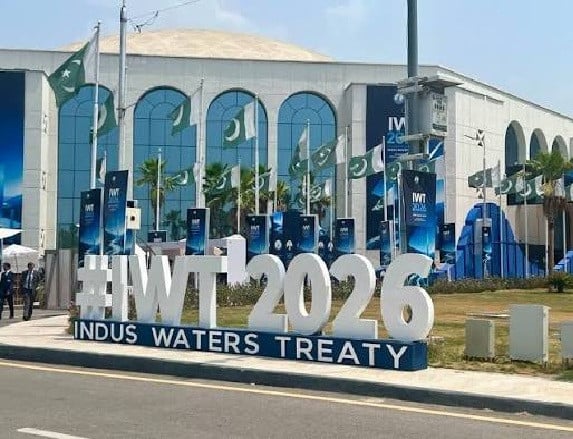
 Against this backdrop, legal experts, humanitarians and a wide range of dignitaries gathered in Islamabad last week, not as some might assume, for a routine diplomatic meeting, but to raise the chorus against a grave violation being carried out by India. The attendees were not indulging in hypothetical discussions about international law, but they were responding to an unlawful act being carried out by the Modi administration. Information Minister Attaullah Tarar, speaking alongside Climate Change Minister Musadik Malik at a press event, delivered a message that carried the gravity of a state under siege: “Water is our lifeline, as well as our red line.”
The conference in Islamabad comes as Pakistan has been left with no choice but to wage a legal campaign in response to India’s unilateral actions. The seminars, the press conferences, the references to international arbitration, and the appeals to the United Nations, while India labels them as propaganda exercises, are the legitimate tools available to a downstream state when an upstream neighbor decides that its physical advantage supersedes its legal obligations, experts noted. The problem, as identified by experts attending the event, is that India has made a calculation that Pakistan’s legal victories, however numerous, will not translate into material outcomes as long as New Delhi refuses to participate in dispute-resolution proceedings.
Legal void of abeyance
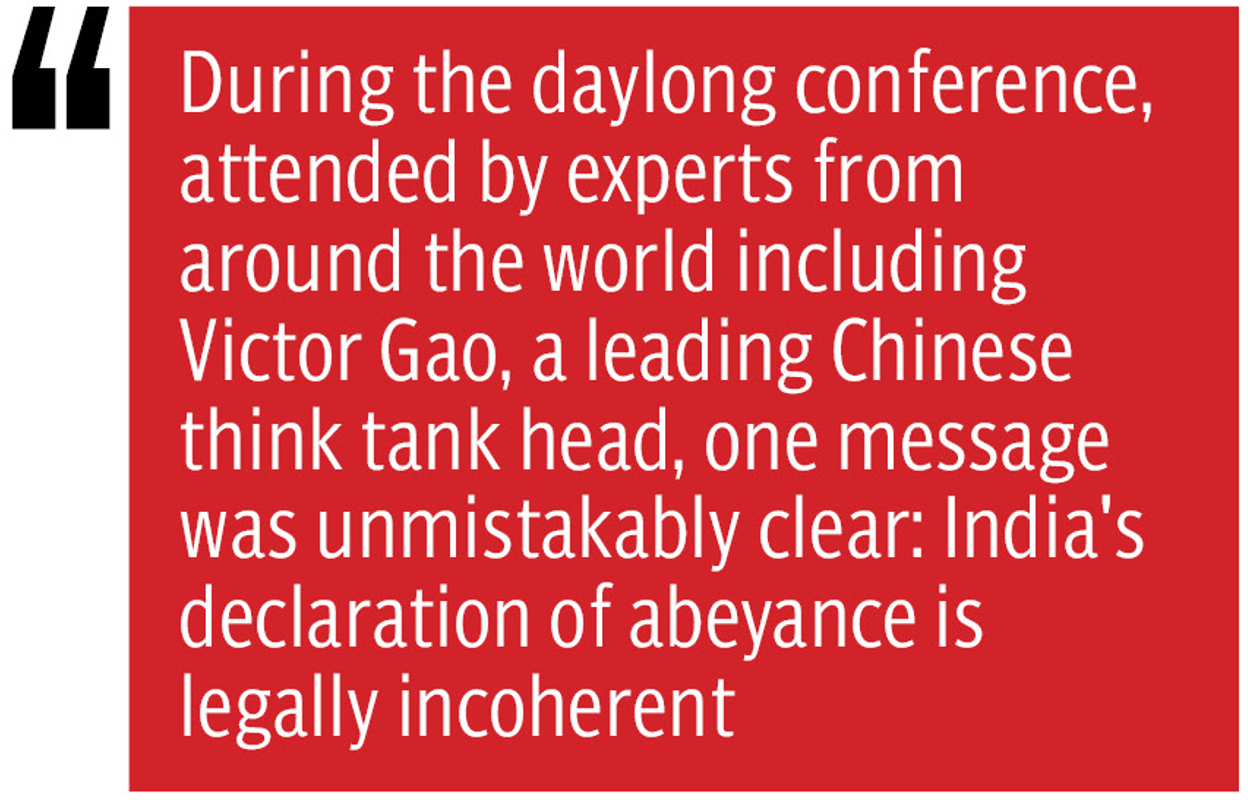
During the daylong gathering, attended by experts from around the world including Victor Gao, a leading Chinese think tank head, one message was clear: India’s declaration of abeyance is legally incoherent.
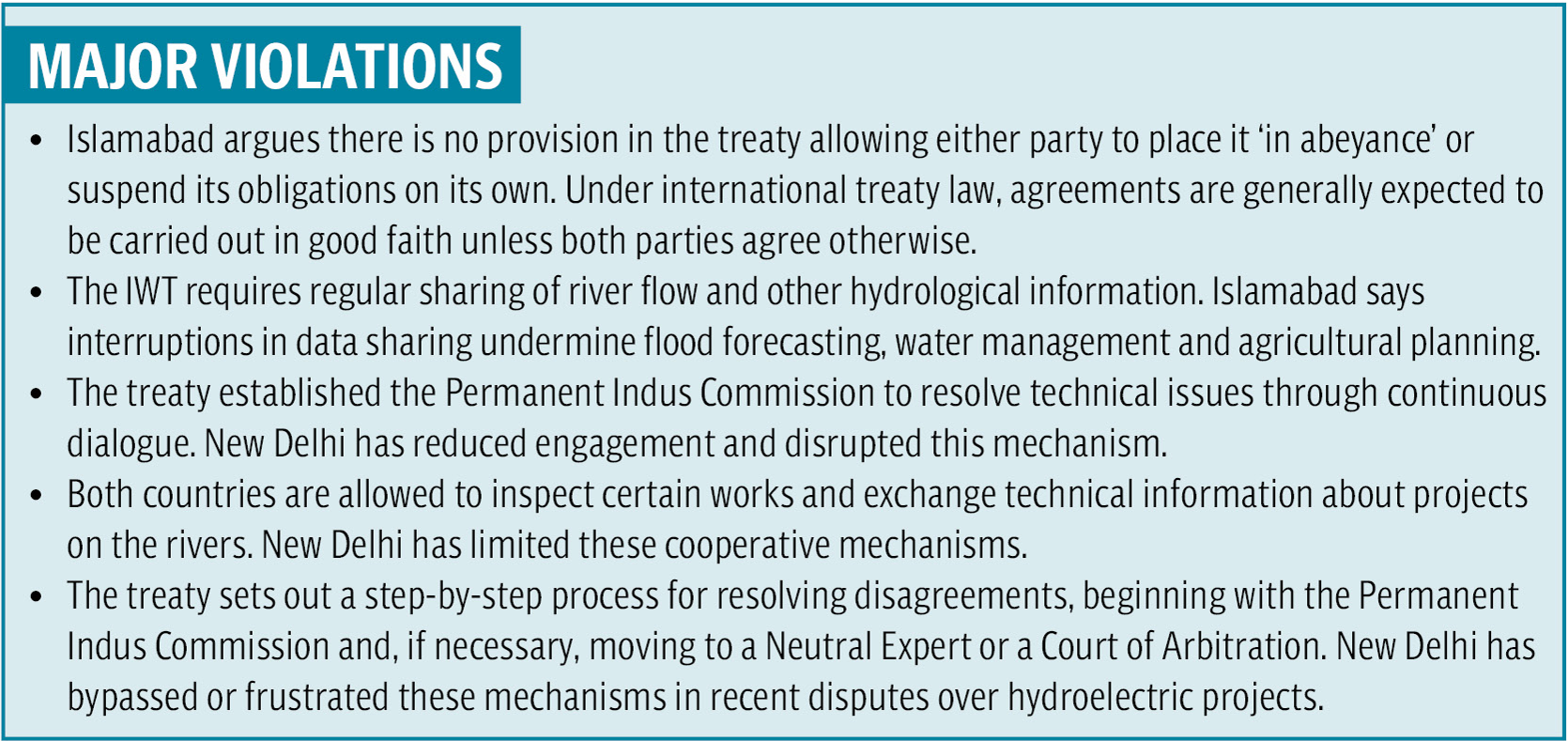
The treaty, experts indicated, contains no provision for unilateral suspension by either party. Article XII(4) states clearly that the treaty remains in force unless terminated by a duly ratified treaty concluded between the two governments. The language itself excludes any such option for India or for that matter Pakistan. The drafters, perhaps aware of the troubled future, wanted to ensure that political tensions, military conflicts, or diplomatic ruptures could not be used to escape treaty obligations. The IWT, experts noted, was designed to survive the very crises that would tempt either side to walk away. But even that did not prevent New Delhi from violating the agreement.
The Permanent Court of Arbitration (PCA) has confirmed this interpretation and in its Supplemental Award of June 27, 2025, the PCA held that the treaty contains no unilateral power of abeyance or suspension and that India’s abeyance position could not affect the Court’s continuing competence. India did not participate in these proceedings. It has chosen to treat international legal bodies as irrelevant to its decision-making. This is not a position that can be sustained in any serious international legal framework, but India appears to have assumed that refusing to engage is politically costless.
The basis for the abeyance that Pakistan has not done enough to address cross-border terrorism, as several experts addressing the conference alluded to, is a transparent attempt to import extraneous considerations into a water-sharing arrangement. The treaty does not condition water rights on security cooperation. If India believes Pakistan has violated the treaty, Article IX provides a dispute-resolution mechanism. If India wants to modify the treaty, Article XII(3) provides the route through a duly ratified treaty concluded by both governments. What India cannot do, experts pointed, is convert unilateral security allegations into a license to suspend water obligations.
The economic stakes
On the surface, the politics across the border appears to be benefiting from the rhetoric around the IWT. But for a nation of more than 240 million, as Tarar pointed out, this is not a matter Pakistan will take lying down.. The country’s dependence on the Indus Basin is not a matter of diplomatic negotiations, it is a matter of national survival. Agriculture accounts for 20-25 per cent of the economy and employs 40-50 per cent of the population. The textile industry, a cornerstone of Pakistan’s exports, depends on cotton, which depends on irrigated agriculture. Food security depends on predictable water flows. Disrupting the Indus flows, experts cautioned, would trigger a cascading economic, social crisis, and humanitarian crisis.
Water is not merely another input into Pakistan’s economy, experts noted that it is the enabling condition for the entire structure. The irrigation system built after the treaty transformed the Indus Basin into one of the world’s most productive agricultural regions. That system is now threatened by upstream decisions made in Delhi for political gains.
According to experts addressing the conference, the international community has a stake in preserving the Indus Waters Treaty. The IWT is one of the most consequential transboundary water agreements in the world as it embeds an institutional mechanism to prevent water from becoming a permanent trigger for conflict. If this treaty collapses, they cautioned, the precedent would be catastrophic. Every transboundary water agreement in the world would be called into question and every downstream state would fear that its security could be traded away in a unilateral decision by an upstream neighbour.
The precedent for the world
The assault on the Indus Waters Treaty is not a bilateral dispute, it is a challenge to the principle that treaties must be performed in good faith, a cornerstone of the international legal order. According to legal experts, the Vienna Convention on the Law of Treaties requires parties to perform treaties in good faith and not to take actions that would defeat their object and purpose. The object and purpose of the IWT is to allocate the western rivers to Pakistan and to regulate India’s use of those rivers. A project that diverts substantial quantities of Chenab water into the Indian system directly undermines that allocation.
Questioning the consequences of India’s decision, experts also said that if India can walk away from a treaty because it finds the obligations inconvenient, what confidence can any state have in any international agreement? If upstream states can use their physical advantage to coerce downstream states, what remains of the principle that shared resources must be managed cooperatively? The assault on the IWT is not just an assault on Pakistan. One expert described it as an assault on the very idea that international law can provide a framework for managing shared resources.
Legal experts have also called on the international community to feel the responsibility to respond, noting that the World Bank, as the treaty’s guarantor, has a particular obligation. The United Nations has documented the human-rights dimensions. The Permanent Court of Arbitration has issued rulings confirming Pakistan’s legal position. These institutions, experts have urged, need to move beyond statements of concern and take concrete steps to ensure that India complies with its treaty obligations. The alternative, they cautioned, is to accept that international law is optional for certain states, a proposition that would undermine the entire international legal order.
Pakistan’s position is straightforward: honor the treaty, share the data, allow inspections, resolve questions through the Permanent Indus Commission and Article IX, and build only what the treaty permits. The treaty survives because it creates obligations despite mistrust, it creates a framework for cooperation even in the absence of goodwill. Despite India’s attempts to frame the treaty as a force against its attempts to develop, the treaty, as described by international experts, only regulates development where India has upstream control and Pakistan bears downstream risk.