
Just when it seems Karachi's theatre scene is struggling for attention, a festival arrives that reminds audiences exactly why live performance still matters. The recently concluded National Academy of Performing Arts (NAPA) Repertory Festival delivered two strikingly different productions—Annapurna and Shaam-e-Dastangoi—that showcased both the enduring power of storytelling and the remarkable range of contemporary theatre. One explored the emotional ruins of a failed marriage; the other revived a centuries-old oral tradition. Together, they offered a compelling snapshot of where theatre in Pakistan stands today. These festivals not only allow alumni and students to perform without restrictions but also provide other media—TV and film—with prospective actors to choose from.
What made the festival particularly interesting was not simply the quality of the performances but the contrast between them. One production relied on psychological realism and emotional excavation; the other depended almost entirely on the ancient art of narration. As a result, it was less a showcase of individual productions and more a test of how different theatrical forms engage modern audiences. While both succeeded in drawing crowds, they did so with varying degrees of effectiveness.
Annapurna
Young actress Noreen Gulwani is a good performer, whether on stage, TV, or film, but did you know that when it comes to adapting foreign plays into Urdu, she is one of the best? The play ‘Annapurna’ was originally written by American playwright Sharr White and translated into Urdu by NAPA’s very own student, who chose to act in it as well, to pay homage to her mentor, Zia Mohyeddin.
The play centres on the complicated relationship between a man and a woman who were once married. The story opens in a dilapidated trailer, where Amir, a poet and writer who has long abandoned any semblance of order, struggles through his daily routine. His health is failing, his surroundings mirror his decline, and years of bitterness have left visible scars.
Into this world walks Ayra, his former wife, who left him two decades earlier and raised their son in his absence. Learning of Amir's deteriorating condition compels her to return and make him feel better so that when the son does visit him, he isn’t shocked to see the frail father and how he lives.
What follows is an examination of regret, resentment, love, and the lingering bonds that endure even after relationships collapse. Like many dramas about human relationships, ‘Annapurna’ explores the emotional terrain between two people who know each other perhaps too well.
The challenge for any production of Annapurna is that it offers very little room for distraction. Without elaborate staging or a large ensemble cast, every pause, gesture and line reading matters. When the performances connect, the play becomes deeply affecting; when they don't, its lengthy conversations risk feeling static. This production fluctuated between those two extremes, producing moments of genuine emotional power alongside passages that felt less assured.
This production deserves credit for tackling a sensitive and mature subject. In an era when theatre often gravitates towards larger social themes or broad comedy, ‘Annapurna’ focuses on the intimate complexities of a failed marriage and the emotional baggage accumulated over time.
Director Moazim Malik's decision to stage a two-hander places the entire burden of storytelling on the interaction between the two central characters. Such plays demand sustained audience engagement through dialogue and emotional nuance rather than spectacle. The script offers ample material for reflection, and the production's intentions are unquestionably sincere.
The star of the play was none other than Noreen Gulwani, the writer and lead actor. Not only did she do double duty, but she also aced both roles. Whether playing the ex-wife who wants to make a difference before the son’s arrival or the woman trying to explain the reasons for her decision to leave two decades ago, she keeps the audience engrossed.
Since writing and acting in two-handers (plays with two actors on stage together) is difficult, and she fulfills both roles without forgetting lines or breaking character. Her chemistry with co-star Husnain Falak was off at the beginning, but at the time, the audience had no idea why she left, why they were living apart, or why she came back.
Once the idea takes hold, Falak’s performance starts to make sense. Whether he is having a panic attack or needs his oxygen tank, he is impressive, to say the least. And when the two characters click, it shows on their faces, but not before the mystery of Ayra’s departure is solved, Amir’s condition is revealed, and matters are resolved amicably.
The name of the play was quite tongue-twisting, which is one reason I couldn't convey it to many of my friends. Secondly, there were a few minor production lapses on the two days the drama was staged at the Zia Mohyeddin Hall, but that has more to do with management than with the actors or the director. It seems management still regards the auditorium as more important than the actors, and they are granted permission to practice on set only when absolutely necessary, which causes issues during the final production.
The character Amir was presented as a poor, out-of-work writer, but his clothes didn’t suggest that. Given that the show was staged in a hall named after a person whose Urdu diction was perfect, pronouncing words incorrectly was criminal. Falak needs to improve his Urdu; otherwise, if and when the play goes beyond festivals, people will point out his diction as the weak link.
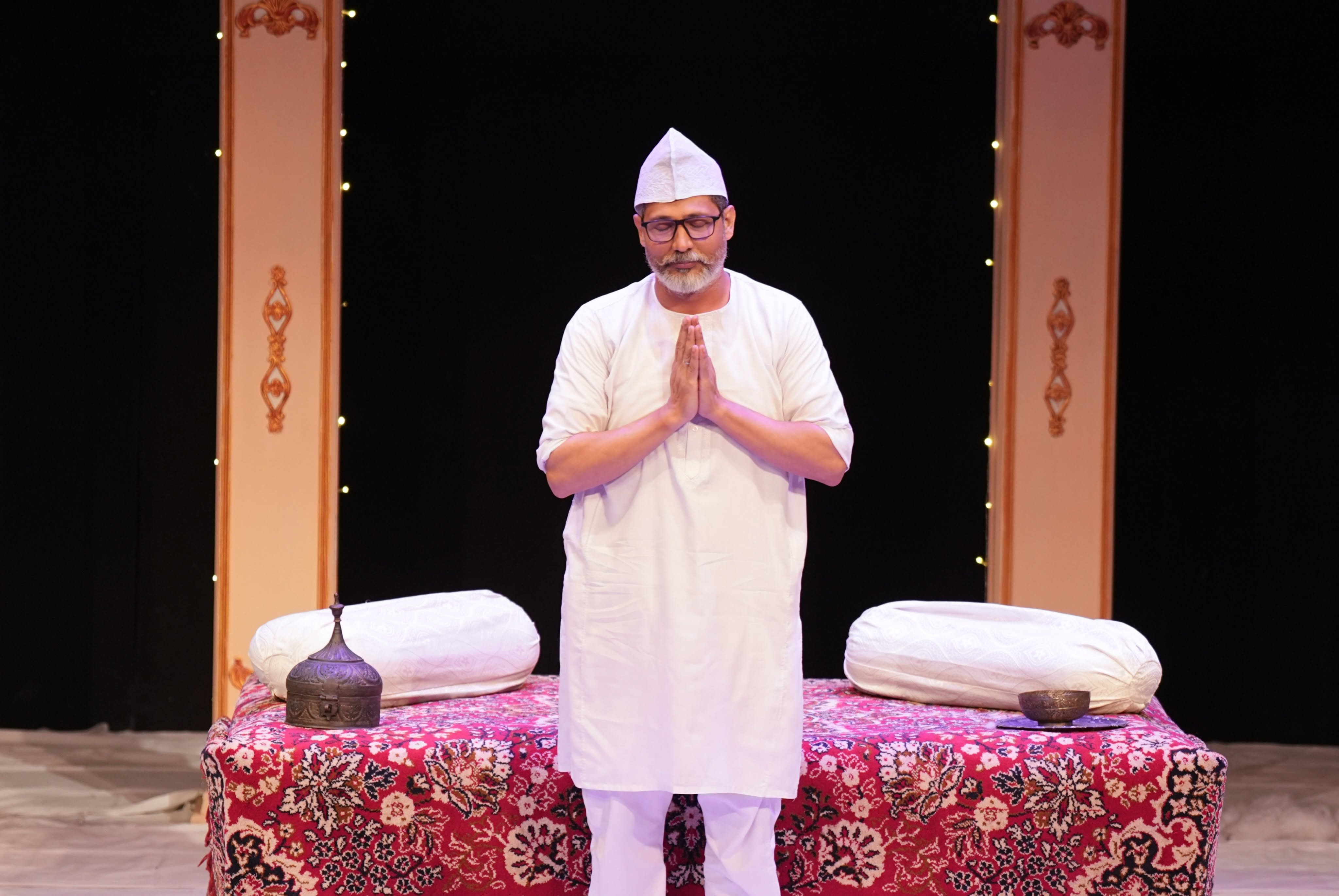
Dastaangoi
The second session transported audiences into an entirely different artistic universe through Dastaangoi, the classical South Asian art of storytelling. Presented by Meesam Naqvi and Nazar ul Hasan, the evening featured two tales: ‘Ek Tha Baadshah’, written by Fawad Khan, and a selection from ‘Tilism-e-Hoshruba’, the celebrated nineteenth-century fantasy epic by Munshi Muhammad Hussain.
Dastaangoi occupies a foundational place in the history of South Asian performance traditions. Long before modern theatre developed its current form, storytellers captivated audiences through voice, language, rhythm, and imagination alone. NAPA's presentation was another effort to preserve and revive this cultural heritage.
The evening's greatest success lay in its simplicity. Stripped of elaborate sets, costumes, and theatrical machinery, the performance relied entirely on storytelling and performance skills. The narrators—both Hasan and Naqvi—kept the audience engaged, demonstrating why Dastaangoi has survived for generations.
First came Hasan, fresh from the success of Parwarish, his TV drama that was directed by Naqvi, the second participant. The way Hasan explained the story from Dastaan-e-Amir Hamza was both mystical and comical since it was one of those stories where fantasy reigns supreme.
The way he discussed the issue of a husband and wife brought the house down. While the king ordered the husband to capture mystical soldiers from Hamza’s army, the wife argued that the king had no right to send her husband on a mission from which he might not return.
What happened next was a classic tale laced with comedy, action, suspense, and fantasy, in which the king’s man seemed to have the upper hand. The music also added to the situation; whenever the story slowed, it shifted the mood and quickened the pace.
Naqvi, whose latest play Kafeel became a huge hit, followed the first participant and shared his own tale, ‘Ek Tha Baadshah’. Although many have heard the tale growing up, Naqvi’s telling was exhilarating, to say the least. Not only was his pace as fast as it should be, but he also proved to be a master at switching characters.
He played multiple characters with ease and introduced each character with a chant of ‘Ek Tha Baadshah,’ which made the people even more attentive. The way he draws the audience along is one of the many reasons they keep returning whenever a session is held. The addition of music also elevated the environment where people from all walks of life came to enjoy themselves, away from social media and their own mobile phones.
The audience's response was telling. A packed house remained engaged throughout the session, responding enthusiastically to the stories and their delivery. The performance reaffirmed that compelling storytelling, when executed well, requires little more than skilled performers and attentive listeners.
Unlike ‘Annapurna’, this session left little to criticise from a performance standpoint. That’s because there was only one character on stage at a time who had to win over the crowd in front of him, just like a soldier standing alone before the opposing army. Even then, the very difficult language of the first session could have been simpler, and the below-the-belt puns in the second could have been avoided. Trust me that would have helped the play, in general, and Dastaangoi, in particular, in the long run.
More importantly, Dastaangoi highlighted something contemporary theatre often forgets: audiences do not necessarily require elaborate production values to remain engaged. What they do require is confidence, command of language and performers capable of sustaining attention through sheer presence. In that regard, this session was considerably more successful than its theatrical counterpart.
If there is a broader concern, it is that Dastaangoi remains a niche form that many younger audiences encounter only occasionally, or just to show that they hang with the cool people. Its continued survival will depend on institutions such as Napa consistently programming such performances rather than treating them as occasional festival attractions.
Taken together, the two sessions offered a fascinating contrast. ‘Annapurna’ sought to dissect the complexities of a deeply personal relationship but occasionally stumbled in execution despite noble intentions. The Dastaangoi session, meanwhile, embraced a centuries-old storytelling tradition and demonstrated how powerful performance can be when fundamentals are executed with confidence.
One looked inward at the emotional wreckage between two people; the other looked back to a storytelling tradition that continues to enchant. Both served as reminders of the theatre's remarkable range, even if one proved considerably more effective than the other.
The writer is a freelance contributor who writes about film, television, and popular culture
All facts and information are the sole responsibility of the writer