
Years ago, a friend lost her aged father to the great unknown. I didn’t know much about him or how he passed away finally and I still don’t recall. What is a clear memory even today though are my friend’s words as I sat beside her. She said it meant the world to her that I visited her and that I checked up on her during her time of grief. ‘Those who have been there for me through this time are etched in my heart,’ she said.
I did not comprehend her sentiment. It felt too big for me then. I knew she was expressing vulnerability, but I was not familiar with it, nor could I pretend to be.
After her dad’s passing, her life as she knew it, as I knew it, changed. Only those who are well-versed in the loss of loved ones have faced this change.
It is a lonely and otherworldly change when it is upon us. When it comes, you will be unprepared. You won’t have your gear or bags ready. No matter how farsighted we are, when the time comes, we are shot into the unknown. Alone, we drift on a landscape empty, frightening and desolate—just like the vast and limitless nothingness that surrounds Earth. Alone we each discover a new planet—the planet of grieving. You will land on this planet when you lose your child or children, your parent or parents, your spouse, siblings... the list goes on and varies for each of us.
Any space expedition requires a base and control room on Earth. When you are on this planet too you will reach out for validation to get your bearings. But why is there silence, many grievers wonder? How come I am left alone to explore this dark new vast world? You notice the absence of your base—friends or relatives or whoever you considered to be your support network before your loss.
“Grief is lonely as hell. People vanish when you need them most—maybe because they don’t know what to say, or they’re scared of making things worse. But silence? That’s worse,” writes William Hunter Howell in The Pretty Painful Grief Book, a journal of sorts about processing grief.
Why are your friends and relatives unable to keep in step when you are grieving?
In Islam, there is great emphasis laid on the rights of God and the rights of people. Included in the rights of people is the advice that one should check in on their neighbour and see if they are not going to bed hungry or wanting or if they are ill. We no longer live in such communities where we have daily interactions with next-door neighbours. But if not physical neighbours, then what about those in your social circle? Maybe among them are those who are grieving the loss of a loved one. Are they not lacking, needing comfort, and possibly going to bed hungry because they cannot cope with their loss?
Death is the inevitable reality which Muslims believe in and, in many ways, it forms the basis of our creed. It is the great equaliser, for as you live, so shall you die. It is also the great divider, for Muslims believe what you do in this life will help or hurt you after death. Culturally, we do honour and pay respect to those who pass away. Janaza (funeral), soyem (the third day of mourning), chaleeswaan (40 days after), barsi (death anniversary); these days numbering the passage of time after death all are marked with a communal gathering. Muslims feel it incumbent upon them to attend the janaza especially—the participation is said to bring you reward in your afterlife. However, that might be the last occasion you see many relatives and acquaintances. You may hear from them next when another religious day comes around, like Eid. On days when you feel alone on your planet, you can’t help but wonder why they have not kept in touch? Or notice that they have not reached out since you departed from your old reality. For them you are present on the same Earth going about your routine life, meanwhile you are floating without gravity and unanchored in your new existence of bereavement.
Why does social support fade after the rituals are over?
What makes talking about death awkward?
On American TV and film, a lasagne casserole is a cultural token of extending sympathy for the bereaved family. Neighbours and friends show up with dish upon dish to ensure the family has comfort food. The excess of carbs is intended to make up for the grief that is too much to talk about. The people who know you try to keep you well fed while you sort out the practical tasks of burying your loved one.
In our society, the family going through the loss must feed the condolers who come to pray for the deceased. Relatives usually pitch in to get degs for at least 3 nights’ dinner if not a week’s but the mourning household has to do their part of hosting the visitors, ensuring an endless supply of fresh tea and refreshments. (And yes even those meals get the same criticism as meals catered for weddings.) In a week, the doorbell stops ringing and there is silence for dinnertime.
Writing about the death of her father, Bryna Talamentez, a licensed family therapist, posts: “Then, the meal train and people stopping by just ended. After a few weeks, our friends went back to their daily lives and we seemed to be forgotten. We went back to our simple meals at home with just us or my mom and I with my Grammy. Yes, my friends would still come and go from the house as usual, but everyone had suddenly stopped talking about my dad and stopped asking how I was doing with my grief. Did they just forget? Did they no longer care? These were questions I and others who are grieving have asked when the ‘lasagna period’ ends.”
She continues about the growing isolation experienced by the bereaved after the funereal rites and condolence visits are over: “In reality, we cannot expect people to continue to bring us meals months on end, but what I was most upset about is it seemed like my dad’s existence had never happened. People stopped saying his name. Many of our friends stopped asking how we were in our grief. They were wonderful about asking if my mom needed help with rides after school and to activities, and we were grateful for that. But I was hurt that all of a sudden they just didn’t care that my dad was dead.”
Grief is something each of us experience in our lifetime yet it is a subject we avoid talking about, according to Talamentez. Through her work, she is raising awareness and starting conversations on grief.
Talking about why social support largely fades away for the bereaved in our Muslim society, Rabeea Saleem, a mental health researcher based in Toronto, Ontario, says, “A major reason for this is the widely held religious belief that mourning lasts only three days. While that’s true, the process of grief does not end after three days.”
She stresses the importance of differentiating between grieving and mourning. “Grieving is the internal, personal experience of loss, which includes thoughts and feelings like sadness, pain, or loneliness. Mourning is the outward expression of that grief—the behavioural, social, and cultural rituals used to process loss,” she explains. From the Americas to the Middle East, death wailing and keening is a socially sanctioned ritual to process grief. The vocal expression of grief is meant to show social support by publicly sharing the burden of grief, bringing the community together, and signalling the profound magnitude of the loss to surrounding members.
However, in modern times, we crave quieter strength and support from our society.
“In a collective society like ours, there is a strong emphasis on injunctive norms—behaviours that one is expected to follow and expects others to follow in a given social situation,” Saleem continues. “Erving Goffman’s theory of impression management relates this to people wanting to control how others perceive them in the service of personal or social goals. Showing up is a visible way of signalling care, respect, and that you’re a ‘good’ member of the community. It’s not just about supporting the grieving family; it also communicates something about your own values. But once those formal rituals are over, the social pressure and visibility wear off. Support often fades not because people suddenly stop caring, but because there’s no longer a clear social script or expectation pushing them to keep showing up. In other words, grief is highly supported when it’s public and structured, but much less so when it becomes private and ongoing.”
That is the irony of it all. There is not much vocabulary to reach for when someone dies. Many of us feel inadequate in mumbling ‘Sorry for your loss’; the words ‘God give you strength to bear this loss’ might ring hollow. However, these are the simple social graces we cling to when there are no other words. They are not to be skipped. For when said with a hug, or physical touch to show support, they carry weight and comfort for the aggrieved. Even a sincere text message, if meeting in person is not possible, is better than not reaching out at all.
Perhaps, what will create more empathy is when we pause to think how life is changing for those whom the departed leaves behind. Placing ourselves in their shoes requires only a little imagination to picture what they might need during a time of loss: the bereaved are still counting the hours and days without their loved ones after the lasagne period is over.
The perils of isolation
When much of the support offered in early grief diminishes quickly, the bereaved, while navigating one loss, might get bewildered with the absence of more people. While we get back to our routine lives, their need for support continues.
Some studies show that both the quantity and quality of social support may influence well-being for grievers. Those who have more frequent contact with family and friends reported better quality of life-- whether this support comes through technology (email and the internet) or in-person. The meaningfulness and solace comes from the quality of relationships not the number of people contacting you.
“Scientifically, the evidence behind the role of social support in facilitating grief adaptation has been inconsistent,” argues Saleem, who has previously worked at Aga Khan University Hospital and Dow University of Health Sciences. “While some studies suggest that social support in the first six months after loss can prevent [post-traumatic stress disorder] PTSD and depression later, other research suggests that the emotional suppression that occurs when people feel pressured to mask their mourning or ‘hold it together’ to meet social obligations can prolong their process of grief. It all depends on whether the person feels safe enough to be honest about their grief within their social relationships, rather than having to perform coping for others.”
Therapists often urge you to ruminate about your grief and stress the importance of getting catharsis while you are holding a myriad of emotions and thoughts inside. The bereaved person may need to express, vent, or make sense of their emotions by talking it out with someone they can trust. But if the other person takes the approach of offering solutions as if grief were a problem to be “fixed” rather than an experience to be held, the griever may distance themselves. They will shut down emotionally when people around them answer by avoiding conversation (e.g., changing the subject or signalling their discomfort through body language), or encouraging them to move on or offer religious platitudes (like “they are in a better place” or “it was destined to be this way”).
The bereaved individual feels intense social disconnection following their loss. “This can show up as feeling distant or cut off from others and difficulty trusting them to relate to their loss,” explains Saleem. “Because of this, it’s important to give them space to grieve in their own way, without trying to steer, correct, or ‘fix’ the experience,”
If not processed, grief may turn into emotional numbness or detachment and can become increasingly disconnected from their own emotional experience. Coping with their routine and connecting to their social support network becomes challenging. Without the ‘normalcy’ in daily functioning it is harder to process and adapt to the loss over time.
Prolonged grief disorder is characterised by intense longing for or preoccupation with the deceased. It is accompanied by symptoms such as identity disturbance, disbelief about the loss, avoidance of reminders, intense emotional pain, and feelings of numbness, loneliness, or meaninglessness. These experiences can cause significant distress and interfere with important areas of daily functioning. There are noticeable signs to watch out for in people who have experienced loss: Impairment in daily functioning, emotional volatility in romantic relationships, and addictive tendencies. One or all of these changes should be taken as a silent cry for help.
Some scholars have found a relationship between loneliness and post-bereavement depressive symptoms, adding to the global burden of mental illness. This situation worsened considerably by the Covid-19 pandemic. The medical journal Social Psychiatry and Psychiatric Epidemiology published a paper on the link between suicidal ideation in adults who are grieving and social withdrawal. The paper identified thwarted belongingness, withdrawal from others, lack of connection, and loneliness as significant risk factors for suicidality in grievers.
Strong social support for those dealing with intense grief may not expedite recovery, but it may improve their capacity to cope. Much of the responsibility for grief support falls on family and friends. Yet, bereaved people often report insufficient support from these sources. Each person has unique needs. For instance, those who have lost a spouse at an early age or a child often need more support than family or friends can provide. Additionally, while the death of a loved one sometimes strengthens family relationships, often these relationships are strained, as family members may also be grieving, adding to the psychological distress of the bereaved. In such complex cases, professional therapy and grief counselling would prove most beneficial.
Just as the initial wave of social support begins to fade, the true, complex work of grieving begins. We often hear about the seven stages of grief. This is a mid-century psychology concept which tried to categorise the chaotic aftermath of loss into a predictable sequence: shock, denial, pain/guilt, anger/bargaining, depression, the upward turn, and finally, acceptance.
But anyone who has ever sat in the wreckage of a major loss knows that grief is not neatly experienced. It is a bombardment of feelings and thoughts every day. You do not "graduate" from shock to denial, nor do you leave anger behind forever once acceptance arrives. Grieving individuals tend to loop back, skip steps, and experience multiple stages at the exact same time. On Monday, they might feel the quiet resolve of acceptance; by Tuesday morning, a sudden scent or memory can plunge them right back into acute pain and anger. Grief is non-linear, unpredictable, and deeply exhausting.
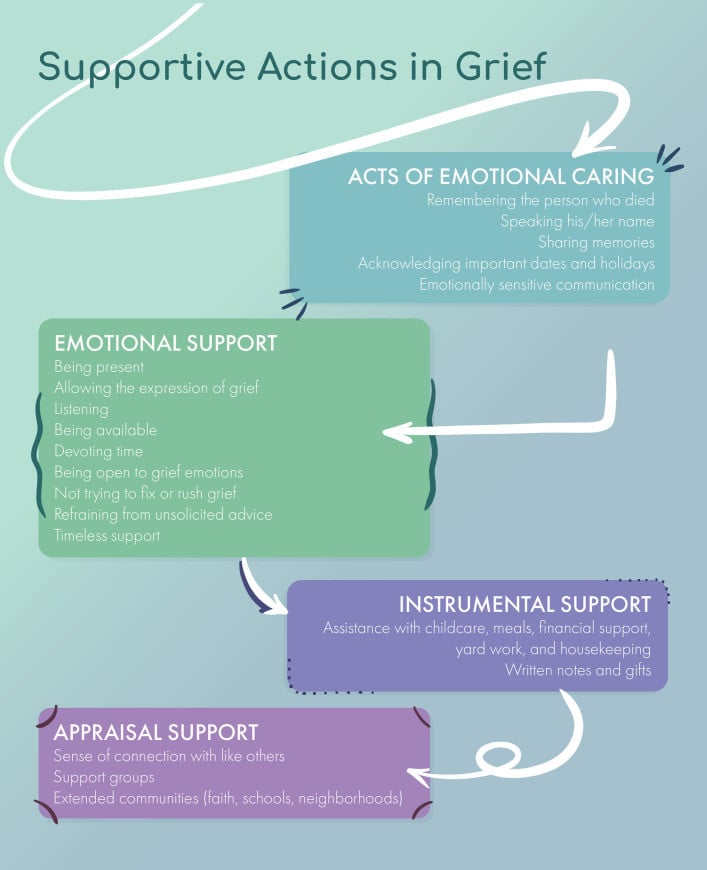
When someone we care about is trapped in this emotionally volatile landscape, we must be patient and learn to figure out what kind of support they require for healing at different times. To truly help someone carrying this weight, we must learn how to meet them exactly where they are—regardless of which stage they happen to be enduring today.
“One of the most meaningful ways to support someone grieving the loss of a close family member is to stay present and regularly check in in a consistent, low-pressure way, especially in the weeks and months after the loss,” recommends Saleem. What helps most is being compassionate, nonjudgmental, and emotionally available—someone who can sit with them in it, rather than try to take it away.”
When routine breaks, so does your reality. When someone precious to you is taken away, you leave behind your old life, the one you lived with their presence and you forget your old self because you are facing a new life, without the ones who died. In this isolation, you can hurt and lose even more. The fragile link between this new reality and ‘normal’ life can only be built by social interaction that provides a healing space for you.
To support those in grief, we don’t have to make elaborate gestures. “You just need to show up, send a text,” as Howell writes in his book. “Grief is heavy, but when someone holds even a fraction of that weight, it becomes a little less unbearable.”