
The Staircase is a curious piece of television. It extends beyond straightforward adaptation in that it is based on a documentary about a murder trial that took place in Durham, North Carolina,following the mysterious death of a woman on a staircase in 2001, more than two decades ago. So the time of the setting of the gruesome death seems like a lifetime away, for all practical purposes, the world before 9/11. Yet enacting and dramatising the documentary for 2026, the creator Antonio Campos has pulled out a drawer stuck underneath all the media attention the Peterson case received; a drawer containing the enduring search for an evasive truth behind a man and what he was capable of. The obfuscation and lies come out of the woodwork as the trial proceeds. But the truth about the death remains shrouded in secrecy.
Michael Peterson, a successful novelist, married Kathleen, a successful telecom executive and they have a blended family of five children. Two sons from his first wife, two adopted daughters and Kathleen's daughter from her previous marriage. On a night in December 2001, Michael placed a call to 911 to help his wife who fell down the stairs in their home. She has lost consciousness, he says, hysterically, while his wife lies lifeless in a pool of blood around her. Yet he says she is still breathing. He remains the sole witness to her death and maintained he did not kill his wife to date.
The husband and wife
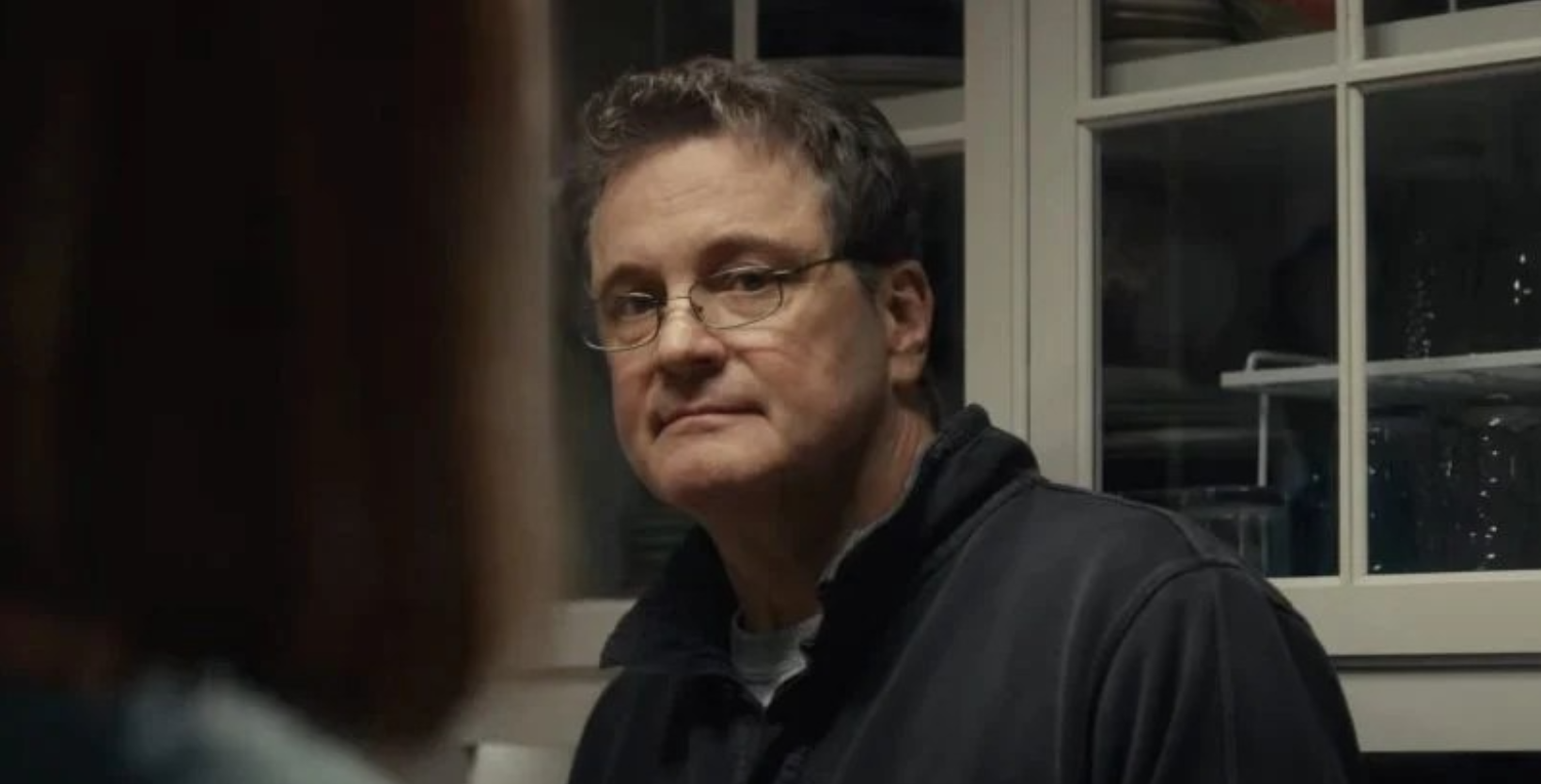
Colin Firth is a surprising choice for this role. He bears no physical resemblance to Michael. However, from the get go he brings back the recollection of the original documentary. Michael is a performative, egotistical man, smug in his conviction that he can charm the socks of anyone. The irony is that as soon as you are introduced to him in the documentary, you hold him circumspect for his manner of conversation and the very fact that he is allowing himself and his family to be filmed during his trial. He displays magnanimity and emotion - lots of it - at all the right moments.
Throughout the five-month long trial, his children dote on him.. What more evidence of a good man does one need?
Firth, who will forever remain the perfect Mr Darcy, has probably not played such a complex character in the past – certainly not a real-life murder suspect.And the show gives him time to marinate in it across eight episodes. As Michael, he will evoke in you reactions that the actor is not associated with, he is darkly dubious whereas we are familiar with his humble charm. It is only the softness around his eyes that Firth could not get rid of which are a total contrast to Michael's beady eyes.
The role of Kathleen has offered Toni Colette much more elasticity than any of her recent roles, especially those seen in Netflix productions. Off the bat, her characterisation hints at ‘a bit too good to true’ feeling, so you may wait for her mask to fall. But she is shown to be a working mother and supportive wife who glues the family together as honestly as she can in her situation. She is Michael's provider. He awaits his books getting picked up for TV or a film deal. She makes sure all the children are home for the holidays. Michael can throw a tantrum and antagonise them no matter what the season. For Thanksgiving right before her death, Kathleen finds out that Michael told off his older daughter about her bad grades and refused to send her a ticket to visit Durham. That is just how severe Michael is shown to be toward his children. When she finds out, Kathleen promises to send money for the ticket despite being stretched thin. Just one instance of how she quietly tries to bring order and togetherness in their unconventional domestic world.
The Petersons’ marriage is idolised. But the chink in the armour is always there. In a flashback, in the second half of the show, Kathleen is telling someone about her fiance Michael, who is too much and wonderful both at the same time. It is exciting to her then and after marriage it is something to work around. Colette is flawlessly comfortable in her skin as a woman who is holding up her business and home running successfully without any real support. Her meltdown when her company is losing stocks is the only window where she is shown to lose composure. Yet the feeling of her being a saint is not held over your head. She is just doing the best she can and has the wherewithal to do it better than some people.
Michael is a charismatic personality who is tremendously lucky to have kind and forgiving people around him who consistently overlook his flaws. He has made for himself a larger than life persona as an extremely clever man and talented writer, so somehow all who exist in his ken put him on a pedestal no matter how domineering his ways. They allow him his manipulations and maneuvers. Whether it be his sons, always seeking his approval, his daughters who show unconditional love for him and indeed all family. Or Kathleen… who seems to treat their marriage as an equal partnership all the while pulling all the weight in the union for all practical purposes. There is another person who comes later in Michael's life, who will make you feel better about ignoring the red flags in your exes. But more on her later.
The lawyers
As luck and fate would have it, Michael has a devoted brother, Bill, who is a lawyer and who helps him hire a noted attorney David Rudolf, played dexterously by Michael Stuhlberg, probably the most sympathetic and decent lawyer you will see on television. There is goodness oozing out of both Bill and David and one wonders how they take on legal battles as wholesome and untainted as they seem. They are both antithetical to the sharks that many TV shows are based around for courtroom drama. The show makes the district attorney and his assistant a foil to Michael's legal team, when the state prosecutor begins a smear campaign against him. By digging only a little into his private life, Michael's affairs with men surface and a new question hangs heavy in the air: did Kathleen know her husband was bisexual?
Bill and David are steadfast in their belief of Michael's innocence which is a miracle in itself. It is not just one curveball that is thrown their way. Michael's past is uncannily patterned, truths he has hidden from the light which throw a damning shadow on his trial to prove innocence. One can expect blind trust from his brother but David too acts like he has sworn fealty to him to fight to death. He is unshakeable in his belief overall despite an abundance of circumstantial evidence that does not add up to save his client.
The children
Out of all the children, Sophie Turner shines as Margaret, the elder daughter. Turner has offered the role a tempered pathos and relatability as a daughter who loves her dad and will do anything to prove his innocence. Her readiness to help is annoying after a while but she depicts what daughters in our part of the World especially are conditioned to do and that is to sacrifice to keep the peace. Her close relationship with her younger sister Margie is tested by the unpacking they have to do as a family of their past, their childhood and their dynamic with their dad. He and his first wife were named the guardians of Margaret and Margie and adopted them after the girls’ biological mother died.
Every other sibling’s backstory is explored in great detail in order to paint a context for whether they would believe Michael is a killer or their protective dad. Every relationship with his children has a strain of sorts and he is not a parent who makes them all feel loved equally. Whenever he wants, Michael chooses a favourite kid to “rely” on more than the others.
His sons Todd and Clay seem to have more of a direct access to him, and have more screen time. But I found the glimpse into Margaret and Margie's story more touching than the rest. Margaret cannot help but be the big sister who plays her part for the good of her family while younger and wearing her heart on her sleeve, Margie questions things that feel off and trusts her gut more.
The drama
The trap in the attempt to place all characters in the story in their individual context is tedium. It inevitably surfaces halfway through the limited drama series. This Netflix format, stretched to maintain the binge-watching, does not seem to be debated in the editorial offices. The Staircase does not avoid this trap either. Those with attention spans even shorter than mine might miss out on the climax of the show because they have had enough of following around a family being a family. Having said that, the suspect is a page-turner himself, so the viewers will be compelled to see ‘what next’ as the trial keeps peeling back the layers of his secret life. And there are lacunae in both defence and protection that are still being debated today.

The filmmakers
Here is the ultimate reach of the dramatisation of the documentary based on a true crime – a play within a play. The French documentary filmmakers are part of the characters in the story. Not only has the drama brought to the foreground the individual struggles of each family member but it also offers a long focus on how inextricably absorbed were the filmmakers with the subject of their documentary. On the whole their sentiments reiterate that perception can hardly be objective, as two out of three producers of the documentary are completely swayed by the humanness of Michael's case, the love he professes for his wife and his unshakeable stance that he will never admit he is guilty of committing her murder because he never would and never did. That leaves the third filmmaker who is quintessentially French in his outspokenness about all the evidence that points otherwise. Michael is a cheat and a liar; he lives off his wife's money. He is hungry for fame; he never tires of watching himself on TV or listening to praises about his novels. He is not above board with his wife or even his fans for he never speaks the whole truth. When the whole picture accidentally comes out, he defends himself using the general excuse of life as it transpires and the incongruity of it all. You can't pin him down.
The other two biased towards the suspect and feeling him to be wrongfully indicted are a case study of extreme naivete. Or you can call it the pureness of believing the best about people. Jean-Xavier and Sophie (Juliet Binoche) colour their sketch of Michael by acknowledging his words and outward emotion, so enhanced does their subject become in their imagination that they are in love with him, each in their own way. It is remarkable to discover that despite a conviction of murder for which he is incarcerated for 16 years, Sophie secretly writes letters to him in jail much like Ted Bundy's wife wrote him expressing her sympathy while he was on trial for multiple murders. Bundy was an American serial killer who raped and murdered at least 30 women.
The Staircase takes its time to lay out the biases of every player in the trial around the suspect. The kaleidoscope of emotions and affiliations that help and protect one man become a web of lies and preconceived notions. At the heart of the web is one man who ensnares all these people into being good and loving towards him, no matter how selfish or cruel he is.