
Over the millennia, wars have been fought on many battlefields and have taken many forms. While the most common conception of a war is probably direct conflict one of the key areas in any conflict is communication. This can also take many forms, from formal addresses by leaders to their own people to what is often called ‘public diplomacy’ or exchanges of threats or suggestions through transnationally disseminated public statements by leaders whose countries have cut off diplomatic ties.
And sometimes, particularly with regard to the current war between the US-Israel and Iran, there are memes.
Though a ‘meme’ can have many definitions, for the purposes of this article, a meme can be thought of as any concept or image that spreads virally through and across cultures and subcultures. They are usually disseminated on social media platforms, especially X/Twitter, as they are image-heavy. Anyone who is online even occasionally, has inevitably seen them, and probably shared them. My particular favourite is one from an early episode of animated sitcom The Simpsons, which is a GIF of Homer Simpson first walking out of a hedge and then walking backwards into the hedge again. The image generally has connotations (additional meanings) of walking into a situation that one quickly realises is something they do not wish to be involved in and quickly leaving. The image, in and of itself, does not carry any specific political meaning. When used as a response to a political post or reference it can certainly take on that meaning, such as if one uses that GIF in reply to a post about the US and/or Israel entering into an inadvisable conflict and trying to quickly find a way to exit. The above example illustrates that memes exist in wider contexts, both sociocultural and interactive. A meme is a statement or response, but it is meant as dialogic– that is, it is part of a conversation and exists within a wider, often global, cultural and subcultural context.
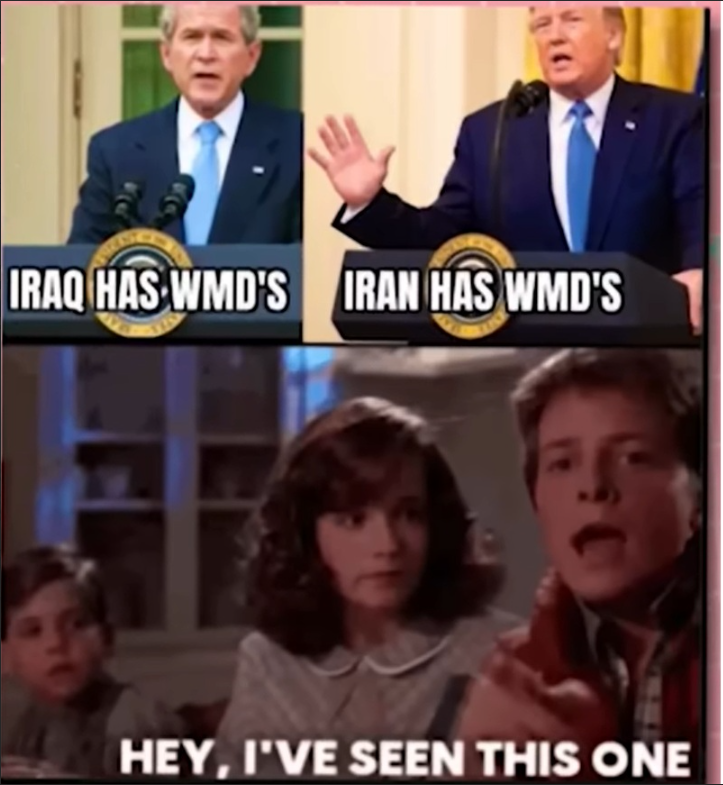
Memes relating to the current war are not only used by official representatives of governments, of course; the many millions (if not more) of Americans who are against the war and who disagree with the current US government often use them as a way to express our dissatisfaction with both those in charge and those who have the power to do something to stop those in charge but who instead do nothing. Yet the memes produced and disseminated by official accounts can be thought of as a form of political communication just like official speeches and other forms of public diplomacy.
I realise that the idea of ‘funny pictures’ being treated like serious political communication might seem somewhat odd. Yet they engage with a long tradition of visual (or primarily-visual) propaganda and other nationalist forms of communication. In some cases, these forms can seem to be relatively benign; social psychologist Michael Billig talks about how national flags and other symbols associated with a particular national or regional identity can help construct, reinforce and sometimes modify national or regional identity by ‘flagging’ the nation or region. Essentially, through flagging, one is constantly reminded of where one is in the world. But even that can be turned against people like as has recently happened in the UK and, to a lesser extent, Ireland, where national flags have been appropriated by far-right ethno-nationalists who use putting up flags as a way of terrorising migrants, especially non-white migrants. What these visual references hold in common is that the goal is to spark a strong emotional response. Instead of educating or informing, as public communication should, or persuading through the use of valid arguments based on facts, like political communication should, this is the work of propaganda, to encourage fear or anger or uncritical patriotism in the viewer or listener. Thus, in cases where memes and trolling are being put to political purposes or are done by governments and their representatives, they can be viewed as a form of propaganda. This can be directed domestically, transnationally or both. In the case of Iran, because internet access has been so suppressed even before the war began, the implication is that their memes and trolling are directed at the transnational audience, including, but hardly limited to, the American government.
The US, on the other hand, seems to be playing to both its domestic and transnational audience. While the responses by different audience segments vary – much of the domestic audience is as appalled as the majority of the transnational audience is – the use of memes plays directly to the far-right ‘MAGA’ base.
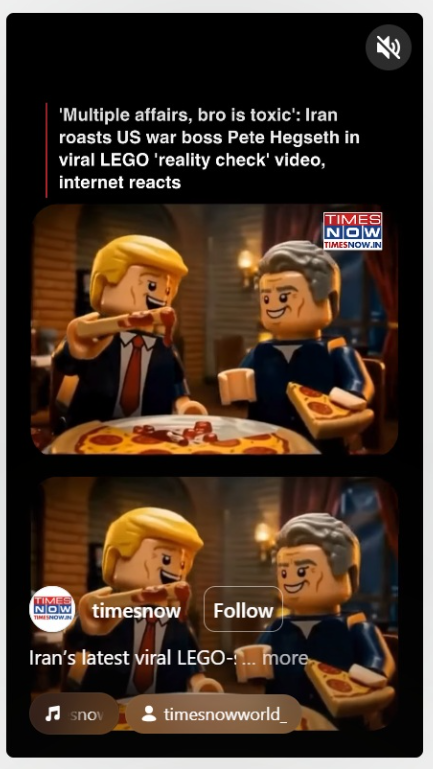
A number of studies in the past decade, including one by Törnberg and Chueri just last year, have shown that far-right and right-wing politicians and those aligned with them use deception as a matter of course. Lane, in a book on the right-wing media ecosystem in the US, points out that the goal of the right wing, especially the far right, is to diminish trust in governmental and sociocultural institutions. This helps the rise of populism and authoritarianism– essentially what we have seen in the US in the past decade. Memes, often as part of wider trolling efforts, are frequently used for this purpose. Woods and Hahner wrote a recent book about memes and the ‘alt-right’, which, for the purposes of this article can be thought of as a far-right group of mostly white men in the US. One of the main features of the alt-right is their use of trolling, including through memes, for ‘lulz,’ which Woods and Hahner define as finding amusement in causing distress to others, usually people from marginalised groups. Yet because memes can be used ironically or earnestly and such context can be easily lost as the meme travels, this can also distance meme-creators and meme-sharers from individual responsibility, though that distance becomes shorter when memes are posted by an official account of a government (blaming interns notwithstanding).
Regardless, the basic idea of ‘lulz’ stems from détournement, which is the idea of challenging or ridiculing hierarchies through absurdism. One can certainly view the use of memes by both the US and Iranian governments in this way, trying to ridicule each other to negatively impact their perceived power and to cause distress to the other – and, in so doing, distressing audiences home and abroad. Memes often engage with whatever discourses are also present within particular cultures or subcultures that produce them. In the case of the US, whose domestic paramilitary force (ICE) often has social media creators embedded within operations to create social media content, memes against Iran have often invoked the uncritical veneration of the military in the context of toxic masculinity as expressed through first-person-shooter games alongside Christian ethnonationalism. Islamophobia and other forms of xenophobia. While all of these discourses are recognisable to Americans and those who are familiar with American culture, these discourses are also strongly tied to emotional response. In the case of the alt-right and their overlap with the current US government’s ‘MAGA’ supporters, these memes connect with a shared sense of persecuted or threatened identity -- Bebout argues in a book chapter from 2019 that a key aspect of right-wing media is the false perspective of victimhood -- as well as to what they have learnt as morally correct through far-right Evangelical and other groups. This can often serve as a recruitment tool; it is common enough to see a meme or post one likes and follow the creator or poster. This leads to exposure to more memes and similar content and what is often called a para-social relationship can form. This type of relationship, though mediated through a platform, does still create an emotional and social bond which can then lead to a sense of community and shared identity, particularly if the person already had elements of shared identity or shared perspective before the first encounter with whatever meme drew them in.
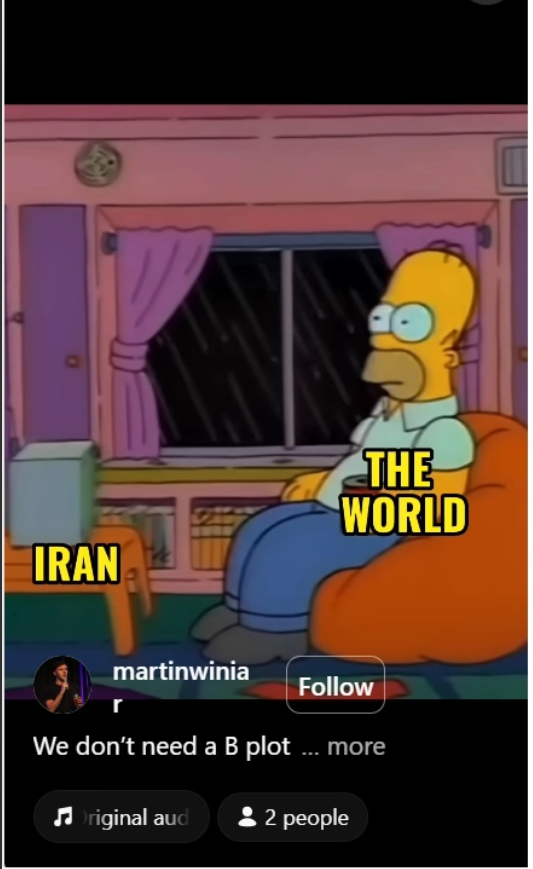
The idea of creating official content for ‘lulz’ and of repurposing video game content into political communication may seem juvenile. But many devotees of the far right and the current US government are teenagers and very young adults -- the voting age in the US is 18 -- and these strategies may well be designed specifically to appeal to them. Young people are often targeted by predators who realise that young people do not always have the life experience to recognise when they are being deceived and that young people may not have the strength to resist authority. In this, one can almost see the exploited young people as being subjected to abuse as they are taught and encouraged to abuse others.
That said, there is also an economic motivation behind trolling and memes that has to be included in any discussion of contemporary social media. Any sort of monetised account, whether on X, formerly known as Twitter, or YouTube, or any other platform, makes money through engagement. Clicks or retweets or time spent on a site or another metric of a person’s attention -- and sometimes their data -- equal money for the person who owns or runs the account. Appealing to the emotions is one of the primary ways to increase engagement -- in essence, the person or account’s job is to make people angry or afraid. This is another way in which memes can be used as propaganda – the goal of both is emotional rather than rational. Propaganda and memes can fall apart quite easily with a combination of critical thought and applicable context. But because memes especially are positioned as ‘just jokes,’ there can be a tendency to view or disseminate them uncritically.
Memes are not, in and of themselves, automatically negative or harmful. As with any form of communication, they can establish social bonds, critique power imbalances or give wider awareness to someone or something that would otherwise be excluded. Détournement, when utilised by an oppressed group to satirise or otherwise challenge a hierarchy, can be a way to encourage positive social change. What we see with the use of memes by the US and Iranian governments, however, is not positive. Rather, it is two oppressive regimes using real death and destruction to create social media content which enriches their supporters, online and off, and further entrenches authoritarianism across the globe.
And that is not at all funny.
All facts and information are the sole responsibility of the writer
Dr Melissa is an independent scholar of media who has worked at universities around the world