
Ever since Priyanka Chopra-Jonas transitioned from Bollywood to Hollywood, she has been on a relentless quest to carve out a space for herself in an industry that is as unforgiving as it is competitive. While her journey has been admirable for its persistence, the results have often been inconsistent. With her latest outing, The Bluff, Chopra-Jonas once again attempts to headline a major international project—but the film ultimately lives up to its title in more ways than one.
At its core, The Bluff tells the story of Mariam, a former pirate who has left behind her violent past to embrace a quieter life with her family. However, as is customary in such narratives, her past resurfaces, forcing her to return to the very world she had abandoned. It is a premise that has worked effectively in countless films before, from gritty revenge dramas to larger-than-life action spectacles. Yet here, despite the familiar blueprint, the execution falters at nearly every turn.
One of the film’s most glaring issues lies in its casting. Chopra-Jonas, despite her undeniable screen presence, struggles to convincingly portray a hardened pirate with a shadowy past. There is a disconnect between the character’s supposed history and the persona she brings to the screen. Unlike the rugged authenticity audiences have come to expect from the genre—popularised by franchises such as Pirates of the Caribbean—her portrayal never fully immerses the viewer in the world the film is trying to build.

This is further compounded by her dialogue delivery, which often feels exaggerated and inconsistent. In several scenes, her attempt to adopt a more Westernised tone comes across as forced, echoing the criticisms she faced during her television debut on Quantico. Much like that series, in which her character struggled to resonate with audiences, The Bluff suffers from a central performance that lacks the nuance needed to carry such a demanding role.
Comparisons are inevitable in cinema, and in this case, the film seems to draw inspiration from the classic trope popularised in Indian cinema by icons like Amitabh Bachchan—the reformed individual forced back into a life of conflict to protect loved ones. However, where Bachchan’s performances are layered with gravitas and emotional depth, Chopra-Jonas’s interpretation feels surface-level, never quite capturing the internal conflict that defines such characters.
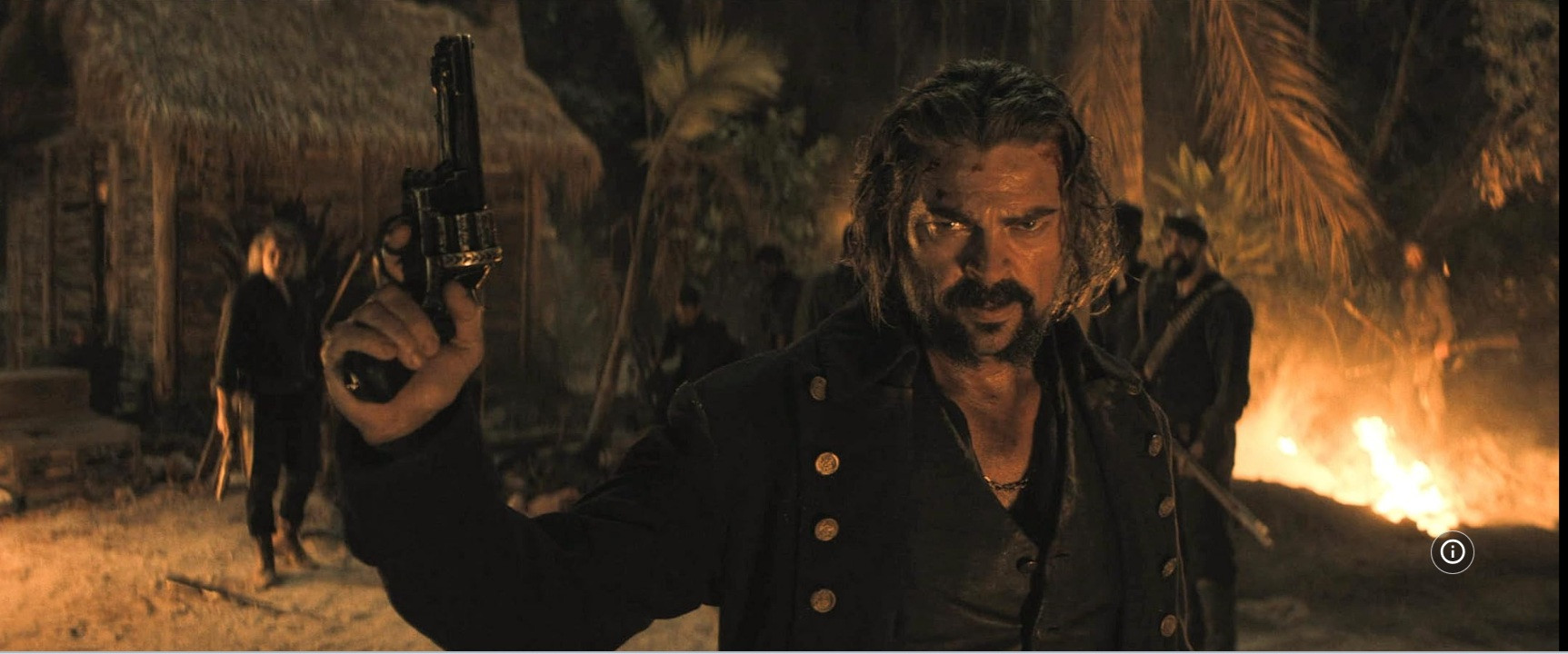
Ironically, the film’s most compelling element is its antagonist, portrayed by Karl Urban. Urban brings a certain intensity and charisma to his role, elevating scenes that might otherwise have fallen flat. His presence provides brief moments of engagement, offering a glimpse of what the film could have been with a more cohesive cast and stronger character development. Yet even his performance cannot fully compensate for the film’s overarching shortcomings.
There is zero chemistry between Karl Urban and Chopra -- Jonas, which is one of the reasons why the project falls flat. Unfortunately, the supporting cast also does little to enhance the narrative. Aside from the two leads, the film lacks performances that are recognisable or impactful, which could have added depth and texture to the story.

In a genre that thrives on ensemble dynamics, this absence is particularly noticeable. Strong supporting characters often serve as the backbone of such films, grounding the narrative and making the protagonist’s journey more believable. Here, they feel more like placeholders than fully realised individuals. You might recognise a couple of actors from their previous work but that’s it. The connection these characters should have had with the audience in the 103-minute flick isn’t there.
The film’s script, penned by Joe Ballarini and directed by Frank E. Flowers, emerges as its weakest link. The narrative lacks coherence, with plot points that seem underdeveloped and, at times, outright implausible. It often feels as though the story was rushed from concept to screen without undergoing the rigorous refinement necessary for a project of this scale.
Attempting to tap into the enduring appeal of pirate adventures, the filmmakers appear to have aimed for the same audience that flocked to grand spectacles like Pirates of the Caribbean. However, the decision to release the film on a streaming platform raises questions about its intended impact. In an era where viewers have access to a vast library of content at their fingertips, a film needs to offer something truly distinctive to stand out. Unfortunately, The Bluff offers little that audiences haven’t already seen—and done better—elsewhere.
There are moments when the film ventures into almost fantastical territory, with Mariam displaying skills and ingenuity that stretch the limits of believability. Was she a pirate or was she someone who was a predecessor to MacGyver who came in the 1980s, that’s one of the many questions that arise in the audience’s minds. Be it the scene where she concocts weapons from everyday items, is exactly what Richard Dean Anderson’s legendary character was known for, and had it not been a period film, that could have been acceptable. However, since the film is set in the 1800s, the MacGyverisms contribute to an overall sense of inconsistency. The film begins to resemble a hybrid of historical drama and modern action fantasy, without fully committing to either.
Visually, the film does manage to deliver in parts. The action sequences are competently staged, and the production design shows a certain polish that reflects the film’s budget. However, spectacle alone cannot sustain a film, especially when it lacks a compelling narrative or engaging characters. The action, while well-executed, feels repetitive and lacks the emotional stakes needed to truly resonate with the audience.
The musical score by Henry Jackman is another missed opportunity. In swashbuckling adventures, music plays a crucial role in enhancing the sense of grandeur and excitement. Memorable scores have historically elevated films within the genre, sometimes becoming as iconic as the films themselves. I still remember going to watch Aamir Khan and Amitabh Bachchan's Thugs of Hindostan three times, twice because of the fabulous background score. Here, however, the music fails to leave a lasting impression, blending into the background rather than amplifying the drama unfolding on screen.
It is also worth noting the broader context of Chopra-Jonas’s career trajectory. From Baywatch to The Matrix Resurrections and Heads of State, she has consistently secured roles in high-profile projects. Yet, despite these opportunities, there remains a sense that Chopra-Jonas has yet to deliver a performance that truly defines her Hollywood career. In an industry where longevity is often determined by a combination of talent, timing, and project selection, this pattern raises important questions about the choices being made.
Meanwhile, actors like Aishwarya Rai Bachchan, Dimple Kapadia, and Freida Pinto — all of whom also gained international recognition — have, in different ways, demonstrated a stronger alignment between their screen personas and the roles they undertake. This contrast only highlights the challenges Chopra-Jonas continues to face in finding projects that play to her strengths.
As for Karl Urban, his involvement in The Bluff remains puzzling. Known for his versatility and commanding presence, his talents seem underutilized in a role that does not fully exploit his capabilities. Those who have seen him in Star Trek films, as Judge Dredd in Dredd, or in The Boys, will find this role a step down for the marvelous actor known for his towering presence. Whether it was the allure of the project, the opportunity to explore a different genre, or professional associations that drew him in, the end result feels like a mismatch between actor and material.
Ultimately, The Bluff is a film that aspires to be more than it is. It aims for the excitement of a high-seas adventure, the emotional depth of a family drama, and the intensity of a revenge saga. However, in trying to juggle these elements, it loses sight of what makes each of them compelling. The result is a film that feels fragmented, lacking the cohesion needed to deliver a satisfying cinematic experience.
In the end, The Bluff lives up to its name—not as a clever play on narrative deception, but as a reflection of its own shortcomings. Despite its ambitious premise and the star power of Priyanka Chopra Jonas and Karl Urban, the film fails to leave a meaningful impact. It is a reminder that in cinema, no amount of star power can compensate for weak writing, inconsistent performances, and a lack of clear vision. For audiences seeking a memorable pirate adventure, this voyage may not be worth embarking on.
All facts and information are the sole responsibility of the writer.
Omair Alavi is a freelance contributor who writes about film, television, and popular culture