
It is the first weekend of 2026. The world wakes to a social-media post from Donald Trump, one year into his second term as president, claiming US forces have captured Venezuela’s Nicolás Maduro. A bold statement, delivered with the casual certainty of a post on Truth Social, it lands against a world already fraying at the edges.
Since Trump returned to the White House, the rules that once governed international power have been tested and bent. Laws meant to restrain leaders are applied selectively. Multilateral institutions struggle to assert influence. Meanwhile, wars that should have ended continue to cause death and destruction. In Gaza, a ceasefire the president called peace has collapsed repeatedly. In Ukraine, negotiations between Trump, Vladimir Putin and European capitals have yet to produce an end to the suffering that began in 2022. In Sudan, a brutal conflict continues, attracting far less international attention than its scale demands.
Accusations of war crimes hang over multiple leaders. Putin and Sudan’s Omar al-Bashir face international warrants and are treated as outlaws by the west. While Benjamin Netanyahu faces similar charges, he recently traveled freely over Italy and Greece to meet the US president at Mar-a-Lago, apparently without consequence.
The epitaph of 2025 is written not only in conflict and broken law. The world emerged from another UN climate summit in November that failed to commit to ending fossil fuels or even outline a credible plan to phase them out. Scientists report that 2025 was the hottest year on record, marked by unprecedented heatwaves and climate disasters. While leaders continue to dither and delay, nature is taking its own course, and none of us will escape its consequences.
The year ended with no relief in sight, and 2026 opens under the same shadow of unresolved crises—conflicts that refuse to end, leaders whose actions flout law, and a climate that grows ever more volatile. Experts say optimism is scarce, and nothing suggests relief is coming anytime soon.
Alongside wars and climate disasters, human rights face mounting pressure in 2026. Governments across the world, particularly in the global south, are leaning toward authoritarianism, tightening control over dissent and undermining democratic norms.
Amid a world of such encroachments and failing norms, Kenneth Roth argues that the demand for human rights remains strong. “People around the world continue to want their rights. No one wants to be executed or tortured, imprisoned for their political views, discriminated against, or deprived of housing, education, or healthcare. These are universal needs and desires.”
Roth cautions, however, that the system is under pressure. Authoritarian governments—China, Russia, Saudi Arabia, Egypt—and manipulated democracies such as Turkey, Hungary, and Pakistan are testing its limits. At the same time, Trump’s alignment with autocratic leaders reflects a broader pattern in which powerful states are emboldened to disregard democratic norms. “Yet, as mass protests in Iran and elsewhere show, people continue to demand democracy as the most reliable safeguard for their rights.”
Through it all, President Trump’s administration remains the single major unknown factor for 2026. Ashok Swain, a Sweden-based expert on international politics, conflict, and climate, argues that Trump’s election has further weakened the rules-based order by treating international norms as optional and transactional.
He adds that over the next three years, this approach is likely to reinforce a system in which power and loyalty matter more than law and consistency. Alliances, he notes, are pressured rather than strengthened -- institutions are used instrumentally, and multilateral cooperation is viewed with suspicion.
According to Swain, a professor of peace and conflict at Uppsala University, this dynamic encourages other states to follow suit, accelerating a global shift away from shared rules toward ad hoc deals, unilateral actions, and coercive diplomacy. Even when framed as strength or realism, he warns, the long-term effect is greater instability and less predictability.
Conflicts and illusion of peace
The conflict in Gaza dominated the headlines over the past twelve months. More than 71,000 Palestinians were killed during Israel’s military assault on the Strip, which began in 2023 following a Hamas-led attack. A momentary ceasefire was announced by Trump, accompanied by a number of Middle Eastern and Western leaders. Praise from figures including Pakistan’s Prime Minister was lavish, seemingly intended to flatter the president, but on the ground the reality remained grim: more than 400 were killed in Gaza since the ceasefire was announced in late October, and over 1,000 were injured. Independent estimates suggest Israel has violated the ceasefire more than 500 times over the past two months.
Swain warns that the war-torn Palestinian enclave is likely to enter 2026 trapped in a familiar cycle of death and destruction. He notes that ceasefires, while announced with political fanfare, often fail to alter the underlying dynamics of the conflict. “What was presented in 2025 as a functioning ceasefire increasingly resembled a temporary pause without protection, allowing violence to continue under a different name,” he notes. Without accountability, Swain adds, such arrangements only freeze the conflict while suffering deepens. He emphasizes that a genuine and lasting peace would require an enforced ceasefire with independent monitoring, unrestricted humanitarian access, an end to large-scale territorial control and forced displacement, and a political settlement that restores Palestinian self-determination rather than treating Palestinians as a permanent security problem. Without these measures, he cautions, reconstruction will remain a cycle of destruction and repair, with no horizon of dignity or safety.
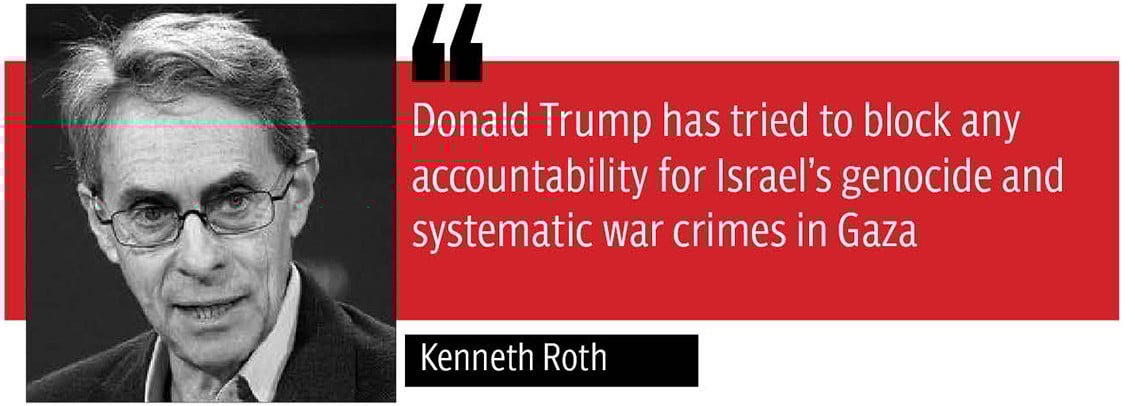
Roth observes that Trump has provided Israel with room to carry out atrocities without accountability. “The US president has attempted to block justice for alleged war crimes in Gaza, including by imposing sanctions on International Criminal Court prosecutors and judges.” Yet, he emphasizes, few governments have joined Trump in opposing accountability. Most ICC members, he explains, continue to back the court, and several governments supported South Africa’s genocide case against Israel before the International Court of Justice. “Strong condemnations have also come from the UN General Assembly and the UN Human Rights Council, though the UN Security Council has been blocked by the US veto.”
According to Roth, the broader global system remains resilient, as the vast majority of states continue to uphold norms, pursue accountability, and resist unilateral obstruction. That resilience appeared to be on display after Trump’s recent claim of attacking Caracas and taking Venezuela’s president into custody. Even a close ally such as the UK felt compelled to publicly distance itself, with Prime Minister Keir Starmer clarifying that Britain had no involvement in the operation.
When asked whether global responses, or inaction, have exposed the fragility of international law, Roth acknowledges that longstanding exceptions remain. He points to Israeli repression—its military actions in Gaza, apartheid policies across the occupied territories, and systematic repression of Palestinians—as a striking example where Western claims of promoting human rights have always been selective. At the same time, he notes, double standards persist elsewhere. “The European Union, for instance, largely overlooks severe repression in Egypt under President Sisi, motivated by his cooperation on migration control.”
In Gaza specifically, the former HRW executive director points out that the problem is not the ceasefire itself. Temporary pauses in fighting can be a necessary step toward a lasting peace, he notes. The real question is what comes after the ceasefire. “Trump’s abandoned vision for a “Gaza Riviera”—a Gaza without Palestinians—has been replaced with promises of reconstruction. Yet, other governments remain hesitant to contribute troops for stabilization or fund rebuilding efforts while the occupation continues. They insist on a pathway toward Palestinian statehood, a demand Israel refuses to meet.” Roth points out that this creates a tension: “although Trump’s peace plan references Palestinian self-determination, it is unclear whether he will apply sufficient pressure on Israel to turn those words into action.”
Elsewhere, the picture is no less complicated. In Ukraine, now approaching its fourth year of conflict, Trump’s approach has whiplashed traditional alliances, favoring a more conciliatory stance toward Vladimir Putin, who had been treated as a pariah by previous US administrations. The former HRW executive director notes that Trump initially sought to push Ukraine into accepting Putin’s maximalist demands—a move that would have left its democracy highly vulnerable to further Russian aggression. The former HRW executive director notes that the US president has not yet enforced the “severe consequences” he had promised for Russian intransigence.
In Sudan and eastern Congo, according to Roth, Trump was initially reluctant to publicly name the main perpetrators. “Only recently has his administration acknowledged Rwanda as the invading force in eastern Congo, and it continues to allude to—without explicitly naming—the United Arab Emirates’ role in arming Sudan’s genocidal Rapid Support Forces.” The former HRW executive director points out that these conflicts will not end without sustained international pressure on both Rwanda and the UAE.
The erosion and selective application of international law adds another layer to the crisis, Swain explains. The Sweden-based expert points out that inconsistent enforcement will make resolving ongoing conflicts even harder. When violations of international law continue unchecked and Western governments shield allies like Israel from consequences, he notes, the legal order does not collapse suddenly—it erodes quietly through hypocrisy. Law increasingly appears as a tool applied to adversaries while close partners enjoy exceptions. Swain warns that this encourages other states to ignore rulings they dislike, weakens international institutions, and reduces human rights to rhetoric rather than obligation. He emphasizes that reversing this trajectory will require consistent enforcement of the law, including against allies, with real consequences tied to arms transfers, sanctions, and diplomatic relations.
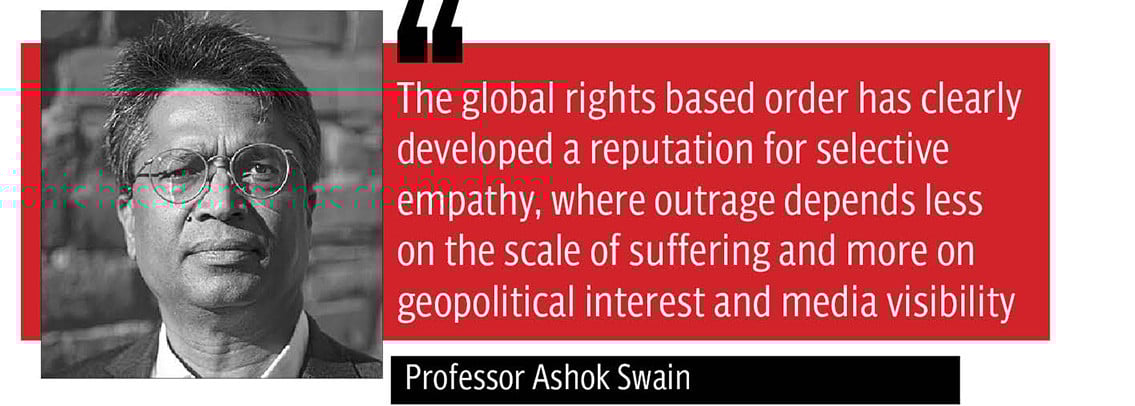
Sudan, the academic adds, illustrates the consequences of selective international attention. As the conflict dragged through 2025 with minimal sustained focus, mass displacement, famine, and systematic violence became normalized. By 2026, Swain warns, this neglect risks locking Sudan into prolonged state collapse with serious regional repercussions. He points out that the global rights-based order has developed a reputation for selective empathy, where outrage depends less on the scale of suffering and more on geopolitical interest and media visibility. Such selectivity, he argues, sends a dangerous signal: some lives appear to matter less than others, and extreme violence can continue with impunity when it occurs outside the spotlight.
The climate conundrum
The global environmental crisis accelerated sharply in 2025, with no shortage of climate-related tragedies and human suffering. Extreme weather events struck with alarming intensity, from deadly typhoons in the Philippines and Indonesia to devastating floods and heatwaves across India, Pakistan, Bangladesh, and Mexico. Record-breaking rainfall triggered landslides and mass displacements, while prolonged droughts worsened water scarcity and agricultural losses. Scientists confirmed that 2025 was the hottest year on record, breaking previous temperature highs and intensifying disasters tied to climate and ecological disruption. The relentless impact of human-driven emissions and environmental degradation has made it clear that nature’s wrath is impartial—no region, rich or poor, is immune.
Despite mounting evidence, global climate and environmental diplomacy once again fell short. The UN climate conference in Brazil toward the end of the year offered little more than lip service. Negotiations on emissions reductions, fossil fuel phase-outs, and broader environmental safeguards remained stuck in rhetoric, with delegates struggling to achieve meaningful commitments. Current trajectories suggest the world could exceed 2°C of warming between 2030 and 2050, with cascading consequences: severe food insecurity, intensified natural disasters, displacement, and threats to human survival and social stability.
Swain, who has recently authored a book on climate and conflict, points out that the summit failed to match the scale of the crisis. He notes that it “offered incremental progress while avoiding hard decisions on fossil fuels.” The Sweden-based expert cautions that the world is heading toward more extreme heat, floods, food insecurity, and climate-driven displacement, yet environmental crises continue to be treated politically as future problems rather than urgent realities. He adds that one of the greatest dangers lies not only in rising temperatures but in the political response: securitized borders, abandonment of vulnerable populations, and authoritarian measures justified in the name of stability.
For Swain, what will determine whether 2026 marks a turning point is decisive action rather than new promises. “Rapid fossil fuel reduction, massive investment in clean energy and adaptation, real climate finance delivered now, and a just transition that protects livelihoods—these are the measures that can align policy with reality. Without them, climate and environmental responses will continue to lag behind the urgency of the crisis, with profound consequences for humanity,” he concludes.
Neglect, trends, and looking ahead
While headlines often focused on conflicts and crises, several of last year’s most consequential human rights violations, Roth points out, went largely unnoticed.
“In Africa, the UAE-backed Rapid Support Forces continue to carry out out a genocide in Sudan, while the Rwandan-supported M23 inflicted slaughter and sexual violence in eastern Democratic Republic of Congo. Beyond the continent, China’s systematic persecution of Uyghur Muslims in Xinjiang continued unabated.” These atrocities, Roth notes, expose the depth of human suffering that too often escapes sustained international attention.
The former HRW executive director stresses that last year was less a rupture in the global order than an acceleration of existing trends. While violations were widespread, they were widely condemned, and some steps toward accountability were taken. “When there is crime on the street, we don’t call it the end of criminal law unless the crime is officially authorized,” he observes. “The same principle applies to human rights: abuses were never legitimized, but the year reinforced the urgent need to strengthen global pressure on those responsible.”
For the months to come, Roth warns that media coverage alone is insufficient. Crises in Gaza, Ukraine, and increasingly Sudan are known to the world, but the crucial task is sustained pressure on the perpetrators—Israel, Russia, and the United Arab Emirates—to halt their atrocities. Some progress has begun, he notes, but the year ahead demands an intensification of international commitments, ensuring that the most abusive governments are compelled to curb their actions. “Without decisive enforcement, human rights risks remaining a principle rather than a practice, perpetually vulnerable to impunity and selective attention,” he concludes.