
The Bulletin of the Atomic Scientists will be meeting in the new year to decide how close to “midnight” we are at the present moment. This is going to be a much anticipated unveiling of the Doomsday Clock considering significant development this year. “Midnight” is in reference to the possibility for total annihilation of the human race.
“We’ll be making the Doomsday Clock announcement on January 27 on our website and YouTube channel,” Alexandra Bell, CEO of the Bulletin, told The Express Tribune by the phone.
The “Bulletin of the Atomic Scientists” is an organisation that was created at the end of World War II, by scientists who were involved in the Manhattan Project, as well as Albert Einstein. The Manhattan Project led to the invention of the first atomic bomb, beating the Nazis and the Soviets.
Following the war, however, struck by the unparalleled power of this technology that could wipe out the human race, these scientists introduced what is known as the “Doomsday Clock”. “The Doomsday Clock is set by the Bulletin's Science and Security Board. The board is made up of scientists and other experts with deep knowledge of nuclear technology and climate science, who often provide expert advice to governments and international agencies,” CEO Bell added. “They consult widely with their colleagues across a range of disciplines and also seek the views of the Bulletin’s Board of Sponsors, which includes eight Nobel Laureates.”
“They meet twice a year in person or more frequently online to discuss world events and reset the clock as necessary. They make that decision based on world events, trends, and numbers and statistics — looking, for example, at the number and kinds of nuclear weapons in the world, the parts per million of carbon dioxide in the atmosphere, the degree of acidity in our oceans, and the rate of sea level rise. The board also takes account of the pace of leaders’ and citizens’ efforts to reduce nuclear dangers, and the urgency of actions by governments, markets, and civil society organisations to reduce greenhouse gas emissions,” explained Bell, when asked how the Bulletin arrives at its decisions regarding the position of the clock.
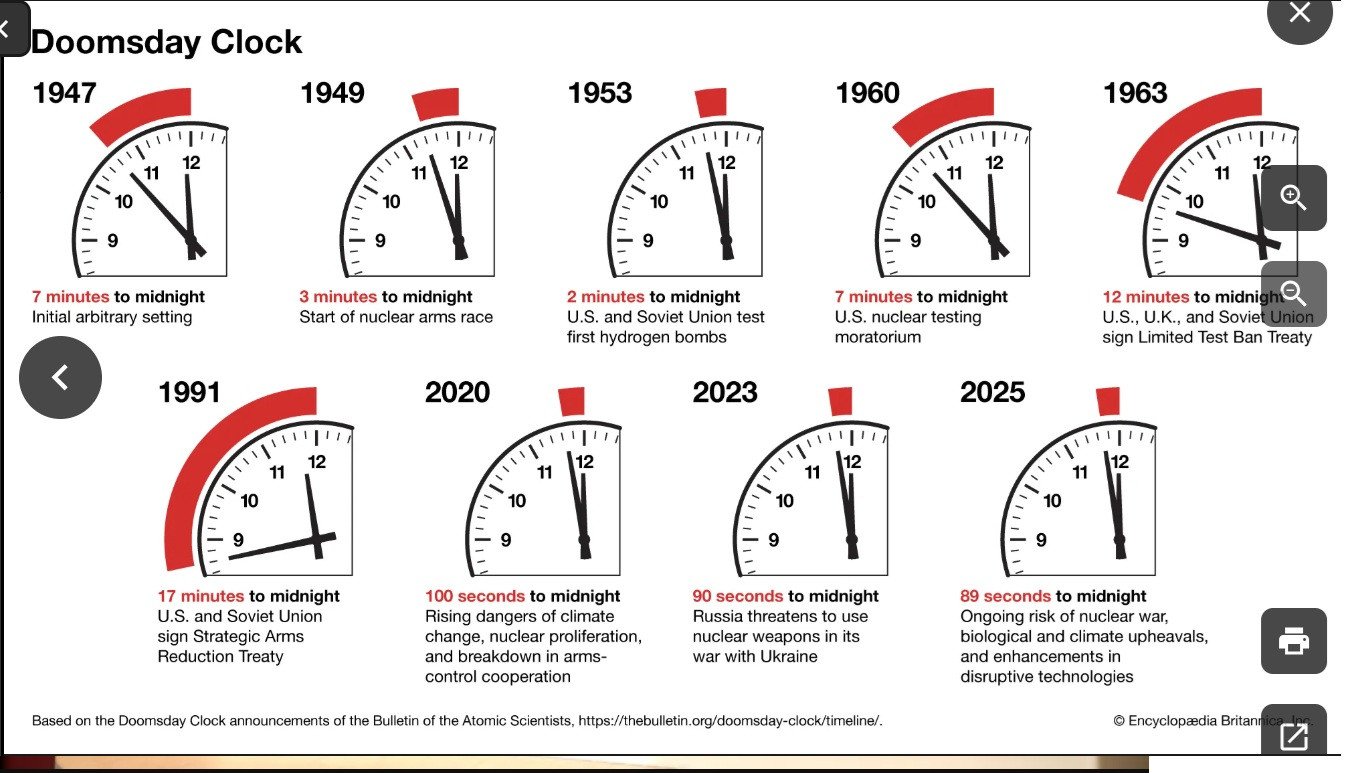
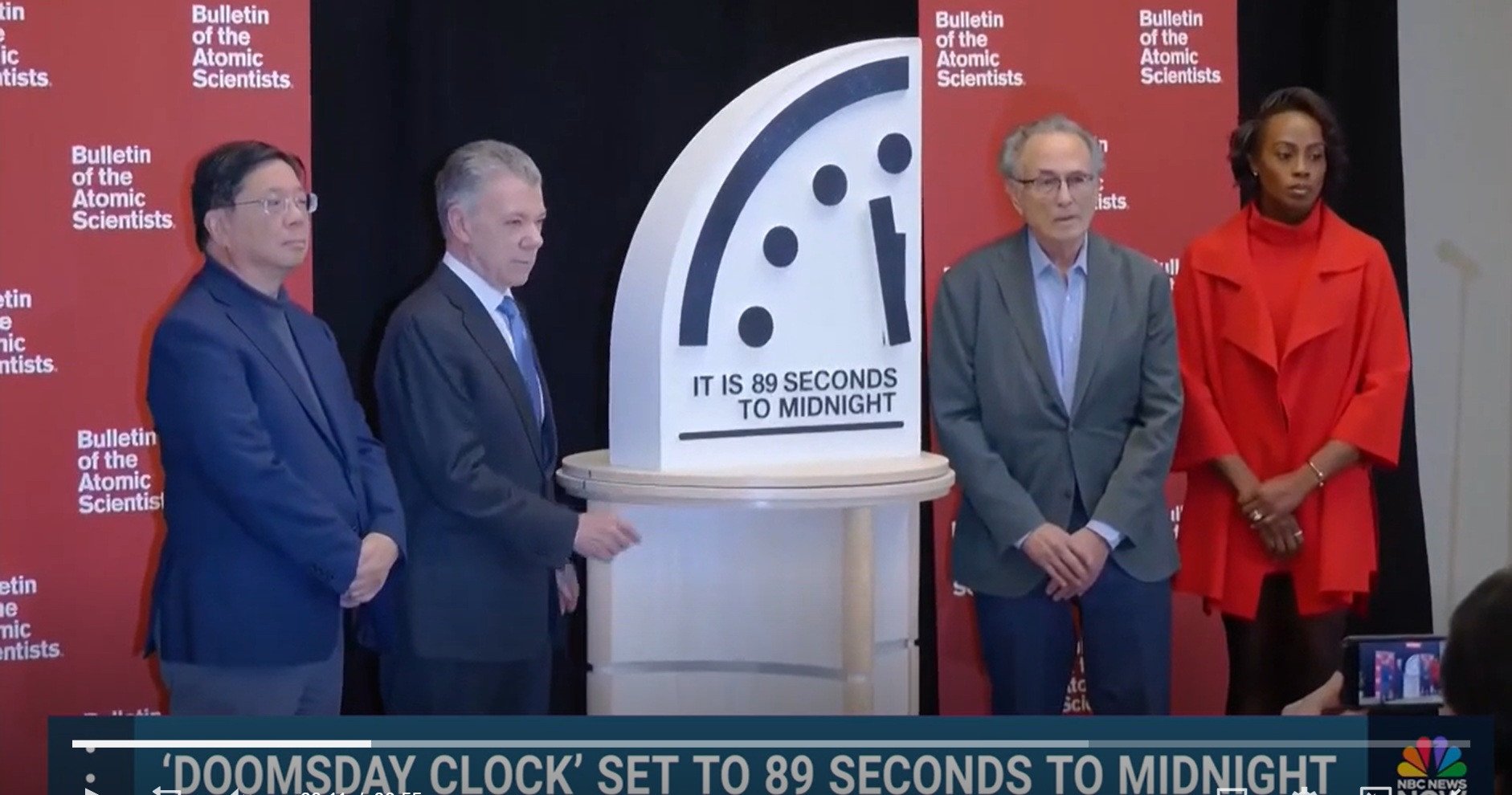
Of course, when they first introduced the Doomsday Clock in 1947, their main concern was the risk of nuclear annihilation. The world came close to annihilation during the "Cuban missile crisis” under Kennedy and Khrushchev. However, even then, the clock was placed at “7 minutes to midnight”. Today, the clock is placed at “89 seconds to midnight”. We should not be surprised if it goes below 1 minute in the New Year.
Their website further explains, “The Bulletin considered possible catastrophic disruptions from climate change in its hand-setting disruptions for the first time in 2007”.
There are two factors in the world today that could annihilate the human race: The climate crisis and the use of nuclear weapons, which is reflected on the organisation’s website.
Since the last unveiling of the much anticipated Doomsday Clock, which was in January of 2025, things have changed. Pakistan and India, two nuclear-powered states, got extremely close to a full blown war. Russia President Vladimir Putin had just made changes to the nuclear doctrine of his country before the most recent unveiling, and since then Donald Trump became US President again and set off a butterfly effect of chaos and unpredictability. On the other hand, according to reports, the Islamic Republic of Iran may now be out of the race for nuclear weapons.
Asked whether climate has surpassed the threat of nuclear proliferation, CEO Bell said, “Each of these threats has the potential to destroy civilisation or to render the Earth largely uninhabitable by human beings.”
According to Bell, “We can’t afford to address one threat without addressing the others, because they are all intertwined. Some advocate for more nuclear power to reduce carbon dioxide emissions, but increasing the number of nuclear reactors, and the amount of enriched uranium and plutonium required for their operation, could also increase the risk of nuclear proliferation. Likewise, as the climate changes, some natural resources, like fresh water, could become more scarce, leading to conflicts that might spiral into war and the possible use of nuclear weapons.”
Pakistani nuclear physicist Parvez Hoodbhoy put more flesh on the bones of the fear of nuclear proliferation. “A destabilising array of new weapon systems, both nuclear and non-nuclear (drones in particular), has emerged globally and are functional in India-Pakistan as well,” warned the scientist, who also sits on the Board of Sponsors of the Bulletin.
He is not very optimistic about the rationalistic view of geopolitics and human nature when it comes to these matters, stating that, “Where perceptions could make all the difference, it is stupid to assume the rational actor model – such as used in game theory applied to financial systems. Nuclear conflict situations could work by very different rules. Fear and aggression are factors that cannot be written into operating manuals. India and Pakistan are playing with fire and seem to be enjoying it”.
Sir David King, the former Chief Scientific Advisor to the UK government, said, “What we do in the next 3-4 years, I believe, will determine the future of humanity.” He provided the world with this warning three years ago. We are on the brink of crossing that timeframe if we haven’t already.
On the climate front, Canada got rid of the “consumer carbon tax”, which had been credited with reducing carbon emissions in the country, and plans on increasing oil and gas expansion. This is consistent with the theme of President Trump’s declaration, “drill baby drill”, although not consistent with the Canadian prime minister’s stated beliefs. Furthermore, it led to the resignation of Canada’s former environment minister, Steven Guilbault, from cabinet, who had been arrested multiple times for nonviolent civil disobedience in the past as part of Greenpeace — stating that “it is impossible to meet our 2030 targets”, referring to a legally binding emissions reduction target set by the house of commons in Canada, which will no longer be adhered to. This is significant due to Canada’s position as a major oil and gas producer, a G7 economy, and the highest per capita emitter in the G7.
The 30th Conference of the Parties (COP) was held in Belém, Brazil, this year, and is being reported as being a toothless COP. This is considering not only the absence of the world’s biggest economic power at the conference, but considering that the final deal failed to mention the phasing out of fossil fuels, and even the term “fossil fuels” itself.
The New York Times reported on December 20th, 2025, that “In late November and early December, rainfall was down by roughly 90 per cent”, adding the troubling detail that “Tehran is just the latest major city to be perilously close to Day Zero”. The article, which was taken on the front page of the New York Times listed Chennai, Sao Paulo, and Cape Town to be some of the other cities that came close to that level. We know that dams in Pakistan also came close to “dead levels” earlier this year. “Much of the Middle East, including Iran, is warming twice as fast as the global average”, warned the report on the front page of the New York Times.
In a major setback to the effort to rid the world of its nuclear weapons, the invasion of Ukraine by Russia, forces the question: Had Ukraine not given up the entirety of its nuclear arsenal in the Budapest treaty, would Russia have invaded Ukraine? Unfortunately, the answer is, probably not.
This simple fact may encourage other countries to not give up existing nuclear weapons and potentially even entice some countries to try and get some of their own.
As for the nuclear flashpoint between Pakistan and India, here’s what Professor Hoodbhoy suggests to the people of the two countries, “Sensible Indians and Pakistanis should demand that their governments negotiate issues, not bellow threats at each other because threats are consequential.”
This is because in the fog of war as it were, there can be miscommunication and confusion, leading to disastrous consequences as it nearly did during the Cuban missile crisis, when a Russian nuclear submarine almost launched a torpedo at an American ship, which could have triggered a world war. Hoodbhoy explains that, “Climate change needs a joint strategy based on cooperation, not conflict. Ultimately, both nations [Pakistan and India] must embrace their pluralistic identities; weaponising sectarianism for political gain is a path to self-destruction.”
The only question is whether cool heads can realistically prevail in the heat of armed conflict. “The Kargil, Pulwama, and Sindoor crises were successfully wound down. But luck eventually runs out,” warned Hoodbhoy.
In summary, when the clock was last unveiled, COP 30 had not ended in a hollow compromise, Pakistan and India had not come close to an all-out war, and Trump had only just become president, yet again. One wonders, how many times does one have to roll the dice before the undesired outcome becomes inevitable?
CEO Bell provides us with a much-needed reminder, “At the end of the day, trying to answer the question of which threat is worse is like standing around in a burning house arguing about the most likely manner of death." Often, we can get lost in intellectualising these existential threats, such that many political parties use these excuses as fronts for other ideological agendas, seemingly forgetting the existential nature of the threat. This is true for much of the politics of the Left universally.
When asked whether the Bulletin has been successful in achieving its mission and purpose since its founding in 1945 she explains, “The first appearance of the Doomsday Clock was in June 1947 and it's now a globally recognised symbol of the risks we collectively face from nuclear weapons, climate change, and disruptive technology.”
Tim Takaro is an American-Canadian professor emeritus at the Simon Fraser University and a public health physician focused on the impact of climate change — who spent some time in jail as a fellow activist for his nonviolent civil disobedience, had this to say, “Conventional conflicts continue to rage in several regions where adversaries possess nuclear weapons, while the most powerful and bellicose leader in the world spreads a web of lies that raises risk to unprecedented levels. Civil society needs to take control of these false narratives to avert disasters before we reach midnight.”
Given that we seem to be moving closer towards annihilation, it will be for people and history to decide whether the clock simply showed us the time before our execution or if it succeeded in motivating us to take action and defend ourselves. History tells us that large scale systemic change does not occur in universities.
The author is a freelance writer. All facts and information are the sole responsibility of the writer.