
The last two decades have transformed the ecology of literary culture worldwide, but perhaps nowhere more dramatically than in the geographically dispersed world of Urdu letters. Social media, with its open gates and restless churn, has become both an agora and an anteroom, a performance space and a rehearsal hall. In this environment, Urdu literature finds itself simultaneously liberated and unsettled, connected and scattered, amplified and diluted. What once required institutional mediation is now launched, edited, critiqued, and canonised — sometimes haphazardly — through platforms designed for speed rather than reflection. And yet, despite persistent anxieties about the waning authority of gatekeepers, something unprecedented has occurred: Urdu literature has become a truly global, participatory sphere in real time.
Social media has opened unprecedented permeability among Urdu writers and readers across borders, collapsing old hierarchies of access and enabling instant exchanges of drafts, discussions and instruction. Yet this democratisation comes with contradictions: the absence of editorial filtration has produced an overflow of unpolished work, hurried judgment, and derivative writing, often drowned out by the noise of unmoderated commentary. Still, amid this volatility, serious efforts have emerged to reclaim digital space for rigorous pedagogy and thoughtful engagement: experiments that show the breadth of possibilities in this new literary landscape. The landscape is wide, and its most ambitious initiatives deserve careful attention.
Halqa-e-Arbab-e-Zauq
In the wake of Covid, when public gatherings were banned, Halqa-e-Arbab-e-Zauq Lahore — the country’s revered and time-honoured literary organisation, led then by Secretary Hammad Niazi and Joint Secretary Farah Rizvi — moved its weekly sessions online via WhatsApp. This enforced change of medium proved a blessing in disguise. Where its physical meetings were limited to Lahore-based participants, the online sessions opened the floor to contributors from other cities and even other countries, transforming the Halqa into a global platform. Writers and enthusiasts from outside Lahore and Pakistan could not only attend but, in some cases, present their work for critique. Other branches of the Halqa, such as those in Karachi and Islamabad, adopted similar arrangements — though not always at the same scale. The Halqa has since returned to physical meetings, but it retains the technical capacity for dual sessions, both offline and via WhatsApp, whenever a particular programme requires wider outreach.
Hashiya
In the early years of Facebook, around 2011, Pakistan witnessed the emergence of Hashiya, a remarkably potent and serious group devoted to the nazm, the poem distinct from the ghazal. Initiated by novelist and broadcaster Zef Syed, the group drew its real vitality from the active involvement of its executive members, notably poet Ali Muhammad Farshi and fiction writer Muhammad Hameed Shahid. Membership was deliberately selective, limited to major poets of the nazm as well as established critics, fiction writers and prose stylists.
Hashiya operated with a discipline unusual for early social-media groups. Its sessions followed the format of classical critical gatherings reminiscent of Halqa-e-Arbab-e-Zauq: each sitting was presided over by a senior writer, introduced by a member who presented a selected poem accompanied by a substantial critical essay — sometimes even exceeding four thousand words. The poem and the analysis then opened into an extended, in-depth discussion by the group’s members. The sessions had no rigid periodicity but often continued intensively for up to two weeks. Hashiya remained active until 2013, leaving behind a brief but influential legacy of rigorous criticism and a renewed seriousness around the nazm within the digital sphere.
Inhiraaf
Among the most striking examples of these ambitious, well-constructed literary initiatives on social media is Inhiraaf, an Islamabad-based collective that has grown into one of the largest digital communities for Urdu literature. What distinguishes it is not grand claims but a disciplined attentiveness to younger writers bewildered by the “plethora of information” on social media and the absence of reliable guidance. Many were students of the sciences or other non-literary fields, aspiring to write but unsure of how to enter the tradition. Inhiraaf created not merely a space for visibility, but a comprehensive training system.
Its weekly “training mushaira” became an unexpected pedagogical device. Participants were given a single line — often from a classical poet or a respected contemporary — and asked to compose a ghazal following that metre and other technical patterns. The exercise revived an older discipline: imitation as apprenticeship, structure as initiation. The thematic mushairas extended this logic, sometimes running for fifteen hours at a stretch. The group’s seven-day programme on the prose poem attested to the seriousness with which it approached experimentation within form. Remarkably, Inhiraaf has remained active without interruption since its inception — a rarity in a landscape where enthusiasm frequently outpaces persistence. Much of the credit belongs to poet Rehman Hafeez and his team, who treat administration as a literary vocation.
Khalid Moin and the multimedia turn
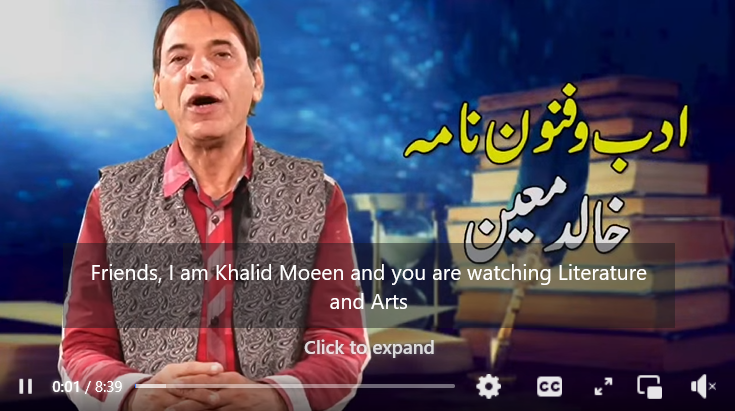
If Inhiraaf resembles a digital academy, poet and journalist Khalid Moin from Karachi offers something closer to a multimedia periodical. His vlog Adab aur Funoon Nama, launched during the social isolation of the Covid years, extends the literary conversation into a broader cultural frame: interviews, commentary on artistic events, and surveys. A recent feature asking women poets how their marital lives affected their artistic development was emblematic of Moin’s interest in candid, often neglected dimensions of literary experience. His style is lively without surrendering intellectual seriousness: a difficult equilibrium in the visual economies of Facebook.
Idara-e-Urdu: Structured inquiry in an unstructured world
In Islamabad, poet, critic, and university teacher Abid Sial has shaped Idara-e-Urdu into a forum devoted to thoughtful, structured literary dialogue. Each session centres on a single, carefully framed question posed to a guest, encouraging reflective exposition rather than debate. For students of Urdu literature and younger aspirants, these conversations offer an important orientation to the major questions shaping contemporary literary thought.
Nazm foundation
Young poet Salman Sarwat has approached the digital space with a different strategy: grounding the conversation not in raw participation but in curated seriousness. His Nazm Foundation centres the Urdu poem — the nazm — particularly in its modernist configurations. Events are hosted physically at the Karachi Arts Council, recorded, and then circulated through WhatsApp and Facebook. The echo chamber here is productive: a local literary event becomes a transnational conversation.
Inspired by this approach, Arshad Meraj and Gull E Zahra Kazmi launched Odyssey: The World of Poem, further extending discussions of the nazm into specialised, form-conscious corridors.
Fiction in the age of WhatsApp
The short story has found its own quietly robust digital life. Bazm-e-Afsana, operated through WhatsApp from India, functions as an interactive literary magazine for Urdu fiction. With nearly four hundred members, including senior writers such as Zakia Mashhadi, Tariq Chhatari, Syed Muhammad Ashraf, Abdus Samad, and Ghazanfar, it circulates old and new stories, followed by informed discussion. The format is informal, but the engagement is rigorous
The literature of distance
The Urdu diaspora has long maintained enclaves of literary activity; however, social media has drawn these communities into greater visibility. In the UK, poet Gulnaz Kausar launched Birmingham Poets as a dual-presence group operating on WhatsApp for local participants and on Facebook for the wider Urdu world, creating a vibrant space for interaction across distances.
The Urdu Academy of North America, established in 2000 by Tashie Zaheer in California and later expanded to include a chapter in Phoenix, Arizona, represents one of the continent’s earliest organised attempts to nurture Urdu literary culture abroad. Its monthly Mehfil-e-Sher-o-Sukhan, held on the third Sunday of each month, originally centred on classical poets—from Quli Qutub Shah onward—and later, poets of the twentieth century were also included in parallel. The format combined an introductory yet comprehensive critical paper with recitations or musical renderings of the selected poet’s work. With the advent of social media, the Academy began recording and sharing these sessions on YouTube and other platforms, thereby extending its reach far beyond its immediate local community. It now maintains its own website as a digital repository of its activities.
North America has since witnessed the rise of additional groups such as the Literary Forum of North America, a bilingual Urdu-English forum run by poets Rizwan Ali and Abid Raza, which also now confers an annual award on individuals who have made notable contributions to Urdu literature through social media
.Prosody in the digital age
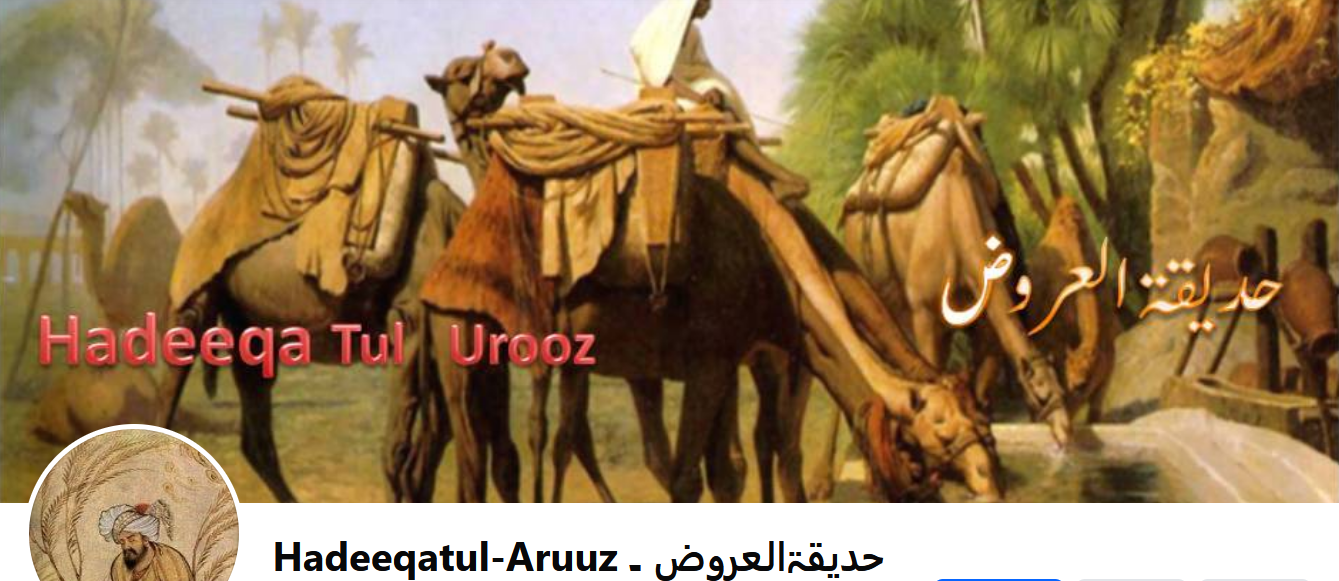
The pedagogical impulse appears again in the page Hadeeqatul-Aruuz, created by Jameel Ur-Rahman, a UK-based poet and critic, where he offers systematic lessons in Urdu prosody. In a literary ecosystem where formal instruction is often unavailable or uneven, such initiatives provide valuable scaffolding. The page remains on Facebook, though it has been inactive for some time.
Rekhta foundation
As the largest digital archive and promotional platform for Urdu language and literature, Rekhta’s most significant contribution to the Urdu universe now lies in its mastery of social media. Its presence across Facebook, Instagram, X, and YouTube has made it the central conduit through which a new generation encounters Urdu poetry and literary history. By posting couplets in clean visual formats, offering short biographical capsules, and releasing brief explanatory videos and recitations, Rekhta has turned fragmented scrolling habits into moments of literary engagement.
It has also imposed a rare discipline on the digital sphere. In an online environment rife with misattribution and casual invention, Rekhta’s verified content, corrections, and searchable resources have become the default reference point. Its transliteration tools and dictionary entries circulate widely, quietly shaping standards of accuracy and presentation.
A future of deliberate community
The transformation brought by social media is neither a calamity nor a triumph, but a reshaping of how literary communities inhabit their new spaces. The initiatives outlined above reveal the range of possibilities emerging across this digital landscape.
The task now is not to regulate this multiplicity but to cultivate discernment within it. Social media has opened the gates; what remains is to carve out spaces where attentive reading, careful writing, and substantive conversation can survive the surrounding noise.
If the initiatives surveyed here are any indication, the Urdu literary world is responding with ingenuity, seriousness, and a certain stubborn optimism. And perhaps that is the true promise of this moment: not that every voice finds an audience, but that the republic of letters, long confined to editorial chambers and literary cafés, has begun to rediscover itself in the crowded, erratic, exhilarating marketplace of the digital age.
The writer is a Pakistan-born and Austria-based poet in Urdu and English. He teaches South Asian literature and culture at Vienna University
All facts and information are the sole responsibility of the writer