
The National Security Strategy (NSS) released by the White House last month signals the most sweeping ideological shift in decades. While redefining the US foreign policy, the 33-page document lays out a new ‘America First’ doctrine that the Donald Trump administration argues will pragmatically reshape America’s role in the world.
The new strategy makes “Making America Great Again” (MAGA) the explicit compass for US foreign policy, spelling out an unapologetically nationalist vision that rejects the globalist assumptions guiding American policy since the Cold War. It calls for shutting the door on mass migration, rebuilding US industrial power, demanding far greater burden-sharing from allies, and reasserting US dominance in the Western Hemisphere — while avoiding the costly entanglements that have shaped American strategy since the 1990s.
Required by law, the NSS is a document that typically outlines an administration’s view on geopolitics. The White House presented its version of the strategic manual as an attempt to reverse “decades of misguided foreign policy” that left the US vulnerable abroad and polarised at home.
Experts tracking shifts in Washington’s strategic playbook hold differing views on the Trump administration’s latest move. While some see it as a sea change, others view it as consistent with Trump’s ‘America First’ vision.
Historic break from the past
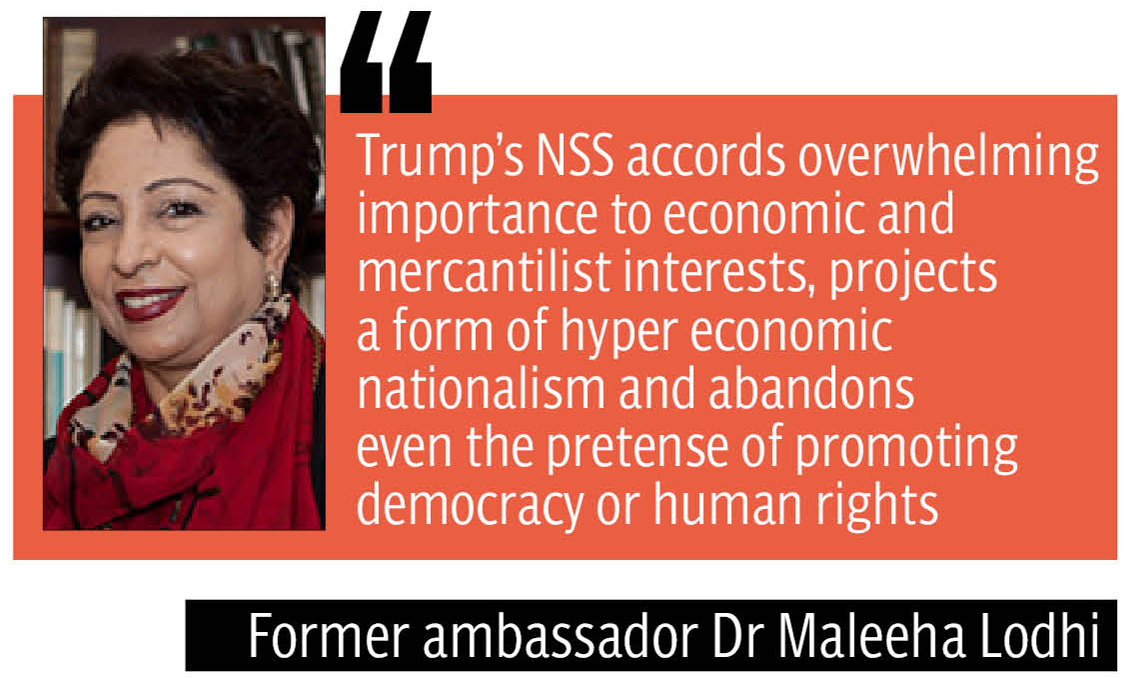
Former ambassador and political scientist Dr Maleeha Lodhi calls it a historic break from the past. “It lays bare Trump’s transactional, coercive and unilateral view of how America should engage with the world. It upends longstanding US foreign policy and previous national security priorities, setting a dramatically new direction,” she tells The Express Tribune.
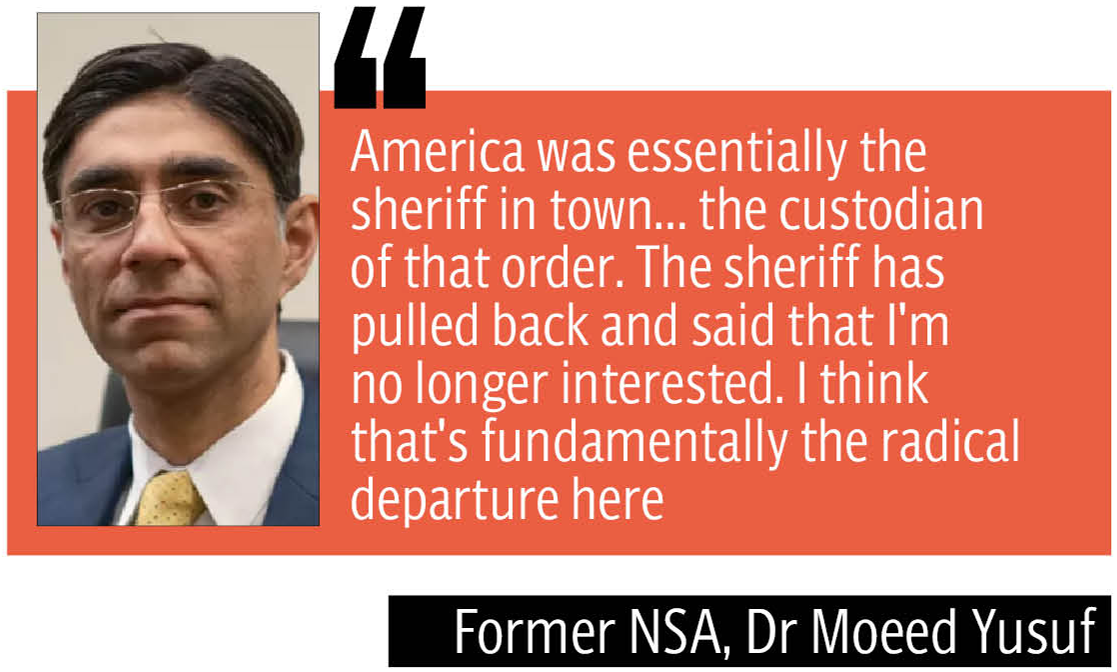
Former national security adviser Dr Moeed Yusuf offers a different interpretation, arguing that the strategy is not a radical departure. He notes that the United States has often prioritised the Western Hemisphere — from the Monroe Doctrine to later administrations — without being truly isolationist.
“What is radical is that it is abruptly moving away from the post-World War II liberal international order. America was essentially the sheriff in town… the custodian of that order. The sheriff has pulled back and said that I'm no longer interested. I think that's fundamentally the radical departure here,” says Dr Yusuf.
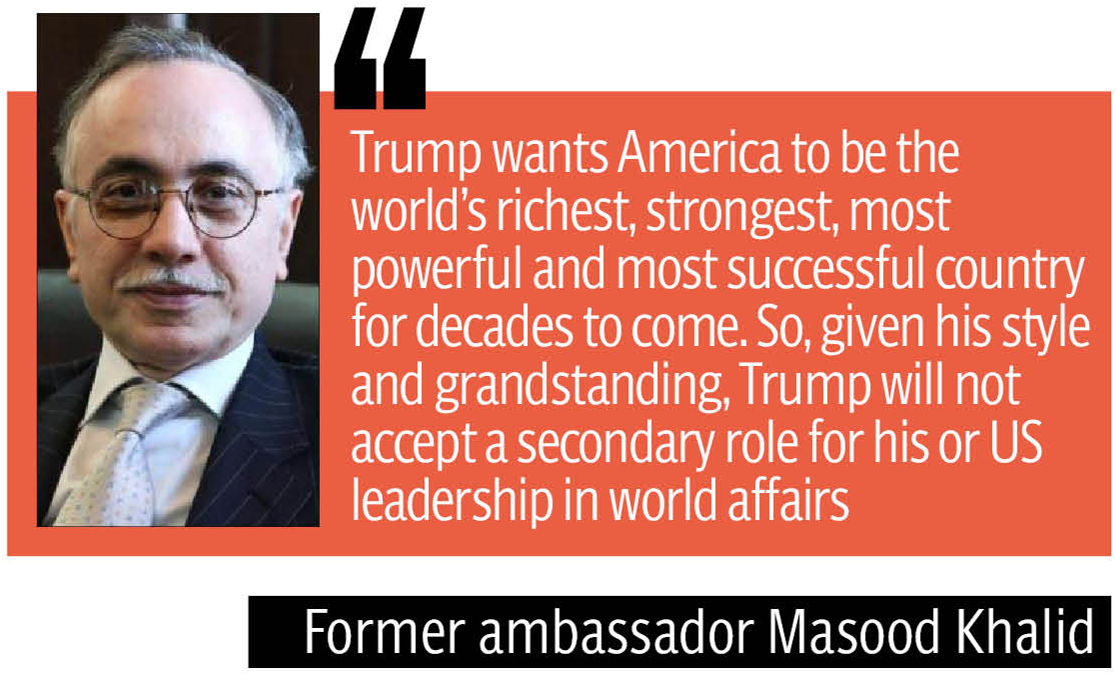
Career diplomat Masood Khalid views the new strategy as being consistent with the broader MAGA vision. “The NSS declares that not every country, region, issue or cause can be the focus of American strategy,” he says. “The new strategy is highly critical of the previous elite and the administrations for miscalculating America’s willingness to shoulder a global burden not connected with US national interest.”
The NSS 2025 casts Trump as a “President of Peace,” citing negotiated de-escalations in global flashpoints — from India-Pakistan tensions to Middle East standoffs — while asserting that peace is possible only through overwhelming American strength and a refusal to bend to what it calls the ideological pressures of global institutions. Those institutions, the strategy warns, have eroded US sovereignty.
The previous security assessment, released under President Joe Biden, sought to maintain America's global dominance, stressing the containment of competitors’ rise through fortifying alliances and bloc politics, maintaining a forward presence in key global regions, thus continuing the post-Cold War “global intervention” security model.
Trump’s version, however, signals a significant shift in strategic focus. It overturns the previous approach, explicitly abandoning the concept of global dominance and arguing that “the affairs of other countries are only relevant to us when their actions directly threaten US interests.”
“The NSS 2025 marks a retreat from the kind of global leadership it [the US] sought to exercise in the past and instead engages with the world on a framing of narrower interests,” says ambassador Lodhi, who has served in the US, the UK and the UN. “It says plainly that ‘the US will no longer be Atlas propping up the world and instead it will ruthlessly prioritise’.”
Mushahid Hussain, former chair of the Senate Foreign Relations Committee, highlights three underlying but unstated premises of Trump’s NSS, which he believes are a welcome change from the ideologically-driven, security-centric, military-minded approach of the past.
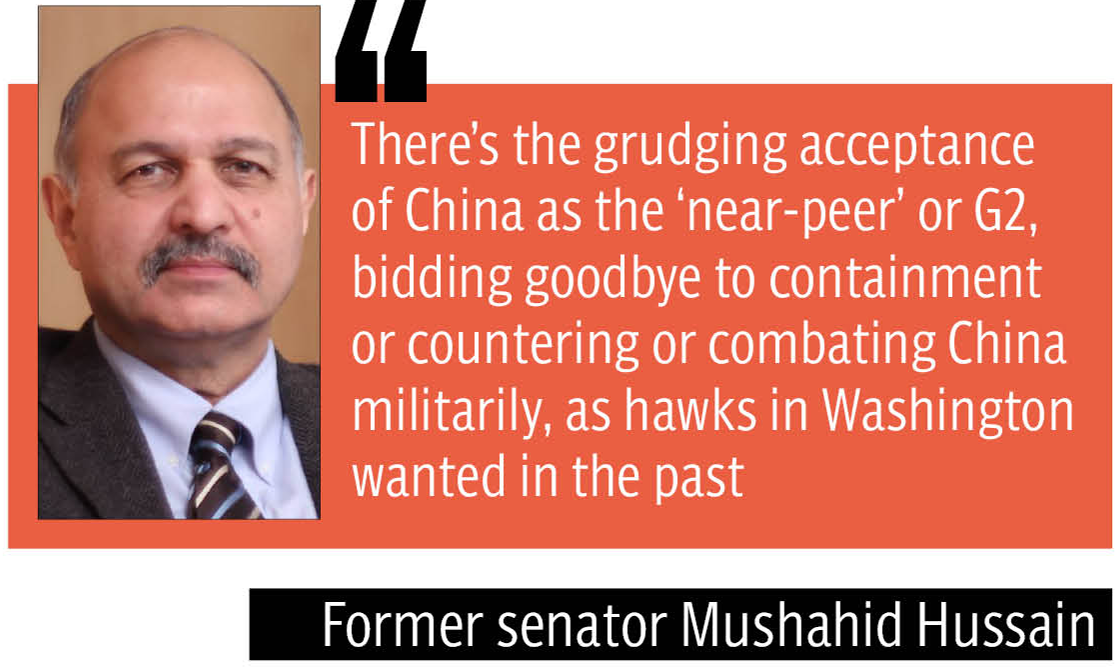
“First, the US is no longer the preponderant ‘sole superpower’ as we now live in a multipolar world. Second, there’s the grudging acceptance of China as the ‘near-peer’ or G2, bidding goodbye to containment or countering or combating China militarily, as hawks in Washington wanted in the past. Third, there’s this realistic focus that drivers for primacy in the future would be essentially non-military,” says Mushahid.
However, ambassador Masood doesn’t think Washington is willing to cede ground. “Trump wants America to be the world’s richest, strongest, most powerful and most successful country for decades to come. So, given his style and grandstanding, Trump will not accept a secondary role for his or US leadership in world affairs. It is a different thing that the interplay of competing interests and contradictory positions may see a lesser acceptance of US leadership.”
At the heart of the new strategy is a desire to cut Washington’s dependence on foreign manufacturing, minerals, energy, and supply chains, a reliance it blames for weakening the middle class and increasing exposure to geopolitical pressure. The approach mirrors Trump’s election pledges on tariffs, trade deficits, and reindustrialisation.
“It accords overwhelming importance to economic and mercantilist interests, projects a form of hyper economic nationalism and abandons even the pretense of promoting democracy or human rights,” says Dr Lodhi. “It turns America’s back on free trade that is already evidenced by Trump’s tariff policies and the trade war he has unleashed on the world.”
The strategy pledges to “win the economic future” by cementing US leadership in artificial intelligence, biotechnology, quantum computing, and autonomous defence systems. “There’s this realistic focus that drivers for primacy in the future would be essentially non-military: economy, energy, hi-tech, science and soft power, areas where the US can rightly claim an edge over China and Russia,” says Mushahid.
Since his return to the White House, President Trump announced sweeping “reciprocal” tariffs on friends and foes alike. America’s most trading partners buckled under pressure and agreed to “unfair” deals, but China retaliated against the “coercion”, sparking a grueling trade war between the world’s two largest economies and raising concerns over a potential decoupling.
Masood, Pakistan’s longest-serving ambassador in China, believes decoupling is not possible. “The US and Chinese economies are closely intertwined. Together they contribute roughly 50% to global growth. It is not easy to divert from the global supply chains heavily dependent on China. Neither is it possible to manage US industrialisation,” he adds. “So punitive measures against China may happen from time to time to extract concessions, but a delinking of their economies is a remote prospect.”
China — a ‘near peer’
For decades, Washington positioned Beijing as the “most significant geopolitical challenge” and the “primary threat,” calling for a comprehensive containment and confrontation strategy in the military, technological, and economic fields, stymieing China's progress through exclusive alliances, technological blockades, and tariffs.
The NSS 2025 criticises past engagement with China as “a three-decade mistake,” shifting the main axis of America’s policy to “winning the economic future and preventing military confrontation.” Masood points to this sharp shift in both policy and rhetoric.
“The US accepts the reality of China as a near peer. Trump would attempt to have a rebalanced trade relationship with China without seeking a direct confrontation although some tough language has been used on Taiwan and South China Sea,” he says. “The US knows the risks of a military confrontation with China, so the US may try to contain China in trade and technology domains and by maintaining pressure in the Western Pacific while avoiding frontal clash.”
The NSS adopts a visibly more conciliatory tone toward competitors, especially when compared to America’s traditional China policy. It accepts the “the outsized influence of larger, richer, and stronger nations” as “a timeless truth of international relations,” and rejects the “ill-fated concept” of global domination. “China is seen as an economic competitor, not an adversary or military rival as the Biden and previous national security strategies did,” says Dr Lodhi
Europe – ‘on brink of civilisational erasure’
The NSS 2025 also delivers a grim diagnosis of Europe, an even grimmer prognosis: declining confidence, demographic challenges, overregulation, and political fragility are pushing the continent towards “civilisational erasure”. The document reiterates many themes from Vice President JD Vance’s speech at the Munich Security Conference, in which he censured European states not only for their weakness on defence but also for yielding to the pressures of mass migration.
“I think Europe will not be happy reading this National Security Strategy document… the view is that the Europeans have been free riding, though President Trump is not the first one; multiple US presidents have in the past asked Europe to up their spending,” says Dr Yusuf, who is currently vice chancellor of the Beaconhouse National University. “For globalists, especially those who have relied on transnational partnerships to uphold the liberal international order, this will be a shock.”
He believes Europe is going to have a very hard time because it’s a huge transformation for them given where they were in the last 75-80 years, especially for countries like Germany which are the economic powerhouse of Europe. “The shift will be especially difficult culturally and societally, as it will be hard for Europeans to rearm and rally public support for the idea of war once again,” he adds.
Trump’s policy playbook will come as music to the ears of the Kremlin because it avoids casting Russia as a direct threat to the United States. Conversely, this shift may raise concerns in Brussels, which has wagered all its energy and resources on portraying Vladimir Putin as a pariah and Russia as an existential danger to Europe. The NSS focuses on “ending the perception, and preventing the reality, of NATO as a perpetually expanding alliance” — a longstanding grievance for Russia.
This explains the stark contrast in reactions from Moscow and Brussels. Kremlin spokesperson Dmitry Peskov stated, “the adjustments correspond in many ways to our vision.” Conversely, Gérard Araud, former French ambassador to the US, described the document as having the tone of a “far-right pamphlet,” while a German government spokesperson reiterated that Russia remains a “threat to trans-Atlantic security.”
“Europe is downgraded by the NSS, which sees Europe as more of a threat than Russia,” says Dr Lodhi. “The strategy talks of reestablishing ‘strategic stability’ with Russia, which is not viewed as an adversary any more. But Europe is strongly criticised on several counts, seen to be in economic decline and facing ‘civilisational erasure’. This and the sidelining of Europe in its priorities signals a potential end to the Western alliance,” she adds.
But does that mean the new doctrine limits America’s global leadership? “I think the goal for the Trump administration is to redefine it on US terms… on terms where the US uses its power and wields its muscle and influence to get the concessions it requires from other countries,” says Dr Yusuf.
“Others, of course, the globalists will actually see this as limiting America's leadership and retreat. What is quite clear is that America is moving in a fundamentally different direction. It's not for the first time America is moving in this direction, but in today's interconnected world, this is certain to be a major transformation and disruption,” he adds.
Transactional allies and alliances
Through the NSS 2025, the Trump administration not only adopts a distinctly transactional approach, but makes it official, evaluating alliances in terms of direct US benefit and equitable cost-sharing. Support for partners is framed as conditional on their “usefulness” to American interests. It voices skepticism about the long-term reliability of some European states, pointing to concerns over immigration policies, restrictions on free speech, and declining military capacity.
Dr Lodhi believes the strategy’s transactional approach de-emphasises alliances and poses an unprecedented challenge to the future of NATO. “The NSS seems to envision a ‘spheres of influence’ world where the big powers would hold sway and determine the rules of the game in their domains,” she adds.
Dr Yusuf argues that many US allies around the world are feeling increasingly vulnerable — and understandably so, given the shift from global leadership toward a focus on regions and spheres of influence.
However, the rest of the world might view it differently, perhaps even more optimistically.
“The Global South may actually see this as a potential democratisation of the concept of global security [which they believe was long monopolised by the US]. Others may view China occupying more space, which some of the Global South countries may feel is an advantage to them if they felt that they had lost out in the liberal international order's conversation,” he says.
Good news for Pakistan
While the NSS 2025 doesn’t directly mention Pakistan, it briefly refers to the resolution of its military conflict with India in May this year. President Trump’s second-term approach to Islamabad stands in stark contrast to the blistering tone of his first term, raising questions about how Pakistan should view its position in his latest strategic framework.
Mushahid sees the new US policy document as positive for Pakistan on several counts. He argues that Pakistan is now being treated on par with India, which he says is no longer being groomed by Washington as South Asia’s regional policeman.
“The US push for stabilising relations with China reduces the likelihood of a new Cold War, easing pressure on Pakistan to choose sides,” he says. “A shift away from an Israel-centric Middle East in US priorities creates space for Pakistan to position itself as a net security provider for friendly Arab states.”
Masood also notes this “welcome change” in the US strategy, but argues that the US would still need India to contain China in the Indo Pacific because the NSS 2025 still talks about resisting China’s power and influence in Latin America, the Middle East, Asia-Pacific and Africa through a combination of measures and partnerships.
“We were ignored during the Biden administration. That policy has seen a shift under Trump which is a source of satisfaction for us. Important thing is to note how much importance India will be given in Trump’s second stint, particularly in view of recent strains in their relationship,” says the former ambassador. “I think to contain China the US will continue to rely on India in the Indian Ocean theatre and also as India is a big market for US business.”
Middle East slides down priority list
The document argues that a strategic rebalancing is underway in the Middle East as US dependence on regional energy declines. This, it says, opens the door to a more transactional approach built around peace agreements, counterterrorism partnerships, and expanded Abraham Accords — without returning to what the administration labels the “forever wars” of previous eras.
“The Middle East no longer figures among top strategic priorities and is instead seen as a region where American focus will diminish because energy concerns are no longer what they were previously and after Iran has been weakened by Israel and the US,” says Dr Lodhi.
The document presents an optimistic vision for a region still scarred by conflict, saying that the Middle East “will increasingly become a source and destination of international investment,” including in artificial intelligence. It describes the region as “emerging as a place of partnership, friendship, and investment.” In reality, however, the Middle East remains mired in crises and violence.
Strong traces of MAGA ideology
Domestically, Trump’s policy playbook calls for restoring “merit” in public institutions, protecting Americans from foreign propaganda and espionage, and rebuilding the defence industrial base, including next-gen military and nuclear capabilities. It also urges a tougher stance toward global bodies that seek to influence US domestic policy.
Mushahid, who has an otherwise upbeat assessment of Trump’s NSS, sees strong traces of MAGA ideology, even though says it’s not grounded in traditional political ideology — at times borderline white supremacist when it’s talking of Europe or European.
“Harking back to the Monroe Doctrine is nostalgia about the ‘good old days’ of Pax Americana, just like Muslims harking back to the Golden Age of Islam,” says Mushahid. “It inspires the MAGA base, giving them hope that the glory of the past may return, it’s posturing, not policy!”
According to experts, the NSS 2025 signals a strategic recalibration — one that narrows US commitments abroad, elevates economic nationalism, and embraces a world defined by spheres of influence rather than globalist ideals. It represents a decisive move away from the liberal international order the US once championed, replacing it with a transactional, interest-driven framework that demands more from allies while preserving broad latitude for unilateral action.
For some states, including Pakistan, this reordering may open new diplomatic space. For others, particularly traditional allies in Europe, it introduces strategic drift. Experts agree that Washington’s posture is undergoing a historic transformation — one that will reshape global alignments, test old alliances, and redefine what American leadership means in an increasingly multipolar world.