<?xml version="1.0" encoding="UTF-8"?>
<rss version="2.0"
	xmlns:content="http://purl.org/rss/1.0/modules/content/"
	xmlns:wfw="http://wellformedweb.org/CommentAPI/"
	xmlns:dc="http://purl.org/dc/elements/1.1/"
	xmlns:atom="http://www.w3.org/2005/Atom"
	xmlns:sy="http://purl.org/rss/1.0/modules/syndication/"
	xmlns:slash="http://purl.org/rss/1.0/modules/slash/"
	xmlns:media="http://search.yahoo.com/mrss/"
	>

<channel>
	<title>The Express Tribune &#187; Maha Malik</title>
	<atom:link href="http://tribune.com.pk/author/577/maha-malik/feed/" rel="self" type="application/rss+xml" />
	<link>http://tribune.com.pk</link>
	<description>Latest Breaking Pakistan News, Business, Life, Style, Cricket, Videos, Comments</description>
	<lastBuildDate>Thu, 23 May 2013 05:52:08 +0000</lastBuildDate>
	<language></language>
	<sy:updatePeriod>hourly</sy:updatePeriod>
	<sy:updateFrequency>1</sy:updateFrequency>
	<generator>http://wordpress.org/?v=3.5.1</generator>

		<item>
		<title>The art archive: Sublime feeling</title>
		<link>http://tribune.com.pk/story/377418/the-art-archive-sublime-feeling/</link>
		<pubDate>Fri, 11 May 2012 15:59:19 +0000</pubDate>

		<guid isPermaLink="false">http://tribune.com.pk/?p=377418</guid>

		<description>
		<![CDATA[
			<a href="http://tribune.com.pk/story/377418/the-art-archive-sublime-feeling/">
				<img src="http://i1.tribune.com.pk/wp-content/uploads/2012/05/377418-ArtPHOTOBrentSikemmaGalleryNewYork-1336749835-352-160x120.JPG" width="160" height="120" alt="" />
			</a>
			<p><div><strong class='location'>KARACHI:&nbsp;</strong>
<p><strong>There is a way in which sublime feeling no longer fits with contemporary visual experience. This may be especially true for big city life. A landscape established by human density (ethnoscapes) — or a great visual vitality borne of multiplicity, juxtaposition, occasional excrement — it has in its bombast simply no time for the solitary refinements of the sublime. Or so it seems.</strong></p>

</div>
<p>We use the word at leisure. In colloquial terms ‘sublime’ is used synonymously with ‘great’. We acknowledge at first a sensory experience, a rare savour, almost noble, almost divine (another colloquialism), a refined, ingested pleasure in the absence of theistic experience.</p>
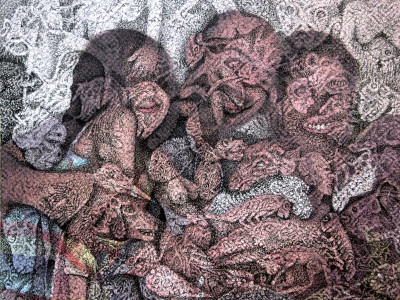
<p>This re-placed idea, from sacred to secular, has a history of evolution in the field of aesthetics over two centuries long. It has been foundational to the idea of western art, both in the sense of creation and in the sense of its value and appreciation. According to theorist Paul Crowther, the ‘legitimising discourse of art’ is based on the idea that an art object is something whose meditation elevates one’s self, expands one’s consciousness through insight, has positive effects via a contrary affective mode we may call ‘the sublime’.</p>
<p>Greek rhetorician, Longinus, first coined the term (first century AD) in order to think through the tools of persuasion for public speech. Influenced by early Christianity, Longinus was trying to get at a certain kind of rapture, inherent to language, but sourced in that grandeur of spirit which is not of this world. This other-worldliness, elsewhere-ness, and passage into its ecstasies, was later taken up by Edmund Burke, Immanuel Kant during the 18<sup>th</sup> century, and by derivation, Jean-Francois Lyotard in the 20<sup>th</sup>. In each case, intellectual effort has been applied to demystify the transcendent function of the sublime — that is, the frightening and pleasurable crossing from this to that world. Or at least such has been the attempt.</p>
<p>With Lyotard, a French postmodernist thinker, ‘that world’ comes to an end in the idea of indeterminacy. If sublime experience, and by extension the sublime aesthetic, is to have contemporary relevance, it must occur in the here and now. This shift brings up two concerns. The first is an inclusion of all things injured, defective, monstrous even, a particular description of human form. And the second implies the acknowledgment of an intrepid blind spot or absence.</p>
<p>Following Lyotard’s trajectory, for western art this meant a thinkable evolution from awe-inspired Romantic landscapes (the key site of sublime intercourse) to avant-garde or modernist experimentation. It implied an organic movement from principles of mimetic art, or art as a window to, in commemoration of visible reality, to the impetus for genres such as minimalism and abstraction. At the core of Lyotard’s persuasion rests the notion that we live in an age of indeterminacy. Alongside a deformation of classical aesthetic values (reference, perspective, dimensionality etc) the witnessing and registering of that which is unknown forms a key aspect of art practice. It is, in his words, the energy of the ‘inexpressible’ or the ‘non-presentable’ which frames the broadest gestures of modern art. Lyotard is thinking about the power of abstract art in particular.</p>
<p>This backdrop has perhaps curious relevance for art production in Pakistan. It may provide a lens for considering art education, practice, and reception, especially within an urban context. One may add to this a cultural milieu ethically questioned by aniconic religious-aesthetic doctrine, and, wherein ideas of sublimity and beauty are not deemed oppositional categories but cohere within the singular aspirational term ‘jalal’.</p>
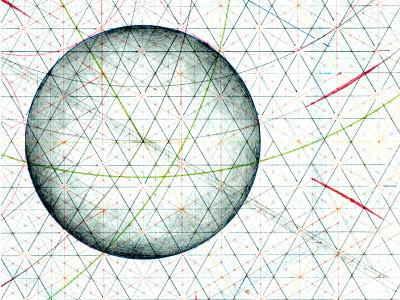
<p>A sympathetic congress of ideas may be found in contemporary non-figurative art and in the work of women artists in particular. Here, I am thinking of a multigenerational exploration, an aesthetic where the lines of figurative and abstract expression have been blurred or crossed over by its practitioners in the course of their painting. Meher Afroz, Nahid Raza and Mussarat Mirza immediately come to mind, as do Lalarukh, Naiza H Khan, Ayesha Qureshi, as well as Shahzia Sikander’s work with geometric abstraction. The question of a sublime aesthetic and its relationship to the feminine may be usefully unravelled, despite distinct concerns and distinctly separable practice in the latter selection of artists. I am thinking of a powerful gallery of images, and an extended essay that allows for such meditation.</p>
<p><em>Published in The Express Tribune, May 12<sup>th</sup>, 2012.</em></p>
</p>
			<br clear="all"/>
		]]>
		</description>

		<media:content width="424" height="318"
							isDefault="true" medium="image" url="http://i1.tribune.com.pk/wp-content/uploads/2012/05/377418-ArtPHOTOBrentSikemmaGalleryNewYork-1336749835-352-640x480.JPG">
			<media:title>Art-PHOTO-Brent Sikemma Gallery New York</media:title>
			<media:description>Selected from ‘51 Ways of Seeing,’ Drawings by Shahzia Sikander, 2005. PHOTO: BRENT SIKEMMA GALLERY NEW YORK</media:description>
			<media:thumbnail url="http://i1.tribune.com.pk/wp-content/uploads/2012/05/377418-ArtPHOTOBrentSikemmaGalleryNewYork-1336749835-352-160x120.JPG" width="160" height="120" />
      </media:content>

		<wfw:commentRss></wfw:commentRss>
		<slash:comments>0</slash:comments>
	</item>
		<item>
		<title>Thin as a playing card: ‘99 Self Portraits’ by Ayaz Jokhio</title>
		<link>http://tribune.com.pk/story/370877/thin-as-a-playing-card-99-self-portraits-by-ayaz-jokhio/</link>
		<pubDate>Fri, 27 Apr 2012 16:06:56 +0000</pubDate>

		<guid isPermaLink="false">http://tribune.com.pk/?p=370877</guid>

		<description>
		<![CDATA[
			<a href="http://tribune.com.pk/story/370877/thin-as-a-playing-card-99-self-portraits-by-ayaz-jokhio/">
				<img src="http://i1.tribune.com.pk/wp-content/uploads/2012/04/370877-ArtpHOTOivsgallery-1335538668-198-160x120.JPG" width="160" height="120" alt="" />
			</a>
			<p><div><strong class='location'>KARACHI:&nbsp;</strong>
<p><strong>I recall seeing <a href="http://tribune.com.pk/story/293050/for-identity-in-constant-flux-artists-freeze-some-people-with-work/">Ayaz Jokhio’s work</a> for the first time in 2009. My first response was mild shock, “Is this really art?” </strong></p>
<p>Hosted by Grey Noise, in Lahore at the time, the show was titled “Old Father Time”. And on display were a number of familiar image forms: a series of clocks with successively erased numbers; a grossly oversized page with a quotation on time by Borges; as well as a photographic print, “The Artist’s Father”. The latter was a group photo with a red circle drawn around one of the standing figures, the artist’s father. By this solitary mark on its surface categories shifted it seemed, seamlessly, and here now was a personal portrait. I was intrigued by its playfulness but also vaguely disturbed. What manner of meditation on time was this? And, simultaneously, what was this strange sense of vertigo, issuing as it was, from such simplified and spare pictorial surfaces?</p>
</div>
<p>Jokhio’s visual effects are remarkable. He suggests that his aim is to demystify occluding concepts, ideas, false narratives within which we live. This intent applies as well to notions of high art, in terms of both subject matter and the artist’s choice of expressive materials. He is not interested in virtuoso performance, pictorial intricacy and aspects of depth, nor is he concerned with traditional transcendent expectations of art. In fact, his oeuvre seems to provide a sustained internal critique of the same.</p>
<p>A now well-known body of work involves portraits of iconic film stars and historic figures. These are rendered in newsprint collage. At once hyperreal, and disposable, and resonant of our imaginative cultural milieu, it leads one to alternatively consider Jokhio in terms of pop art. But that is not purely the case either. His aesthetic appears far more ironic than it is celebratory. Inherent to his image-making are values of visual simplification and accessibility, humour as a kind of humaneness, as well as sharp social critique. Recognisable as the images may be however, their conceptual effect remains complex.</p>
<p>“99 Self Portraits” demonstrates this layered theatre vividly. Currently on display at IVS Gallery, Karachi, it is part of a large, spirited group show titled “Band Baja Baraat”, curated by Sameera Raja at Canvas. The work is a follow-up to Jokhio’s 2005 collation by the same name. On A4 sized paper, a single photograph of the artist has been worked over by marker in different costumed, vocational and gendered images. Here is a proliferation of crisp monochromatic figures, self portraits, bordering on excess and childlike glee. On what terms do we recognise each other? Once again, Jokhio assumes the light visual surface, articulating stereotypes to the point of a large-scale joke, to the point of hazard.</p>
<p>“God could almost be a Marquezian figure,” he suggests, speaking of defiling modes of religious appropriation in Pakistan. The title of the work infers that even Sufi literature is not exempt from such usage, that is, from mystification and obscurantist effect. Of a sudden, the humorous gathering of 99 images takes on incendiary value. It becomes critical satire of another, culturally key motif of high-minded piety. And, once again, in its conceptual shape-shifting, the gesture is immaculate. It leaves the viewer entirely exteriorised, rather un-sublime and humane, and it excludes from the work any trace of sentimentality.</p>
<p>In a statement for a show at Canvas Gallery in late 2011, Jokhio has this to say about his work. “My ambition as an artist, if there is an ambition, is to work with all the things that I see, that I touch, that I know, that I love, or that I hate… I am only the echo, in a certain part of my work, of the anxieties of the contemporary world, of the anxieties of this part of the world where I live.” One may also consider this art as intimacy critically engaged.</p>
<p>A concurrent exhibition titled “A Poet’s Country: His Eyes”, by Ayaz Jokhio, is on show at Green Cardamom Gallery, London.<em></em></p>
<p><em>Published in The Express Tribune, April 28<sup>th</sup>, 2012.</em></p>
</p>
			<br clear="all"/>
		]]>
		</description>

		<media:content width="424" height="318"
							isDefault="true" medium="image" url="http://i1.tribune.com.pk/wp-content/uploads/2012/04/370877-ArtpHOTOivsgallery-1335538668-198-640x480.JPG">
			<media:title>Art03-pHOTO-ivs gallery</media:title>
			<media:description>PHOTO: IVS GALLERY</media:description>
			<media:thumbnail url="http://i1.tribune.com.pk/wp-content/uploads/2012/04/370877-ArtpHOTOivsgallery-1335538668-198-160x120.JPG" width="160" height="120" />
      </media:content>

		<wfw:commentRss></wfw:commentRss>
		<slash:comments>0</slash:comments>
	</item>
		<item>
		<title>Celebrating 25 years of VM Gallery: Rupture|Rapture</title>
		<link>http://tribune.com.pk/story/364219/celebrating-25-years-of-vm-gallery-rupturerapture/</link>
		<pubDate>Fri, 13 Apr 2012 15:50:47 +0000</pubDate>

		<guid isPermaLink="false">http://tribune.com.pk/?p=364219</guid>

		<description>
		<![CDATA[
			<a href="http://tribune.com.pk/story/364219/celebrating-25-years-of-vm-gallery-rupturerapture/">
				<img src="http://i1.tribune.com.pk/wp-content/uploads/2012/04/364219-ArtPhotoVMGallery-1334330125-762-160x120.JPG" width="160" height="120" alt="" />
			</a>
			<p><div><strong class='location'>KARACHI:&nbsp;</strong>
<p><strong>VM Gallery celebrates 25 years of art presentation in Karachi this year. In order to mark the occasion, gallery director Ms Alvi asked six individuals to curate shows which would be hosted by VM through the year. The first in this series is titled “Rupture|Rapture”, a provocative, politically inspired exhibition brought together under the rigorous gaze of Ms Sumbul Khan.</strong></p>
</div>
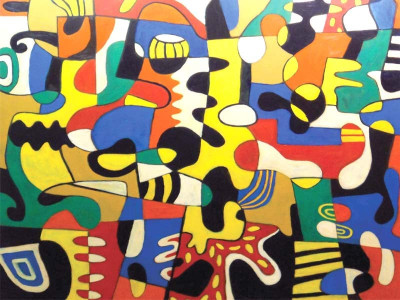
<p>Ordered within two adjacent spaces, the exhibition showcases four free-standing works. A video installation by Nameera Ahmed titled “Bloody Birds”, and a projection of NM Rashid’s poem, “Zindagi se Dartai Ho”, can be viewed in the first gallery space. It is followed by artist Moeen Faruqi’s abstract painting “5 by 5”, and a sound piece on tabla composed by Yousuf Kerai.</p>
<p>With “Rupture|Rapture”, Khan moves away from her signature curatorial practice. Earlier shows, such as “Framing the Local Context” and “Representation is Not a Dirty Word,” were guided by specific contextual, art historic concerns. In this interdisciplinary show, her emphasis has shifted to the world of realpolitiks and audience receptivity. Inspired by the tumultuous events of the so-named Arab Spring, Khan began examining the nature of democratic citizenship alongside forces of prolonged dictatorship in the Middle East and South Asia. Six months later, in the manner of a large installation, or even a literary work, Khan presents a show with a defined narrative arc.</p>
<p>Intentionally, the audience is asked to engage within a dialogic visual space, marked by violent affront and irony. This, whilst the show leads in and of itself outside the pictorial realm, to something more elemental, that is, to music. Khan’s curatorial note highlights the dynamic flux of political processes and seems to frame the show as a magnified moment within it, here, “from the ground up”, as it were.</p>
<p>The distilled nature of the exhibition feels true, powerful, exonerating in its passage. But audiences have a way of drawing in their own psychic paraphernalia. And art works themselves have a way of exerting untoward, unseemly gazes. In the slow-phased, low-lit gallery space at VM, other stories seem to come together or come apart. To the exhibition’s credit, an alternative visceral experience begins, perhaps, with “Bloody Birds”. Perhaps because of its inaugural location, or because of its graphic nature, the brief video piece seems to saturate the atmosphere of the show. Alternatively, it begs the question: What makes violence so absorbing, as subject and as spectacle?</p>
<p>On loop, for two minutes and 18 seconds successively, “Bloody Birds” depicts an everyday occurrence — the manual slaughter of chickens by a butcher. Shot in close frame, from the slitting of its strained throat, to the bird’s tremulous death throes, a very specific, near repulsive agony is captured by this video artist. Shorn of its skin, in an image of exposed and bloodied flesh, the creature quivers without feature, for even the facial form is ripped. As a kind of denouement, or as introduction, we are made privy to the pale still life of feathers and bone. And a second image, soaked in blood, is barely discernable, for the screen is a thick, black-red, clawing wash. Excerpted from a local cooking show, a woman’s voice-over sounds out with recognisable enthusiasm about the feast that is being prepared.</p>
<p>The visible brutality of this piece certainly exceeds its vegan impulse. The viewer is at once a voyeur and is, at the same time, stripped to bare life. The stripping of personal piety occurs simultaneously. Through Ahmed’s counterpoise of image and sound in the work, other forms of normative violence come to mind. Most significantly, one may consider the fabrication of reality within dictatorial regimes — “reality-making”, that is, through the cultural elaboration of fear, humiliation and participatory subjection.</p>
<p>The visceral power of this quotidian piece seems to touch the other three works in an unnerving way. Their own agency appears diminished, or is rendered ironic, at least for this scribe. Violence too is elemental. That we are in a gallery space further complicates the matter. Beyond aesthetic presentation, financial exchange, and pedagogic value, the gallery is coded to provide some degree of visual pleasure. Indeed, in this quietly seismic moment lies the show’s most provocative exploration.<em></em></p>
<p><em>Published in The Express Tribune, April 14<sup>th</sup>, 2012.</em></p>
</p>
			<br clear="all"/>
		]]>
		</description>

		<media:content width="424" height="318"
							isDefault="true" medium="image" url="http://i1.tribune.com.pk/wp-content/uploads/2012/04/364219-ArtPhotoVMGallery-1334330125-762-640x480.JPG">
			<media:title>Art-Photo-VM Gallery</media:title>
			<media:description>“5 by 5” Moeen Faruqi. PHOTO: VM GALLERY</media:description>
			<media:thumbnail url="http://i1.tribune.com.pk/wp-content/uploads/2012/04/364219-ArtPhotoVMGallery-1334330125-762-160x120.JPG" width="160" height="120" />
      </media:content>

		<wfw:commentRss></wfw:commentRss>
		<slash:comments>0</slash:comments>
	</item>
		<item>
		<title>Sacred assemblage: The pottery of Sheherezade Alam</title>
		<link>http://tribune.com.pk/story/356988/sacred-assemblage-the-pottery-of-sheherezade-alam/</link>
		<pubDate>Thu, 29 Mar 2012 17:00:44 +0000</pubDate>

		<guid isPermaLink="false">http://tribune.com.pk/?p=356988</guid>

		<description>
		<![CDATA[
			<a href="http://tribune.com.pk/story/356988/sacred-assemblage-the-pottery-of-sheherezade-alam/">
				<img src="http://i1.tribune.com.pk/wp-content/uploads/2012/03/356988-ArtPhotoSheherezadeAlam-1333037643-452-160x120.JPG" width="160" height="120" alt="" />
			</a>
			<p><div><strong class='location'>KARACHI:&nbsp;</strong>
<p><strong>Koel Gallery’s cream-coloured, light-filled interiors carry an enchantment. One is reminded of an early pleasure, that of pinwheels spinning against an open wind. Such is the effect of a cursory glance. Or more elemental, it is as though a dancer turns, and turns, fired upon an invisible centre. Her motion remains present long after a viewing of potter <a href="http://www.sheherezadealam.com/">Sheherezade Alam’s “207 Vessels”</a>. The turning is hard to contain. A sense of exquisite proliferation marks the show.</strong></p>
</div>
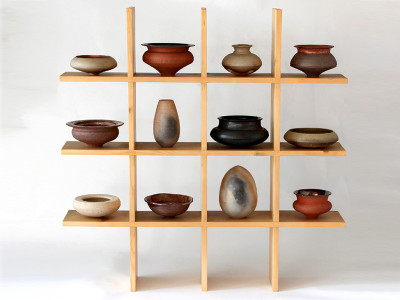
<p>Presently based in Lahore, Sheherezade shares two decades of her craft, a selection of clay vessels dated between 1985 and 2011. Each piece, detailed like no other, carries its own biography. In terms of clay source, methods of firing and glazes, as well as period and location of creation, the show reads as an expansive personal journey. Moreover, it indicates the imaginative largesse involved in cohering and continuing, an ancient earthenware tradition specific to the Indian subcontinent.</p>
<p>Gravitation generates essential form. And at the heart of the matter is the potter’s wheel. Author Sara Suleri Goodyear refers to this in her brief, erudite catalogue introduction. “In pre-Islamic and the Islamic eras, the Indian potter served as a cultural icon, as the one maker who could give physical shape to the unutterable symmetries of mysticism.” And she adds, “Sheherezade Alam revives [the wheel] in order to extend the significance of earth in the aesthetic of the East.”</p>
<p>Research into the traditions of Mehergarh, Harappa and Taxila undergird her sensibility. She further suggests that a study in Multani turquoise and cobalt glazes are fundamental to conventional pottery of the region, which otherwise cultivates work with exposed clay. Both technologies are visible in the show. But ‘tradition’ is not limited to these instances alone. Sheherezade has absorbed influences from as far and wide as Turkey, Greece, Italy, Iran, Scandinavia and Japan. Work with master potters based in England, a residency in Glasgow, teaching in Ankara, studio practice in New Haven and in Toronto, for many years her home base, have each enriched her return to the wheel.</p>
<p>At the current exhibition, we are privy to pots from a range of work periods. For instance, smaller pieces from her early days of experimentation are presented alongside raku vessels (1997), which in turn complement a period of play with unglazed black and white clay (Toronto, 2006). The show is by no means a retrospective, nor is it ordered as such. The mood is more informal. It suggests an occasion for self-reflection and for communally sharing a vernacular craft process. Its reach is nevertheless sublime.</p>
<p>In an essay entitled “Aesthetics and Context”, anthropologist Juergen Wasim Fremgen coins the terms “sacred assemblage” and “votive installations”, in order to describe the material and dialogic aspects of indigenous shrine culture. Here, whether we are looking at elegant grid displays of vessels or at a stunning series of red-glazed pots (<em>Offering Bowls</em>, 2004), Fremgen’s taxonomy may be aptly applied to Sheherezade’s oeuvre.</p>
<p>In speaking of the sacred, we may also move into the realm of the feminine. The potter speaks of a vital connection to the earth, to its fertile, yielding quality and to its strength as a medium. A sense of rhythmic openness and abundance marks each of her works, as though intrinsic to the hands that mould. Therein ritual for Sheherezade is key. It almost appears as a structuring principle. Through her aesthetic, and on the occasion of this exhibition, we may perhaps re-consider located notions of the sacred. For this has, as per Ms Suleri, a rich and irresistibly porous tradition in the land that is the greater subcontinent.</p>
<p>The show continues till April 2 at Koel Gallery, Karachi.</p>
<p><em>Published in The Express Tribune, March 30<sup>th</sup>, 2012.</em></p>
</p>
			<br clear="all"/>
		]]>
		</description>

		<media:content width="424" height="318"
							isDefault="true" medium="image" url="http://i1.tribune.com.pk/wp-content/uploads/2012/03/356988-ArtPhotoSheherezadeAlam-1333037643-452-640x480.JPG">
			<media:title>Art01-Photo-Sheherezade Alam</media:title>
			<media:description>1.75cm by 14cm. PHOTOS: SHEHEREZADE ALAM</media:description>
			<media:thumbnail url="http://i1.tribune.com.pk/wp-content/uploads/2012/03/356988-ArtPhotoSheherezadeAlam-1333037643-452-160x120.JPG" width="160" height="120" />
      </media:content>

		<wfw:commentRss></wfw:commentRss>
		<slash:comments>0</slash:comments>
	</item>
		<item>
		<title>Shri Varun Dev Mandir</title>
		<link>http://tribune.com.pk/story/343998/shri-varun-dev-mandir-darshan/</link>
		<pubDate>Thu, 01 Mar 2012 16:17:30 +0000</pubDate>

		<guid isPermaLink="false">http://tribune.com.pk/?p=343998</guid>

		<description>
		<![CDATA[
			<a href="http://tribune.com.pk/story/343998/shri-varun-dev-mandir-darshan/">
				<img src="http://i1.tribune.com.pk/wp-content/uploads/2012/03/343998-ManoraTemplePHOTOCREDITNAIZAHKHAN-1330616942-196-160x120.jpg" width="160" height="120" alt="" />
			</a>
			<p><div><strong class='location'>KARACHI:&nbsp;</strong>
<p><strong>Like the rest of Karachi, its approach is scatological. Through a narrow lane leading up, wild flowers grow amidst the remains of human garbage. But from a distance, <a href="http://en.wikipedia.org/wiki/Shri_Varun_Dev_Mandir">Shri Varun Dev Mandir</a> lights up the skyline. Time itself becomes mysterious. Set against the Arabian Sea, this seemingly ancient sandstone temple gently commends its surrounding landscape. We are in an old country, one believes then, and the land has witnessed much.</strong></p>
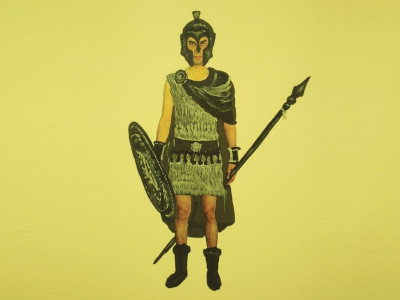
</div>
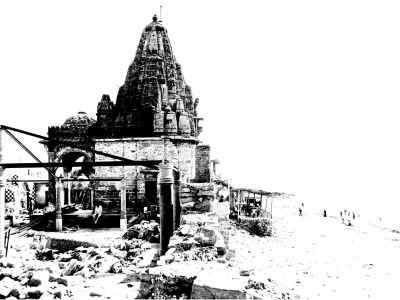
<p>Located at Manora Island, the mandir reveals itself in myth. “He comes, yes, sometimes he visits,” suggests the caretaker, looking out into the enormous blue distance. Gaunt-eyed and visionary, Kishan is speaking of Varuna, the Hindu god of oceans. For Kishan, as for many believers, Varuna is the same deity as Uderolal, the presiding spirit of rivers, of all water bodies in Sindh. “He” is beloved Jhule Lal, whose other incarnation we are to find at Sehwan. This inclusive narrative defines the visible temple — its stone form weathered by continual salt-laden winds.</p>
<p>Legend has it that in the 16<sup>th</sup> century a wealthy sailor by the name of Bhojomal Nancy Bhattia bought this island from the Khan of Kalat, who owned most of the land along the coastline at that time. His family commissioned a temple on the lay terrain. And what we see today — a complex of stone set upon stone skyward — originated perhaps some 500 years ago.</p>
<p>Leap in time, and a 1920s postcard describes the temple in whitewash. Set on a raised plinth, in the Nagara or North Indian style, a dazzling white sanctuary rises above the sea line. It appears as a living devotional site, bounded by a low wall and garlanded in paper streamers. At the time, Manora served as a British naval base, taken over from its Talpur rulers almost a century earlier. In this image one can almost feel the wind drift — and the <em>mandir</em>, as aesthetic form, caught in effulgent, spare, late afternoon shine.</p>
<p>Detractors of “deep-root mythology” argue that this is a colonial-period construction. No written records are available in Pakistan, but architects such as Murlidhar Dewani suggest that the local Hindu community became financially viable only during the time of the British. Dating is contentious, he infers, because it constructs social knowledge. He suggests that the temple &#8220;ruin&#8221; we see today in Manora is, in fact, a modern structure. It is the result of cultural neglect specifically and not age alone.</p>
<p>A present image: pillaged, eroded, impoverished and yet, the temple moves you. Despite its denuded stature, one can still perceive the building’s volume in sculptural terms. A symmetry of stone projections form the outer skein of the foundation, and these continue up along the height of the tower. They emphasise at once the temple’s vertical sweep, but within a rhythmic and curvilinear outline. Its poise is unmistakable.</p>
<p>The rough gold of Shri Varun Dev <em>mandir</em> suggests too a strange notion of fertility. The quality is there in its design, and in the motion of its stone. It is alluded to in the concluding finial, the disc-shaped <em>amalaka</em>, symbolic of healing fruit. And it is present in the generative mythology surrounding the temple. From multiple stories, or stages in its origin, to the heterodox nature of its presiding deity, a richly inclusive narrative stands up to contemporary religious piety. This proliferating sense also questions the idea of a continuous and homogenous temporality.</p>
<p>Here at Manora, we may still recover the dream of a cosmopolitan landscape. Through the solace of such a sight, its anachronism, find mystery, terrestrial meaning and reverence.</p>
<p>The temple currently belongs to the Hindu Council of Pakistan. The Council has publicly pledged renovation efforts.</p>
<p><em>Published in The Express Tribune, March 2<sup>nd</sup>, 2012.</em></p>
</p>
			<br clear="all"/>
		]]>
		</description>

		<media:content width="424" height="318"
							isDefault="true" medium="image" url="http://i1.tribune.com.pk/wp-content/uploads/2012/03/343998-ManoraTemplePHOTOCREDITNAIZAHKHAN-1330616942-196-640x480.jpg">
			<media:title>Manora Temple-PHOTO CREDIT-NAIZA H KHAN</media:title>
			<media:description>Manora Temple. PHOTO CREDIT: NAIZA H KHAN</media:description>
			<media:thumbnail url="http://i1.tribune.com.pk/wp-content/uploads/2012/03/343998-ManoraTemplePHOTOCREDITNAIZAHKHAN-1330616942-196-160x120.jpg" width="160" height="120" />
      </media:content>

		<wfw:commentRss></wfw:commentRss>
		<slash:comments>5</slash:comments>
	</item>
		<item>
		<title>The Artist &amp; the Self</title>
		<link>http://tribune.com.pk/story/337446/the-artist-the-self-the-genesis-of-a-gallery/</link>
		<pubDate>Thu, 16 Feb 2012 16:35:54 +0000</pubDate>

		<guid isPermaLink="false">http://tribune.com.pk/?p=337446</guid>

		<description>
		<![CDATA[
			<a href="http://tribune.com.pk/story/337446/the-artist-the-self-the-genesis-of-a-gallery/">
				<img src="http://i1.tribune.com.pk/wp-content/uploads/2012/02/337446-ArtPHOTOSKOELGALLERY-1329407183-449-160x120.jpg" width="160" height="120" alt="" />
			</a>
			<p><div><strong class='location'>KARACHI:&nbsp;</strong>
<p><strong>“Let the beauty of what you love be what you do,”</strong></p>
</div>
<p><strong>Rumi</strong></p>
<p>During these last days of winter, or the first of summer, when season itself is so near, rhapsodic, it is right to speak of Rumi in the context of art. February 12 marked the third anniversary of <a href="http://tribune.com.pk/story/284050/the-body--exhibiting-figurative-art/">Koel Gallery</a>, in Karachi. An exhibition entitled, “Mein — The Artist and the Self”, displays 85 self-portraits made by artists, sculptors, photographers, as well as architects, who have shown at the gallery since its inception in 2009.</p>
<p>The opening night event was magical. The space of Koel, overwhelmed by its audience as in the spirit of a festival. Days later, students and teachers alike, lay viewers, continue to stream into the premises. To an observer of such uninterrupted flow and aesthetic engagement, Koel Gallery looks like another country.</p>
<p>With the institution of Noorjehan Bilgrami begins a kind of romance. Artist, author, designer and educationist, she first came upon the idea of a gallery in 1989. Koel workshop had been some 12 years in the running, a pioneering effort directed towards the preservation of handloom and block print traditions in Pakistan.</p>
<p>As its organic extension, “Maharat” was intended to showcase works of excellence, both in the idiom of craft as well as indigenous art. The then small, mud walled space was inaugurated with an exhibition by late Zahoorul Akhlaq. Several projects and metamorpheses later, the gallery resurfaced in its current location. But despite Koel’s expansion, the original spirit of zen-like simplicity and quietude continues to mark the space. It seems to belong to everyone.</p>
<p>Over 50 shows have been held at the gallery thus far. Ms Bilgrami is assisted in her curatorial practice by an advisory board including architects Habib Fida Ali and Arshad Faruqui, photographer Amean J and artist Ussman Ghauri, before his tragic loss last year.</p>
<p>Despite their inherent diversity, concern for craftsmanship and a taste for the sublime seem to define Koel’s curatorial sensibility. The best shows have often a meditative effect, in terms of subject matter, aesthetic integration, and interior historic awareness. The current exhibition however, exceeds, indeed consumes the gallery’s own parameters. It is noisome, congenial, young and densely conversational. One might even sense the articulation of a dozen thematic shows, within the single framework of self-portraiture.</p>
<p>Large works, such as Imran Mir’s flamboyant “Picasso and Me…Confused” or Kakul Kamran Kureshi’s sprawling “Kitchen” draw one’s immediate attention. On a more sobering note, artists such as Mehr Afroz, Nahid Raza, and Mussarat Mirza refer the viewer to their signature style, in place of works of sensuous resemblance. Pure abstraction, unusually the purview of women artists, hangs amidst vocal designations of self, as defined by political and social commentary. Humour too finds an honourable place in the show, with works such as Amin Gulgee’s “Born This Way”, Saba Khan’s “Bad Karma”, or Hamra Abbas’s cavalier digital self-portrait.</p>
<p>Amidst the diversity of images and expressive media however, the most powerful works at Koel remain within the ambit of conventional portraiture. By this I mean the staging of a singular, embodied self, physically and viscerally featured. Both Naazish Ataullah and Aasim Akhtar draw from this premise and use physical form as the central subject of their works. The intimacy of their photographic images stand out in the exhibition.</p>
<p>In another case, an early work submitted by Naiza Khan shows a face engraved in cherry wood. The remarkable intensity of her line and colour surface across the wood’s tightly packed grain. It creates in the image an inwardness that is itself hard to contain. In a corresponding light, and despite its burnt, bright orange hues, Asim Butt’s oil painting excludes the world. Meaning pours into his face, only and as a result of this gesture. (Asim’s work has been included in the show in remembrance of the artist’s acute presence, past his death.)</p>
<p>Such singular and sensually introspective expositions inaugurate, at Koel, a genuine narrative of self in contemporary Pakistani art. As an undertaking, the project’s relevance is apparent in both artists’ response as well as the groundswell of viewers witnessed at the show. At once playful and polemical, and on occasion painfully honest, “Mein” marks a coming of age for the gallery. For Ms Bilgrami and co-curator Amean J, it is surely a moment of acknowledgment.<em></em></p>
<p><em>Published in The Express Tribune, February 17<sup>th</sup>, 2012.</em></p>
</p>
			<br clear="all"/>
		]]>
		</description>

		<media:content width="424" height="318"
							isDefault="true" medium="image" url="http://i1.tribune.com.pk/wp-content/uploads/2012/02/337446-ArtPHOTOSKOELGALLERY-1329407183-449-640x480.jpg">
			<media:title>Art01-PHOTOS-KOEL GALLERY</media:title>
			<media:description>Irfan Gul “Arid Dreams 3” — Stop-motion video. PHOTOS: KOEL GALLERY</media:description>
			<media:thumbnail url="http://i1.tribune.com.pk/wp-content/uploads/2012/02/337446-ArtPHOTOSKOELGALLERY-1329407183-449-160x120.jpg" width="160" height="120" />
      </media:content>

		<wfw:commentRss></wfw:commentRss>
		<slash:comments>0</slash:comments>
	</item>
		<item>
		<title>Short Talks on Tassaduq Sohail</title>
		<link>http://tribune.com.pk/story/330949/short-talks-on-tassaduq-sohail/</link>
		<pubDate>Thu, 02 Feb 2012 17:45:57 +0000</pubDate>

		<guid isPermaLink="false">http://tribune.com.pk/?p=330949</guid>

		<description>
		<![CDATA[
			<a href="http://tribune.com.pk/story/330949/short-talks-on-tassaduq-sohail/">
				<img src="http://i1.tribune.com.pk/wp-content/uploads/2012/02/330949-artPHOTOSARTCHOWKjpg-1328204427-583-160x120.jpg" width="160" height="120" alt="" />
			</a>
			<p><div><strong class='location'>KARACHI:&nbsp;</strong>
<p><strong>Not everyone is a cool-eyed customer, come in to view Art. Once a woman will walk in, devastated by love. She seeks nothing from the gallery but imaginable refuge. And she finds herself surrounded — by a drift of coloured fish, or a cream-coloured horse slipping its own outline, veined and pouring mountains, or a naked woman, her body turned exquisitely away. The viewer eases her sense of the real. Here lies a bestiary, and a dwelling place. The gallery space is transformative.</strong></p>
</div>
<p><strong>II</strong></p>
<p>The artist’s studio is a cell, enamoured by a large easel and bereft of natural light. Turpentine, linseed oil, an unnamed bottle line the roughshod table. Used tubes of oil paint cover its surface. A neon work lies drying. The palette knife is 45 years old. It carries his motions. Women, garish, frontal, naive, surfeit the studio walls. All from live models, or from the longing of them, indicates the artist. He sits amidst dust, speaking profanity, smiling sweetly, discussing Picasso’s line. After a life of work, there is little to hide. “They are everything.” They are mothers, daughters, mermaids, prostitutes, patrons.</p>
<p><strong>III</strong></p>
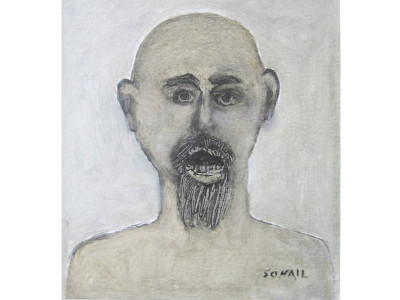
<p>At the age of 82, he has seen much world. From Jalandhar to Lahore, London, Karachi, Tassaduq Sohail has travelled and worked through the most humble vocations. His days as a footpath artist are recalled with reverence. His first show in London occurred in 1978. Almost three decades later, in 2007, Sohail’s art arrived at Bonham’s. His last show was held at <a href="http://www.artchowk.com/">ArtChowk</a> in 2010. He continues to work at his studio — preparing the next body of work for Full Circle this year. His hands tremble when not in use. He considers himself the last of a generation of libertine painters in Pakistan.</p>
<p><strong>IV</strong></p>
<p>A satirist before he came to art, he speaks of his “heated” fictions. There are too the rude pictures. He draws in jest, paints on commission, proliferates the same, the same. He despises forgery. At the heart of the matter lies the sobriety of Sohail’s gaze. His fabled creatures may be addressed once again. One may begin to outline erotics of his art. With this unusual figure, one may begin to pry a necessary history of erotic art in Pakistan. As Garcia Marquez writes in his last novel, <em><a href="http://en.wikipedia.org/wiki/Memories_of_My_Melancholy_Whores">Memories of My Melancholy Whores</a></em>: “Morality too is a matter of time.”</p>
<p><strong>V</strong></p>
<p>The construction of the work remains constant. Here too, the framing landscape is foreshortened. It is inhibited, lifted, flattened out. Only the rendered characters possess narrative depth. On the extreme right of this small painting, a female centaur stands in awkward liaison with an inanimate phallic form. Clarity is hindered by rapidly applied colour. We view, instead, knife smear, frottage, in earth browns, blues, hints of green, as though at once a psychic emergence and a segregation were being described.</p>
<p>The scene of sequestered sexuality is shared by master witness, a slightly bloodied pigeon. Its steady gaze commands the painting. This, whilst loosely coloured flowers adorn the soft distance between. The rest of the image works at disarray — and it resists “interpretation”. Sensual dis-order may perhaps only be felt, even as the painting’s strange Edenic beauty covets the viewer’s attention. For no one is permitted speech, in this or any of Sohail’s canvases. His universe is marked by implicit inner presence. It is always a communal space, enclosed and unutterable, and occasionally humoured.</p>
<p><strong>VI</strong></p>
<p>Sourced in<em> daastans</em> and western myth, Sohail’s canvases queerly proclaim erogenous polemic. The best of his work is either imbued with a feminine quality or is complexly engaged with it. Relief seems to occur in the naivete of his rendering and, counter-intuitively, in the retention of opaque interior life. One may read into this gesture a visible and located cultural history. In the moment however, through his pictorial energies we may return to an older art historic sentiment. Erotic form remains, to date, one of the most powerful ways in which art communicates with its audience.</p>
<p><em>Published in The Express Tribune, February 3<sup>rd</sup>, 2012.</em></p>
</p>
			<br clear="all"/>
		]]>
		</description>

		<media:content width="424" height="318"
							isDefault="true" medium="image" url="http://i1.tribune.com.pk/wp-content/uploads/2012/02/330949-artPHOTOSARTCHOWKjpg-1328204427-583-640x480.jpg">
			<media:title>art-PHOTOS-ART CHOWK.1jpg</media:title>
			<media:description>Face 1. PHOTO: ART CHOWK</media:description>
			<media:thumbnail url="http://i1.tribune.com.pk/wp-content/uploads/2012/02/330949-artPHOTOSARTCHOWKjpg-1328204427-583-160x120.jpg" width="160" height="120" />
      </media:content>

		<wfw:commentRss></wfw:commentRss>
		<slash:comments>1</slash:comments>
	</item>
		<item>
		<title>The construction of dignity </title>
		<link>http://tribune.com.pk/story/324158/the-construction-of-dignity/</link>
		<pubDate>Thu, 19 Jan 2012 19:36:54 +0000</pubDate>

		<guid isPermaLink="false">http://tribune.com.pk/?p=324158</guid>

		<description>
		<![CDATA[
			<a href="http://tribune.com.pk/story/324158/the-construction-of-dignity/">
				<img src="http://i1.tribune.com.pk/wp-content/uploads/2012/01/324158-ConstructionPHOTONARIMANANSARI-1326992129-228-160x120.jpg" width="160" height="120" alt="" />
			</a>
			<p><div><strong class='location'>KARACHI:&nbsp;</strong>
<p><strong>Something strange happens in Nariman Ansari’s photographs. It is as though time slows down. Experience slows down, and spontaneously, the viewer’s gaze softens. Ansari’s subjects emerge in slow motion, physically, emotively. It becomes possible, even obvious, revelatory, that a still frame, of a still subject, can carry pace.</strong></p>
</div>
<p>I first noticed this effect, while looking at an early fashion shoot. It was designer Umar Sayeed’s own first catwalk show, based on the theme of Sadequain’s work. One imagines a standard behind-the-scenes shoot, focusing on the high urgency, sense of preparation and excitement prior to models hitting the ramp. Most fashion photography also tends to idealise its subject. In Ansari’s case however, a slow and detailed energy pervades her images. We see Sadequain’s angular figures on textile; or the pre-eminence of black, drawn from the master artist’s thick outlines, his solar brushstrokes; or the tentative lines of a straw nest accessorised in close-up. In a solitary frame, we follow the designer’s own gaze over his models in reflection. We have time to see.</p>
<p>Much has been written about the relationship between “instant” photography and the press of hyper-visual societies. Theorist Walter Benjamin critiqued what he called “the age of mechanical reproduction”, and a related impoverishment of lived experience. Susan Sontag, much inspired by Benjamin’s work, takes a different lead. In her seminal book of essays on the subject, she suggests that, “Photographs alter and enlarge our notions of what is worth looking at and what we have a right to observe. They are a grammar and, even more importantly, an ethics of seeing.”</p>
<p>Amidst a deluge of print and digital images, Ansari’s young body of work provides welcome direction. Whether she is shooting “invisible soldiers” of Pakistan’s current war on terror, or the tenuous relationship between Islam and lesbian identity (Turkey), her lens is personally attentive. There is something moody, even magical, weighed in, about the world cast by Ansari’s camera. And it suggests, as per Sontag, an ethics of seeing.</p>
<p>Ansari graduated from Indus Valley School of Art and Architecture in 2002, with a major in communication design and minor in photography. Her thesis involved the production of a bilingual book — photo-illustrations set alongside Sa’adat <a href="http://tribune.com.pk/story/299126/the-lone-warrior-for-60-years-he-fought-for-an-egalitarian-peaceful-society/">Hassan Manto</a>’s miniaturised partition stories, <em>Siyah Hashiye</em>. She then worked on a number of media-related projects, including work in television, until the creation of her own company, Firefly Photoworks in 2009. With a studio set up at home, she began to focus on family portraiture. Ansari’s profuse sense of curiosity, however, soon led her to an international arena of photography and to numberless possibilities inherent in the medium.</p>
<p>In 2010, she showed a first body of work on e-magazine <em>Bite!</em> entitled “Stereotypes of Pakistani Women”, the camp, ironic, affectionate set of self-portraits displayed typifying ways in which women are portrayed in the media and in public life. This was followed by a photoessay on gay culture in Istanbul, and in particular, the study of a conflicted young Turk, equivocally religious and sexually partisan to women.</p>
<p>During this period, two international workshops further clarified Ansari’s vision of photography as narrative expression. The latter work came from “Intimacy and Empathy in Storytelling”, at The Foundry workshop in Turkey. And a body of work looking at selfhood and culturally embedded war imagery in the US, emerged from the course, “The Photographer as Author”.</p>
<p>“Why do photographs have to be [aesthetically] sensational to be noteworthy?” Speaking of a more recent project covering wounded soldiers in Rawalpindi, Ansari emphasises the importance of content. “It is odd that we know everything about the geography and interior life of an average American soldier. But we feel nothing for the men who are fighting on our own borders.” The question inspired a series of works for Citizens Archive Project in 2011. And here indeed there is no artistry. A young man, blinded in both eyes during battle in Mohmand Agency, stares directly into the frame, at the viewer. A spare hospital bed and a ceiling fan frame the image.</p>
<p>The notion of quiet scenes, images that slow time and tell stories with historic consciousness, speak of another value: personal dignity. Shame is often considered in terms of isolation against a landscape of socially generated meaning. To be shamed is the same as “losing face”, or the integrity of personal feature. The gentleness of Ansari’s photographic gaze and the force of her subject matter, tend to restore physical interiority, as it were. Her growing range of images brings dignity to the work of picture-making.</p>
<p><em>Published in The Express Tribune, January 20<sup>th</sup>, 2012.</em></p>
</p>
			<br clear="all"/>
		]]>
		</description>

		<media:content width="424" height="318"
							isDefault="true" medium="image" url="http://i1.tribune.com.pk/wp-content/uploads/2012/01/324158-ConstructionPHOTONARIMANANSARI-1326992129-228-640x480.jpg">
			<media:title>Construction-PHOTO-NARIMAN ANSARI</media:title>
			<media:description>Winter Of My Discontent I. PHOTO: NARIMAN ANSARI</media:description>
			<media:thumbnail url="http://i1.tribune.com.pk/wp-content/uploads/2012/01/324158-ConstructionPHOTONARIMANANSARI-1326992129-228-160x120.jpg" width="160" height="120" />
      </media:content>

		<wfw:commentRss></wfw:commentRss>
		<slash:comments>0</slash:comments>
	</item>
		<item>
		<title>Heritage: ‘A life of stone after so many lives’ </title>
		<link>http://tribune.com.pk/story/317068/heritage-a-life-of-stone-after-so-many-lives/</link>
		<pubDate>Thu, 05 Jan 2012 21:09:02 +0000</pubDate>

		<guid isPermaLink="false">http://tribune.com.pk/?p=317068</guid>

		<description>
		<![CDATA[
			<a href="http://tribune.com.pk/story/317068/heritage-a-life-of-stone-after-so-many-lives/">
				<img src="http://i1.tribune.com.pk/wp-content/uploads/2012/01/317068-SatparaRoadPHOTOMAHAMALIK-1325783759-356-160x120.jpg" width="160" height="120" alt="" />
			</a>
			<p><div><strong class='location'>KARACHI:&nbsp;</strong>
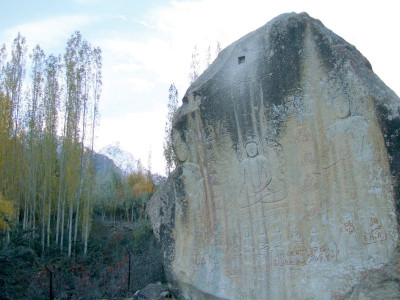
<p><strong>The solitary granite boulder is cordoned off in barbed wire. We are there as of chance. Our jeep can no longer tract a snow-laden Satpara Road and, returning towards Skardu, we catch sight of the single surviving engraved rock in the area. </strong></p>
<p>Located at Manthal, this boulder extends over eight metres high and five metres wide. Poised at an elevation of about 2,500 metres, its weathered northern face catches the soft lights of the setting sun. We are struck almost at once, by the exquisite serenity of the setting and by a kind of whispering disbelief.</p>
</div>
<p>Circa 900AD, the carved image depicts a frame of bodhisattvas, at the centre of which rests the mythic figure of Maitreya Buddha, the friend, the guide, cast in meditation. Here, in the open air, is a sense of transport, and a rich reordering of the world we seem to inhabit. For in an instant something washes over — a feeling as whimsical and enduring as centuries of time, marked by a solitary human hand, human intent. The ancient rock stands as a last remaining emblem of the Tibetan Scholars Empire in this particular location. The remainder have been lost to natural wear, vandalism and use in local construction.</p>
<p>Now imagine beneath the naked sun, thousands of massive stone easels, at such height, in one concentrated area. Imagine around them, an amphitheatre of mountain ranges — solitary pilgrim routes themselves carved between the Karakorums, Hindu Kush and the Himalayas. Imagine a continuous archive of images, often layered on a single site, from Epipaleolithic times, up till the early 16<sup>th </sup>century. Imagine the healing power of such a vast historic chronicle. Imagine it being submerged.</p>
<p>With the construction of the Basha-Diamir Dam, its reservoir will absorb Chilas town and 15 surrounding miles. With it will go this diverse and unparalleled landscape. The modern conundrum persists — national development or preservation of a non-utilitarian heritage.</p>
<p>Anthropologist Michael Taussig provides a disturbing caveat to such monologic state construction. He refers to the Chilean countryside and a story about what happens when a child is abducted by witches. “In order to break the child’s will, the witches crush the child’s bones and sew the body parts together in an abnormal way. The head is turned around so that the child has to walk backwards, and the ears, eyes and mouth are stitched up.” In the making of such a “sutured” reality, what is endangered, Taussig suggests, is the existence of the society’s moral foundations. He comments on peoples and communities, in this way culturally stripped and infantilised, floating apart into fragments.</p>
<p>In order to mitigate plausible losses caused by construction of the dam, the funding source, ADB, executors Water and Power and Development Authority (Wapda) and the research cell at University of Heidelberg, have devised a cultural heritage management plan. The dynamic actor, activist and film-maker Feryal Gauhar currently directs the programme. During a brief interview in Lahore, she mentions some aspects of their multi-tiered approach. These include ongoing documentation of sites, as well as 3-D scanning of select high-significance carvings. The scanned images are to be used in reproductions of 150 out of 33,000 in situ petroglyphs.</p>
<p>Despite the many challenges that such a project imply, Gauhar’s insights are striking. She narrates a particularly arduous journey made in order to gain documentary footage. A narrow climb leads to the top of the nullah where a glacial mill has formed between seven boulders. Each of the enormous granite rocks are engraved with a scene from Buddhist iconography. They read like a living Jataka fable under open skies. In this dramatic setting, a fair, red-haired boy sits with his friends, feet casually splayed over one of the images. When asked who he thinks these figures are, he responds with approved gravity, <em>“Yeh kaafir hein.” </em></p>
<p>These are the disbelievers.</p>
<p>One is reminded of Taussig’s cautionary tale, at the heart of such innocence and in the midst of so much beauty.<em></em></p>
<p><em>Published in The Express Tribune, January 6<sup>th</sup>, 2012.</em></p>
</p>
			<br clear="all"/>
		]]>
		</description>

		<media:content width="424" height="318"
							isDefault="true" medium="image" url="http://i1.tribune.com.pk/wp-content/uploads/2012/01/317068-SatparaRoadPHOTOMAHAMALIK-1325783759-356-640x480.jpg">
			<media:title>Satpara Road-PHOTO-MAHA MALIK</media:title>
			<media:description>Buddhist Carving Off Satpara Road. PHOTO: MAHA MALIK</media:description>
			<media:thumbnail url="http://i1.tribune.com.pk/wp-content/uploads/2012/01/317068-SatparaRoadPHOTOMAHAMALIK-1325783759-356-160x120.jpg" width="160" height="120" />
      </media:content>

		<wfw:commentRss></wfw:commentRss>
		<slash:comments>0</slash:comments>
	</item>
		<item>
		<title>New art at Indus </title>
		<link>http://tribune.com.pk/story/304141/new-art-at-indus/</link>
		<pubDate>Fri, 09 Dec 2011 20:21:32 +0000</pubDate>

		<guid isPermaLink="false">http://tribune.com.pk/?p=304141</guid>

		<description>
		<![CDATA[
			<a href="http://tribune.com.pk/story/304141/new-art-at-indus/">
				<img src="http://i1.tribune.com.pk/wp-content/uploads/2011/12/304141-XParadePHOTOSPUBLICITY-1323448405-555-160x120.jpg" width="160" height="120" alt="" />
			</a>
			<p><div><strong class='location'>KARACHI:&nbsp;</strong>
<p><strong>“Life is sweet, Jasper. There’s day and night, Jasper, both sweet things. There’s sun, moon and stars, brother, all sweet things, there’s likewise a wind on the heath. Who would wish to die…?”</strong></p>
</div>
<p>At the start of WWII, the preeminent New Zealand writer Janet Frame reads from a book by George Borrow. In the novel, a discussion ensues between two protagonists regarding the value of life. For the sensitive Frame, who undergoes excruciating years in a mental asylum, with a falsely diagnosed illness, this passage reads like quiet and marvelous poetry. “[But] who would wish to die?”</p>
<p>The subject of dying, specifically a burial, marks three large canvases by young Indus Valley artist, Fariha Hassaan. Part of the small, fine art thesis show, Hassaan’s work stands out for its striking use of colour and for its vibrant free-form execution. Both aspects seem to belie the convention at hand. And one is compelled to ask, “Where exactly is the painting?”</p>
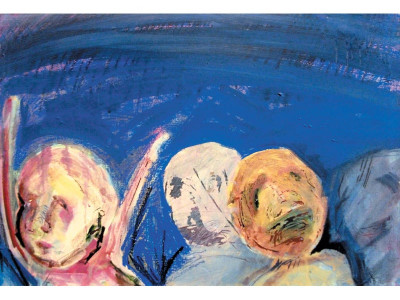
<p>Rendered in oils, a shrouded figure rests in a casket in the foreground of the work. A group of onlookers, spontaneously drawn, stand to one side, almost grasping at the stained cloth. One glimpses a garden, bright flowers and green, as the setting for this scene of mourning. Further in, through flat swathes of blues, shot pinks, in the upper right-hand region, we discern an old silhouette. A picnic is ongoing.</p>
<p>This image is hard to view, for any extended time. It is transformed from its original clarity, in swift overlays of colour, and in rapid pastel strokes. The latter give to the painting as a whole, a tremulous, tentative, desecrating energy — something childlike even, juvenilia, hard to view.</p>
<p>We turn to speak of anger. We speak in fact of aesthetics. With readerly eloquence, Hassaan describes her art-making process as a movement away from description, towards a more gestural style. In this, she cites artists Cy Twombly and Dana Schutz as imminent influences.</p>
<p>This particular canvas grew from a personal reference, an intimate death in the family. She remaindered it for several months and worked on several smaller pieces in the mean. Upon returning to the main work five months later, she found it entirely closed to her. Surface marks then served as a way for the artist to re-enter the image and, in turn, return it to life. Anger, agitation, in its release and as an aspect of grief, is sieved here in brilliant colour. The painting may be “found” in its gestures, the young artist reiterates.</p>
<p>As a first body of work, Hassaan’s paintings possess a distinct persona, aesthetic flare and sense of ambition. Resonant as it is itself in other canvases, “X’s Funeral Part” may be considered striking for its range of sensation, and for its cumulative ambivalence. Set another way, one may surmise that despite graphic exclamation, this is the work of a very private artist.</p>
<p>Looking at it, a legion of expressionist painters come to mind, both locally (particularly in the 80s), and internationally, who were concerned with the polemics of subject-formation on canvas. Such work entails rich, often dangerous emotional quarrying; and it invokes a disruption of the world as it exists, in the structure of the self.</p>
<p>Expressive colour, a sense of vibrancy and free rhythm, strong brushwork are oft deployed to convey a sense of human experience, not yet voiced or otherwise excluded from mainstream discourse. This is not painting for the sake of catharsis or catharsis alone. With rigour, such art generates vital creative energy, counterpoised to systems of psychic and physical erasure.</p>
<p>As with Hassaan’s canvases, one may return to Frame’s sentimental reference, her urge to render a feel for existence. For “who would wish to die…?”</p>
<p><em>Published in The Express Tribune, December 10<sup>th</sup>, 2011.</em></p>
</p>
			<br clear="all"/>
		]]>
		</description>

		<media:content width="424" height="318"
							isDefault="true" medium="image" url="http://i1.tribune.com.pk/wp-content/uploads/2011/12/304141-XParadePHOTOSPUBLICITY-1323448405-555-640x480.jpg">
			<media:title>X Parade- PHOTOS-PUBLICITY</media:title>
			<media:description>“X Parade”. PHOTOS: PUBLICITY</media:description>
			<media:thumbnail url="http://i1.tribune.com.pk/wp-content/uploads/2011/12/304141-XParadePHOTOSPUBLICITY-1323448405-555-160x120.jpg" width="160" height="120" />
      </media:content>

		<wfw:commentRss></wfw:commentRss>
		<slash:comments>0</slash:comments>
	</item>
	
</channel>
</rss>
<!-- Performance optimized by W3 Total Cache. Learn more: http://www.w3-edge.com/wordpress-plugins/

Page Caching using apc
Database Caching 10/40 queries in 1.985 seconds using memcached
Object Caching 1435/1582 objects using apc

 Served from: tribune.com.pk @ 2013-05-23 10:52:31 by W3 Total Cache -->