<?xml version="1.0" encoding="UTF-8"?>
<rss version="2.0"
	xmlns:content="http://purl.org/rss/1.0/modules/content/"
	xmlns:wfw="http://wellformedweb.org/CommentAPI/"
	xmlns:dc="http://purl.org/dc/elements/1.1/"
	xmlns:atom="http://www.w3.org/2005/Atom"
	xmlns:sy="http://purl.org/rss/1.0/modules/syndication/"
	xmlns:slash="http://purl.org/rss/1.0/modules/slash/"
	xmlns:media="http://search.yahoo.com/mrss/"
	>

<channel>
	<title>The Express Tribune &#187; Khurram Ali Shafique</title>
	<atom:link href="http://tribune.com.pk/author/3052/khurram-ali-shafique/feed/" rel="self" type="application/rss+xml" />
	<link>http://tribune.com.pk</link>
	<description>Latest Breaking Pakistan News, Business, Life, Style, Cricket, Videos, Comments</description>
	<lastBuildDate>Tue, 21 May 2013 23:08:54 +0000</lastBuildDate>
	<language></language>
	<sy:updatePeriod>hourly</sy:updatePeriod>
	<sy:updateFrequency>1</sy:updateFrequency>
	<generator>http://wordpress.org/?v=3.5.1</generator>

		<item>
		<title>Iqbal: A new beginning, an end to misconceptions</title>
		<link>http://tribune.com.pk/story/477723/iqbal-a-new-beginning-an-end-to-misconceptions/</link>
		<pubDate>Mon, 10 Dec 2012 13:21:11 +0000</pubDate>

		<guid isPermaLink="false">http://tribune.com.pk/?p=477723</guid>

		<description>
		<![CDATA[
			<a href="http://tribune.com.pk/story/477723/iqbal-a-new-beginning-an-end-to-misconceptions/">
				<img src="http://i1.tribune.com.pk/wp-content/uploads/2012/12/477723-allamaiqbalbyIqbalAcademyPakistan-1355145266-151-160x120.jpg" width="160" height="120" alt="" />
			</a>
			<p><p align="left"><strong>“It is a fact that a non-Muslim cannot be head of the administration in a Muslim State,” said the leader of the Congress, Sris Chandra Chattopadhya, in the Constituent Assembly of Pakistan on March 12, 1949. Prime Minister Liaquat Ali Khan replied that this was not so</strong><strong>. </strong></p>
<p align="left">True to this promise, non-Muslims remained legible for the office of prime minister in all drafts of the constitution produced by the first constituent assembly right up to its dissolution in 1954. Significantly, these drafts always mentioned that Pakistan was an Islamic state, and <em>not</em> a secular state.</p>
<p align="left">On this ground, the founding parents of Pakistan stand in opposition to Iskander Mirza, Ayub Khan and Zulfikar Ali Bhutto who promulgated the subsequent constitutions in Pakistan, respectively in 1956, 1962 and 1973. Those constitutions required that the prime minister should be a Muslim. However, the founding fathers of Pakistan had a different concept of an Islamic state.</p>
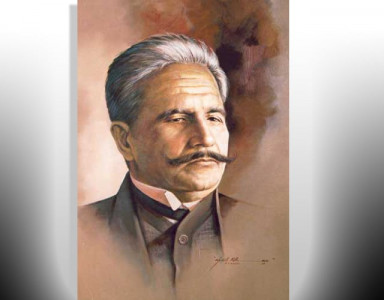
<p align="left">This is where there is a major difficulty in understanding Allama Iqbal. We tend to presume that when he advocated an Islamic state, it would have meant that non-Muslims could not have equal rights. This leads to three other misconceptions, which need to be dispelled right away.</p>
<p align="left">They are:<em> </em>Iqbal was a secularist in some ways, or a socialist, or that he was opposed to democracy.</p>
<p align="left">
<h3 align="left">Misconception one: Iqbal supported secularism</h3>
<p align="left">Due to our misconception of an Islamic state, some of us are led to believe that all references to universal ideals in the poetry and prose of Iqbal amounted to an affirmation of secularism.</p>
<p align="left">The truth is that Iqbal clarified his position on this issue repeatedly, beginning with his groundbreaking paper in 1908:</p>
<p align="left"> “…according to the law of Islam there is no distinction between the Church and the State.” (‘Political Thought in Islam’; 1908)</p>
<p align="left">
<h3 align="left">Misconception two: Iqbal was a socialist</h3>
<p align="left">The idea that Iqbal was a socialist was first proposed by a journalist in 1923, and Iqbal refuted it immediately in a public statement. However, since many people believe that socialism and capitalism are the only options available to human mind, they tend to interpret all references to social justice in Iqbal’s writings as a partial approval of socialism. His position on this issue is best represented by his own words:</p>
<p align="left">“Both nationalism [secularism] and atheistic socialism, at least in the present state of human adjustments, must draw upon the psychological forces of hate, suspicion, and resentment which tend to impoverish the soul of man and close up his hidden sources of spiritual energy.” (<em>The Reconstruction of Religious Thought in Islam; </em>1934).</p>
<p align="left">
<h3 align="left">Misconception three: Iqbal was opposed to democracy</h3>
<p align="left">The most widespread and bizarre misconception is that Iqbal was opposed to democracy. A few of his verses are lifted out of context and quoted with complete confidence to support this assertion. Of course, the most infamous is the Urdu couplet which could be translated as: “Democracy is a form of government in which people are counted but not weighed.” Nobody bothers to look up the preceding couplet in the poem, or the footnote, where it is clearly mentioned that Iqbal is quoting a French novelist, Stendhal. Iqbal’s own opinion on the matter was:</p>
<p align="left">“Democracy, then, is the most important aspect of Islam regarded as a political ideal.” (‘Islam as a Moral and Political Ideal’; 1909)</p>
<p align="left">
<h3 align="left">The promise</h3>
<p align="left">It may seem to be a contradiction that Iqbal believed in democracy and denounced theocracy, but was also opposed to secularism and socialism.</p>
<p align="left">If this is a contradiction, it is also reflected in the entire history of the Muslim world since 1954 (except some Arab states). Unlike India, Muslim countries have not had smooth runs of democracy despite being free for so long. At the same time, they are equally unwilling to replicate the kind of monarchy introduced in some Arab states by European powers during the First World War.</p>
<blockquote>
<p align="left"><em>So what do we want and how can it be achieved?</em></p>
</blockquote>
<p align="left">This is the enigma which Iqbal promises to solve for us. Perhaps that is why he didn’t die. He is back.</p>
<p align="left">_________________________________________________________</p>
<p align="left"><strong><em>This is a weekly web feature that will appear on The Express Tribune website.</em></strong></p>
<p align="left"><em>Khurram Ali Shafique is the author of Iqbal: an Illustrated Biography (2006) and offers online courses in Iqbal Studies for Iqbal Academy Pakistan at <a href="http://www.marghdeen.com/">Marghdeen Learning Centre</a>.</em></p>
<p align="left">
<h3 align="left">Check it out</h3>
<p align="left">Useful resources for Iqbal Studies, including free online versions of the works of Iqbal with English translations, are available on the <a href="http://allamaiqbal.com/">official website of Iqbal Academy Pakistan</a>.</p>
</p>
			<br clear="all"/>
		]]>
		</description>

		<media:content width="424" height="318"
							isDefault="true" medium="image" url="http://i1.tribune.com.pk/wp-content/uploads/2012/12/477723-allamaiqbalbyIqbalAcademyPakistan-1355145266-151-640x480.jpg">
			<media:title>allama iqbal by Iqbal Academy Pakistan</media:title>
			<media:description>Iqbal was not a secularist, or a socialist, or opposed to democracy. PHOTO: IQBAL ACADEMY PAKISTAN</media:description>

			<media:thumbnail url="http://i1.tribune.com.pk/wp-content/uploads/2012/12/477723-allamaiqbalbyIqbalAcademyPakistan-1355145266-151-160x120.jpg" width="160" height="120" />
      </media:content>

		<wfw:commentRss></wfw:commentRss>
		<slash:comments>17</slash:comments>
	</item>
		<item>
		<title>Sohni dharti: From Heer Ranjha to the gandasa</title>
		<link>http://tribune.com.pk/story/468605/sohni-dharti/</link>
		<pubDate>Sun, 25 Nov 2012 07:45:13 +0000</pubDate>

		<guid isPermaLink="false">http://tribune.com.pk/?p=468605</guid>

		<description>
		<![CDATA[
			<a href="http://tribune.com.pk/story/468605/sohni-dharti/">
				<img src="http://i1.tribune.com.pk/wp-content/uploads/2012/11/468605-Sohni-1353419067-306-160x120.JPG" width="160" height="120" alt="" />
			</a>
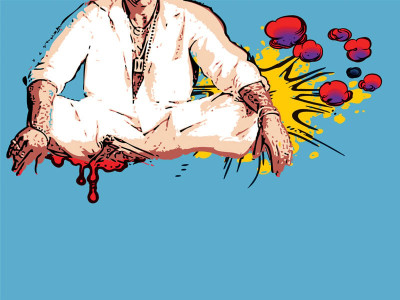
			<p><p><strong>“This is our misfortune: we are giving birth to a society where courage has come to be understood as being a goonda, and the nobility of character is seen as cowardice. Today, a blood-dripping <em>gandasa</em> has become the icon of our culture and civilisation, instead of the reed pipe emanating the melodies of love. Please think, what have we made of this beautiful land (<em>sohni dhart</em>i) of Heer and Ranjha?”</strong></p>
<p>This question was raised thirty-two years ago by Pervez Malik and Masroor Anwar — members of the same team that had given the country its immortal national song, “<em>Sohni Dhart</em>i”.</p>
<p>The glorification of crime and the presence of outlaws in the world of literature and cinema may have started much earlier, but it reached unprecedented height when the character created by writer and poet Ahmad Nadeem Qasmi appeared on screen in <em>Wahshi Jatt</em> (1975) and <em>Maula Jatt</em> (1979). Hence the visionaries of the <em>Sohni Dhart</em>i school of thought were compelled to raise a question, and they did that through the movie <em>Rishta</em>, released on September 5, 1980. The lines translated above are taken from a dialogue of the protagonist in that movie, and constitute the central idea of the film.</p>
<p>Of course, an obvious answer to the question could be that the blood-dripping <em>gandasa</em> is a legitimate icon of our culture and civilisation because it depicts our social reality more than the reed of Rumi and Ranjha. Qasmi, students of literature and the creators of goonda movies would perhaps unanimously agree on this point in spite of any differences in their respective social backgrounds.</p>
<p>It is therefore important to remember those who dared to differ from this point of view. These visionaries believed that it was not sufficient to depict a problem but to also suggest the possible solutions. Through <em>Rishta</em> and a series of subsequent movies culminating in the blockbuster <em>Ghareebon Ka Badshah</em> (1988), Pervez Malik and Masroor Anwar evolved and depicted a coherent social philosophy, addressing the relevant issues from a holistic point of view.</p>
<p><em>Rishta</em> was a story about family vendetta but ended in a climax which incorporated motifs from the incident of Karbala. The heroine of the story was an old woman (played by Sabiha Khanum), whose husband had been assassinated by Shahbaz Khan (Mehboob Alam) due to a family feud. Shahbaz had also sworn to eliminate his enemy’s entire bloodline (just like Maula in Qasmi’s short story). This eventually leads to a head-on clash between the well-armed mercenaries of Shahbaz and the poorly equipped supporters of the old woman and her son, Rahat (played by Nadeem). The woman tries to stop the battle, and gets mortally wounded by Shahbaz. At this point, a few minutes before the ending, the audience learns the first name of this woman, who has been addressed throughout the movie by her title. Her name is Zainab.</p>
<p>Mortally wounded, Zainab announces forgiveness for her assassin. “Neither do I want retribution in the Hereafter,” she declares. “I forgive you in both worlds.” In a dying speech, she explains to Shahbaz that a better world cannot be created for future generations unless we are prepared to offer some sacrifice today. What she has sacrificed is her life and what she succeeds in eliciting from her enemy is the matching sacrifice of the enemy’s base instinct and false ego. Zainab’s son Rahat and Shahbaz’s daughter Saira, who love each other secretly, now receive the consent of Shahbaz to be united in marriage. This vindicates the belief of Zainab that forgiveness and sacrifice on part of one generation leads to happiness and prosperity for the next generation.</p>
<p>Qasmi had depicted the mother of Maula as the instigator of hatred and vendetta, who never stopped nagging her son to spill more blood and demanding that the entire bloodline of their enemy should be eliminated from the face of the earth (and this was the “literary” origin of the famous “mother” of Punjabi movies, whose shout is loud enough to be heard by her son miles away). Hence, the mother in Qasmi’s story becomes the proverbial “temptress” who causes man to commit the “original sin”. Perhaps as a conscious rebuttal of this theory, <em>Rishta</em> offers three motherly characters (played by Sabiha Khanum, Nayyar Sultana and Najma Mehboob), whose circumstances are very different from each other but they all define motherhood in terms of love, sacrifice and social responsibility.</p>
<p>The fundamental difference boils down to the fact that Pervez Malik and Masroor Anwar depict the human being as capable of making choices based on principles. On the other hand, Qasmi and the creators of goonda films agree, implicitly and explicitly, that the human being is the prisoner of instinct and social conditioning. In the short story <em>Gandasa</em>, Maula is a creature of instinct. In the climax of the story, he temporarily stops taking revenge but that is because his instinct for revenge has been overcome by some other instinct (and, once again, this new instinct is stirred in him by yet another woman, who has no other function in the story).</p>
<p>Divided by instinct and social conditioning, the educated and the unschooled live in two parallels worlds in the imagination of Qasmi. One of these is the world of the unschooled, to which Maula belongs together with his friends, family and enemies. The other is the world of public servants, of which we are given brief glimpses through the police and judiciary. The unschooled world of Maula seems to be alive with base instinct and various kinds of lust, and the distant world of the educated ones appears to be impotent and lacking in any purpose. Creatures from these two universes never unite and their interaction is based on apathy and mutual suspicion.</p>
<p>The world of Pervez Malik and Masroor Anwar is fundamentally opposed to this conception of the human beings. Regardless of education, characters can rise above instinct. They can embrace principles, choose values, and by the virtue of these traits they may transcend the artificial divisions of social and educational backgrounds. Ultimately, they can become masters of destiny, and not only change hearts but also alter the course of the future through the conscious sacrifice of personal interest.</p>
<p>This, then, is the conception of human being famously incorporated into the second line of <em>Sohni Dhart</em>i: “As long as the world is there, may we see you prosper” (<em>Jab tak hai yeh duniya baaqi, hum dekhain aabad tujhay</em>).</p>
<p>Whether we choose the philosophy of <em>gandasa</em> or the world of <em>Sohni Dhart</em>i is up to us. However, the choice cannot be made until we have learnt about both. It seems that every one of us has happily, willingly and consciously adopted the national song ‘<em>Sohni Dhart</em>i’ as our collective identity. Yet, we have never bothered to find out anything about the poet who wrote it, the stories he told, and the school of thought to which he belonged. This, perhaps, is the correct answer to the question which he asked in 1980: <em>Why has a blood-dripping gandasa become the icon of our culture and civilisation, instead of the reed pipe emanating the melodies of love?</em></p>
<p>Khurram Ali Shafique is the author of <em>Iqbal: an Illustrated Biography</em> (2006) and offers online courses in Iqbal Studies for Iqbal Academy Pakistan. khurramsdesk@gmail.com</p>
<p><em>Published in The Express Tribune, Sunday Magazine, November 25<sup>th</sup>, 2012.</em></p>
<p>Like Express Tribune Magazine on <a href="https://www.facebook.com/pages/Express-Tribune-Magazine/496571717038735">Facebook</a> and follow at <a href="https://twitter.com/ETribuneMag">@ETribuneMag</a></p>
</p>
			<br clear="all"/>
		]]>
		</description>

		<media:content width="424" height="318"
							isDefault="true" medium="image" url="http://i1.tribune.com.pk/wp-content/uploads/2012/11/468605-Sohni-1353419067-306-640x480.JPG">
			<media:title>Sohni</media:title>
			<media:description>The rise of the Lollywood Goonda did not go unchallenged.</media:description>
			<media:thumbnail url="http://i1.tribune.com.pk/wp-content/uploads/2012/11/468605-Sohni-1353419067-306-160x120.JPG" width="160" height="120" />
      </media:content>

		<wfw:commentRss></wfw:commentRss>
		<slash:comments>2</slash:comments>
	</item>
		<item>
		<title>Movie review: Skyfall - thank you for not smoking, Mr Bond</title>
		<link>http://tribune.com.pk/story/465596/movie-review-skyfall-thank-you-for-not-smoking-mr-bond/</link>
		<pubDate>Sun, 18 Nov 2012 06:48:07 +0000</pubDate>

		<guid isPermaLink="false">http://tribune.com.pk/?p=465596</guid>

		<description>
		<![CDATA[
			<a href="http://tribune.com.pk/story/465596/movie-review-skyfall-thank-you-for-not-smoking-mr-bond/">
				<img src="http://i1.tribune.com.pk/wp-content/uploads/2012/11/465596-sky-1352901887-102-160x120.jpg" width="160" height="120" alt="" />
			</a>
			<p><p><strong>A secret agent in a white car chases two motorcyclists in a crowded bazaar and shoots them dead. A Land Cruiser, in a bid to scoop up the agent, speeds on the wrong side of the road and accidentally runs over another motorcyclist. The rescue attempt fails, and the agent is caught by the crowd and arrested by traffic wardens.</strong></p>
<p>The name is Davis, Raymond Davis.</p>
<p>The world-infamous incident occurred in Lahore on January 27, 2011. Only sixteen days earlier, Eon Productions had officially announced the pre-production of the 23rd James Bond movie. The weeks when the Lahore incident stayed in the headlines across the world was apparently the period when John Logan, Neal Purvis and Robert Wade were working on the script of the new movie in the light of director Sam Mendes’ vision: “It was still possible to make a big, fabulous, glamorous, escapist movie and yet, at the same time, to say something about the world that we are living in.”</p>
<p>Is it then no coincidence that the opening sequence of <em>Skyfall</em> is set in a busy bazaar? It’s Istanbul instead of Lahore, and other details differ too as they should. But the political and diplomatic implications still get represented symbolically.</p>
<p>Conventionally, the pre-title sequences in the Bond movies have been used for establishing 007 as a man who can do the impossible and cannot be defeated or killed (with some partial exceptions such as in <em>You Only Live Twice </em>and<em> Die Another Day</em>). This time, the sequence concludes with the secret agent getting unceremoniously shot in the middle of the action. The hard disk stolen in the process blows the cover of other secret agents (as the electronic devices recovered from Raymond Davis reportedly led to arrests on charges of espionage in Pakistan).</p>
<p>The question whether the trigger-happy approach to espionage has become redundant in our times is central to this film. The film answers the question in the affirmative to the great dismay of pacifists. However, being a true artist, the director has offered his answer through a multi-dimensional masterpiece which can be used to explore the present stream of British consciousness.</p>
<p>Mendes has destroyed “the entire genre, in order to rebuild it” (to quote him from an interview). He has been helped by ‘a dream cast’ — Daniel Craig, Judi Dench, Ralph Fiennes, Helen McCroy, Albert Finney, Bérénice Marlohe, Naomi Harris, Ben Whishaw, Ola Rapace and, of course, the Oscar-winning Spanish actor Javier Bardem, one of the most memorable villains in the entire James Bond series.</p>
<p>This is apt for a film where the protagonist is not exactly perfect. Bond is incapable of shooting his target accurately and ends up losing. He kills a villain who was going to commit suicide in any case, and he fails to save the person whose assassination was the villain’s goal.</p>
<p>The current director has completed the ‘reboot’ of James Bond and MI6 as symbolic representations of what Great Britain is in recent history: “We are not now that strength which in old days/ Moved heaven and earth…” These lines from Tennyson are juxtaposed with a worn-out James Bond, a besieged M, a tribunal of British parliamentarians and a former agent of the British secret service now turned into arch villain. The emerging theme is revenge through suicide, the strings of which are shown to be in the hands of a former British agent rather than anyone else.</p>
<p>A British writer’s fantasy that Her Majesty’s government issues its servant a ‘license’ to kill people in other countries was a symbolic statement that Britain still rules the world. That may have been the reason why 007 sprang in the mind of Ian Fleming in 1952. It may also explain why Bond’s 23rd big-screen appearance at an exceptionally difficult time in British history has broken all records of first-week revenues at the box office in that country.</p>
<p><em>Published in The Express Tribune, Sunday Magazine, November 18<sup>th</sup>, 2012.</em></p>
<p>Like Express Tribune Magazine on <a href="https://www.facebook.com/pages/Express-Tribune-Magazine/496571717038735">Facebook</a> and follow at <a href="https://twitter.com/ETribuneMag">@ETribuneMag</a></p>
</p>
			<br clear="all"/>
		]]>
		</description>

		<media:content width="424" height="318"
							isDefault="true" medium="image" url="http://i1.tribune.com.pk/wp-content/uploads/2012/11/465596-sky-1352901887-102-640x480.jpg">
			<media:title>sky</media:title>
			<media:description></media:description>
			<media:thumbnail url="http://i1.tribune.com.pk/wp-content/uploads/2012/11/465596-sky-1352901887-102-160x120.jpg" width="160" height="120" />
      </media:content>

		<wfw:commentRss></wfw:commentRss>
		<slash:comments>8</slash:comments>
	</item>
		<item>
		<title>Re-reading history: Who wants to be enlightened by Iqbal?</title>
		<link>http://tribune.com.pk/story/463092/re-reading-history-who-wants-to-be-enlightened-by/</link>
		<pubDate>Fri, 09 Nov 2012 05:45:37 +0000</pubDate>

		<guid isPermaLink="false">http://tribune.com.pk/?p=463092</guid>

		<description>
		<![CDATA[
			<a href="http://tribune.com.pk/story/463092/re-reading-history-who-wants-to-be-enlightened-by/">
				<img src="http://i1.tribune.com.pk/wp-content/uploads/2012/11/463092-Iqbaldesignjamalkhursheed-1352404002-237-160x120.JPG" width="160" height="120" alt="" />
			</a>
			<p><div><strong class='location'>LONDON:&nbsp;</strong>
<p><strong>Iqbal was on his way to the Third Round Table Conference, which was going to be held in London at the end of 1932.</strong></p>
<p>In Bombay, a representative of the Roznamah-e-Khilafat asked him on his position if the Hindu majority of British India accepted 13 out of the 14 points of Jinnah but did not concede to separate electorates. Iqbal replied, “In my opinion, the Musalmans do not want to give up separate electorates…” The representative asked what Iqbal would say if the Muslim majority thought otherwise at the forthcoming conference. Iqbal’s answer was, “Then I, too, shall abide by that decision and will not work against it.”</p>
</div>
<p>In a nutshell, this is how Iqbal was different from most of the educated ones who live in his country today. On an issue which he regarded to be a matter of life and death for Islam in India, he was willing to “abide by” the decision of the nation, even if the decision favoured what he considered to be collective suicide.</p>
<p>Seeking consensus, and respecting it, was a principle he upheld not only as a politician but also as a poet, philosopher and social activist. Even when proposing the birth of a new state, which appeared to him to be “the final destiny” of his people, he started his presidential address by saying: “I propose, not to guide you in your decisions, but to attempt the humbler task of bringing clearly to your consciousness the main principle which, in my opinion, should determine the general character of these decisions.”</p>
<p>This may explain to a great extent why his legacy is so enduring.  It may also explain why it has been misunderstood so monstrously by academics, alike in Pakistan and the West.</p>
<p>We tend to find a definite ideology in his writings, whereas he is more of an educator. His philosophy is a tool for training the minds for looking into the conscience of nations and humanity. Since this conscience is ever-changing and always bringing forth new possibilities unknown before, we can only call it a dynamic ideology—if we must call it an ideology at all.</p>
<p>The basic principles, which he offers to us for seeing the world, may be divided broadly into five domains of knowledge: history, art and literature, politics, religious thought and education (and various fields associated with each of these). Even a cursory look at the fundamental principles propounded by him in any of these domains would show us how our outlook on the world is exactly the opposite of how he wanted us to view things.</p>
<p>For instance, the two fundamental principles of history, according to him, are that the entire humankind is evolving like a single organism and that this evolution can only lead to perpetual improvement on the whole (see, for instance, the fifth lecture in The Reconstruction of Religious Thought in Islam).</p>
<p>Ironically, we do not see our times in this light and that brings us in a conflict with Iqbal’s take on literature. According to him, literature is like a collective dream that comes true. Therefore, the purpose of literature is to present an ideal world—it should give us imagined situations where things get sorted out due to the true potential hidden in human beings.</p>
<p>Hence, politics itself can seldom change destinies. Politics, good or bad, can do nothing more than turning into reality the dreams or nightmares which people have chosen through literature. “Nations are born in the hearts of poets,” Iqbal wrote in his private notebook in 1910. “They prosper and die in the hands of politicians.”</p>
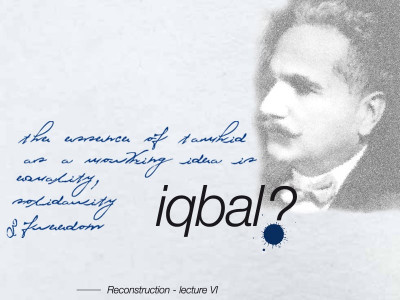
<p>Therefore, the ‘Unity of God’ is not a dogma to him. “The essence of Tawhid, as a working idea, is equality, solidarity, and freedom,” he famously stated in the sixth lecture of the Reconstruction. Elsewhere, he expanded the concept into a book-length Persian poem.</p>
<p>The most daring implication of this last statement is that the three highest ideals over which the Western civilisation has consensus (equality, solidarity and freedom) are the very essences of Muslim faith “for which even the least enlightened man among us can easily lay down his life.” If so, then the much-touted “clash of civilisations” is an impossibility in our times, and a figment of somebody’s imagination. The real problem must be something else, somewhere else.</p>
<p>The real promise of Iqbal as a teacher is that he can help us locate that real centre of problems in our time, and to correct the problems with the least resentment to the many.  Khurram Ali Shafique is the author of Iqbal: an Illustrated Biography (2006) and offers online courses in Iqbal Studies for Iqbal Academy Pakistan. khurramsdesk@gmail.com<em></em></p>
<p><em>Published in The Express Tribune, November 9<sup>th</sup>, 2012.</em></p>
</p>
			<br clear="all"/>
		]]>
		</description>

		<media:content width="424" height="318"
							isDefault="true" medium="image" url="http://i1.tribune.com.pk/wp-content/uploads/2012/11/463092-Iqbaldesignjamalkhursheed-1352404002-237-640x480.JPG">
			<media:title>Iqbal-design-jamal khursheed</media:title>
			<media:description>Iqbal&#039;s philosophy is a tool for training the minds for looking into the conscience of nations and humanity. DESIGN: JAMAL KHURSHEED</media:description>
			<media:thumbnail url="http://i1.tribune.com.pk/wp-content/uploads/2012/11/463092-Iqbaldesignjamalkhursheed-1352404002-237-160x120.JPG" width="160" height="120" />
      </media:content>

		<wfw:commentRss></wfw:commentRss>
		<slash:comments>15</slash:comments>
	</item>
		<item>
		<title>Immortal beloved</title>
		<link>http://tribune.com.pk/story/393670/immortal-beloved/</link>
		<pubDate>Sun, 17 Jun 2012 05:56:24 +0000</pubDate>

		<guid isPermaLink="false">http://tribune.com.pk/?p=393670</guid>

		<description>
		<![CDATA[
			<a href="http://tribune.com.pk/story/393670/immortal-beloved/">
				<img src="http://i1.tribune.com.pk/wp-content/uploads/2012/06/393670-ApaintingofNezamiGanjavihimself-1339682835-275-160x120.jpg" width="160" height="120" alt="" />
			</a>
			<p><p><strong>Layla and Majnun, Shireen and Farhad &#8230; these are the lovers of legend, whose romances have been told and retold for centuries. But how many know of the Persian poet Nezami Ganjavi who re-imagined these timeless tales? And how many know that he modelled his legendary heroines after his true beloved, a slave girl named Afaq? </strong></p>
<p>“Under the dark shadow of her hair, her face was a lamp or rather a torch, with ravens weaving their wings around it; And she really did not need rouge since even the milk she drank turned into the colour of roses on her lips and cheeks.”</p>
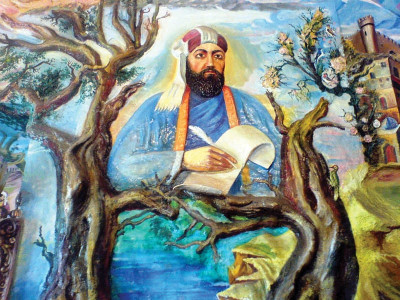
<p>That is how her lover described her, and the lover was no ordinary man. He is the one who gave the world the legends of Shirin, Farhad, Layla and Majnun. He was the Persian poet Nezami Ganjavi (1141-1209) and the woman whose flowing hair he compares to the Ravens’ ebon wings was Afaq.</p>
<p>Nezami’s worldview was inspired by Sanai, a famous poet from Ghazna who had declared: “The pious man combines two in one but the lover combines three in one.” Here, “two in one” is a reference to the individual and God while “three in one” alludes to the individual, society and God. Hence, Sanai gave birth to a trend in literature where the beloved represented the spirit of collective life.</p>
<p>Until then, Sufis had taught detachment from the world, but inspired by the vision of Sanai, a young Nezami felt that the message could be developed further for discovering a unity between the individual, society and God. It was this view that he applied to his first book, which he finished at the age of 25 in 1176 AD, and about which he declared that it contained “resources for becoming a dervish as well as a king.” Quite aptly, he called it <em>Makhzanul Asrar (The Treasure of Secrets).</em></p>
<p>In keeping with contemporary tradition, Makhzan was dedicated to a local ruler named Bahram Shah. Since printing had not been introduced in those days, the “publishing” of a book meant dedicating it to a king or a noble who would not only reward the labour but may also want to disseminate a book that contained a preface in his praise. The rewards offered to Nezami for his labours included a slave girl named Afaq.</p>
<p>Nezami fell in love with her, freed her and married her. In an age when men could easily keep harems, he was amazingly monogamous and remarried only after Afaq’s death. One can imagine the passion which the pioneer of love poetry must have possessed, but how can one estimate the allure of the woman whose soul earned, received and (undoubtedly) deserved all this passion?</p>
<p>Actually, that is the catch. When Nezami picked the folklore of Shirin and Farhad for remaking the heroine in the mould of Afaq, he described Shirin as ‘the soul of Iran’. Hence, by analogy, the stonecutter Farhad would become the common citizen who literally moves mountains for the sake of that soul. Shirin’s marriage with Emperor Khusrau Pervez and her falling in love with him would signify that nations were identified by their rulers in that ancient world, which the advent of Islam was bringing to a close.</p>
<p>There was something about either Afaq or Nezami, or both, due to which the poet’s love for her did not remain restricted to the physical existence of a woman. It instead turned into a living experience of the kind of organic unity that makes the death and resurrection of the entire humanity akin to the death and resurrection of an individual.</p>
<p>In 1180 AD, Afaq died before the epic <em>Khusrau-o-Shireen </em>could be finished, and while Nezami did remarry, it seems he could never get over her memory. When asked by King Sherwan Shah to write an epic about the Arabian folk tale of Layla and Majnun, which was in turn probably based on a true story that had taken place four hundred years earlier, Nezami was reluctant. However, young Muhammad bin Ilyas, his son from Afaq, also showed an interest in the story and hence the soul of Iran that had ‘died’ as Shirin came back to life as “the spirit of all human beings” personified by Layla. She also was Afaq, since the “souls” of all cultures were one, as Nezami was going to show in the book he would write after <em>Layla Majnu</em>n.</p>
<p>By the time he finished <em>Layla Majnu</em>n (1188 AD), in which the heroine did not fall in love with the prince (unlike Shirin), signifying that civilisation was gradually moving away from the kings, Nezami had lost his second wife as well.</p>
<p>The next work, <em>Haft Paykar (The Seven Beauties</em>), featured seven princesses from different lands narrating seven stories. Each story depicted a stage of self-development equally applicable to individuals as well as societies. These stages could be revisited many times.</p>
<p>Nezami remarried for the last time and started his final epic <em>Iskandernameh</em> (The Book of Alexander), a grand combination of ingredients from East, West, Iran, Arabia, Mesopotamia, India and many other climes. Perhaps Nezami was now describing a “final combination” of humanity that might be possible sometime in a distant future. It’s a testament to his vision that this sort of cultural and physical fusion, albeit incomplete, can be seen in the great melting pots of the world.</p>
<p>When his third wife died while he was writing the last epic, he declared that each book had cost him a wife. He had remained loyal to each of his wives while they lived, but the one who assumed a life of her own beyond death was Afaq. If the souls of Shirin and Layla were the collective ego of humanity, their outward forms were modelled on Afaq in the works of Nezami. While her spirit has already been granted a form of immortality, her physical form also found a way of surviving.</p>
<p>In March 1923, Nezami’s grave in his native city of Ganja (now in Azerbaijan) was opened up to move his remains to a newly built mausoleum. Inside were found not one but two skeletons: one of a man and the other of a woman. Experts believed the latter skeleton to be that of Afaq’s, and it was also moved to the new grave along with the remains of the poet himself. On the new grave, someone could have even placed the epitaph that alludes to the combined grave of Layla and Majnun at the end of Nezami’s version of that story:</p>
<p>“Two lovers lie awaiting in this tomb</p>
<p>Their resurrection from the grave’s dark womb.</p>
<p>Faithful in separation, true in love,</p>
<p>One tent will hold them in the world above.”</p>
<p><em>Published in The Express Tribune, Sunday Magazine, June 17<sup>th</sup>, 2012.</em></p>
</p>
			<br clear="all"/>
		]]>
		</description>

		<media:content width="424" height="318"
							isDefault="true" medium="image" url="http://i1.tribune.com.pk/wp-content/uploads/2012/06/393670-ApaintingofNezamiGanjavihimself-1339682835-275-640x480.jpg">
			<media:title>A painting of Nezami Ganjavi himself.</media:title>
			<media:description>A painting of Nezami Ganjavi himself.</media:description>
			<media:thumbnail url="http://i1.tribune.com.pk/wp-content/uploads/2012/06/393670-ApaintingofNezamiGanjavihimself-1339682835-275-160x120.jpg" width="160" height="120" />
      </media:content>

		<wfw:commentRss></wfw:commentRss>
		<slash:comments>3</slash:comments>
	</item>
	
</channel>
</rss>
<!-- Performance optimized by W3 Total Cache. Learn more: http://www.w3-edge.com/wordpress-plugins/

Page Caching using apc
Database Caching 15/33 queries in 0.041 seconds using memcached
Object Caching 862/972 objects using apc

 Served from: tribune.com.pk @ 2013-05-22 04:26:31 by W3 Total Cache -->