<?xml version="1.0" encoding="UTF-8"?>
<rss version="2.0"
	xmlns:content="http://purl.org/rss/1.0/modules/content/"
	xmlns:wfw="http://wellformedweb.org/CommentAPI/"
	xmlns:dc="http://purl.org/dc/elements/1.1/"
	xmlns:atom="http://www.w3.org/2005/Atom"
	xmlns:sy="http://purl.org/rss/1.0/modules/syndication/"
	xmlns:slash="http://purl.org/rss/1.0/modules/slash/"
	xmlns:media="http://search.yahoo.com/mrss/"
	>

<channel>
	<title>The Express Tribune &#187; Maria Waqar</title>
	<atom:link href="http://tribune.com.pk/author/2205/maria-waqar/feed/" rel="self" type="application/rss+xml" />
	<link>http://tribune.com.pk</link>
	<description>Latest Breaking Pakistan News, Business, Life, Style, Cricket, Videos, Comments</description>
	<lastBuildDate>Fri, 24 May 2013 06:49:21 +0000</lastBuildDate>
	<language></language>
	<sy:updatePeriod>hourly</sy:updatePeriod>
	<sy:updateFrequency>1</sy:updateFrequency>
	<generator>http://wordpress.org/?v=3.5.1</generator>

		<item>
		<title>Beyond beards and stilettos  </title>
		<link>http://tribune.com.pk/story/402524/beyond-beards-and-stilettos/</link>
		<pubDate>Mon, 02 Jul 2012 16:58:23 +0000</pubDate>

		<guid isPermaLink="false">http://tribune.com.pk/?p=402524</guid>

		<description>
		<![CDATA[
			<a href="http://tribune.com.pk/story/402524/beyond-beards-and-stilettos/">
				<img src="http://i1.tribune.com.pk/wp-content/uploads/2012/07/402524-MariaWaqarNew-1341246070-802-160x120.JPG" width="160" height="120" alt="" />
			</a>
			<p><p>Over the last decade, a stereotypical image of Pakistan has crystallised over a span in the Western media. For most people abroad, Pakistan is a haven for bearded, gunslinging extremists gung-ho about blowing places up and imposing Sharia law. Contrary to this depiction are some alternative stories about Pakistan that have been making headlines abroad.</p>
<p>Recently, Declan Walsh’s piece, “<a href="http://www.nytimes.com/2012/06/25/world/asia/in-a-troubled-country-still-time-for-high-society.html?pagewanted=all">In a Troubled Country, Still Time for High Society</a>” (published June 24, 2012) in <em>The New York Times</em>, about the high society in Pakistan, offers a glimpse of a world of Louboutins and designer lawn. Walsh’s article is heralded by many similar efforts, which show ‘the other side’ of Pakistan: Adam Ellick’s report in <em>The New York Times</em>, “<a href="http://www.nytimes.com/2009/04/28/world/asia/28fetish.html?pagewanted=all">Lacy Threads and Leather Straps Bind a Business</a>” (April 27, 2009), on the manufacturing of sex toys in Karachi, Jonathan Foreman’s article “<a href="http://www.telegraph.co.uk/news/worldnews/asia/pakistan/9153934/Ale-under-the-veil-the-only-brewery-in-Pakistan.html">Ale under the veil: the only brewery in Pakistan</a>” (March 24, 2012) in <em>The Telegraph</em> on the brewing industry in Pakistan and the countless headlines on Veena Malik’s nude photo shoots in every top Western publication.</p>
<p>The underlying idea in most of these works is the same: in the Islamic Republic of Pakistan — the stronghold of radical forces — there are startling contradictions. Behind the veil of extremism, there is sex, alcohol and high fashion. And strongly depicted in many of these stories is a clash between the liberal cohort and the extremists. The brothers who manufacture sex toys in the ‘Islamist stronghold’ of Karachi were apparently threatened by the Taliban. Veena Malik vowed to challenge death threats by Islamists and brewing beer is a dangerous job in ‘one of the world’s strictest Islamic states’. Notice the similarity in the narrative?</p>
<p>Thus, for the audience abroad, Pakistan seems like a burka-clad woman wearing the skimpiest bikini underneath. There’s no better metaphor to describe the tantalising spectre of Pakistan’s liberal-conservative dichotomy that captivates the Western imaginary. Even though some might criticise this as blatantly stereotyping a country, it’s actually clever journalism because it gets people talking.</p>
<p>However, Pakistanis themselves have started mistaking this powerful image of their country as its reality. Clash of civilisations might be a shoddy theory but for educated Pakistanis, it actually has great resonance. They think that their country is nothing but a grand battlefield for two opposing worldviews. Countless op-eds have been published on the conflict between modernity and tradition, moderate Islam and extremism and liberalism and <a href="http://tribune.com.pk/story/372054/extremism-thrives-in-pakistan-despite-bin-laden-death/">radicalism that has supposedly gripped our country</a>. This type of writing reveals a typical mindset, which considers that Pakistan is defined by the clash between liberals and extremists. Yet, in reality, the two groups hardly cross paths; it’s not exactly Pakistan’s privileged lot that gets targeted in suicide bombings.</p>
<p>And so, when we want to show the ‘soft side’ of Pakistan to the world, we immediately think of touting the glamorous haven of fashion, music and parties that exists on the margins. We, too, want to project the paradox of Pakistan to salvage our image. But by negating one stereotype, we reinforce another.</p>
<p>So, let’s look around us and gauge the authenticity of this polarity. I, for one, don’t just see bearded mullahs and stiletto-wearing liberals.</p>
<p><em>Published in The Express Tribune, July 3<sup>rd</sup>, 2012.</em></p>
</p>
			<br clear="all"/>
		]]>
		</description>

		<media:content width="424" height="318"
							isDefault="true" medium="image" url="http://i1.tribune.com.pk/wp-content/uploads/2012/07/402524-MariaWaqarNew-1341246070-802-640x480.JPG">
			<media:title>Maria Waqar  - New</media:title>
			<media:description>The writer holds a master’s degree in political science from National University of Singapore and has worked as an associate sub-editor for The Express Tribune. She tweets @MariaWaqar</media:description>
			<media:thumbnail url="http://i1.tribune.com.pk/wp-content/uploads/2012/07/402524-MariaWaqarNew-1341246070-802-160x120.JPG" width="160" height="120" />
      </media:content>

		<wfw:commentRss></wfw:commentRss>
		<slash:comments>45</slash:comments>
	</item>
		<item>
		<title> Plants</title>
		<link>http://tribune.com.pk/story/394249/plants/</link>
		<pubDate>Fri, 15 Jun 2012 18:14:17 +0000</pubDate>

		<guid isPermaLink="false">http://tribune.com.pk/?p=394249</guid>

		<description>
		<![CDATA[
			<a href="http://tribune.com.pk/story/394249/plants/">
				<img src="http://i1.tribune.com.pk/wp-content/uploads/2012/06/394249-MariaWaqarNew-1339776533-287-160x120.JPG" width="160" height="120" alt="" />
			</a>
			<p><p>Empty vessels make the loudest noise. This saying comes to my mind whenever I hear TV anchors stridently interrogating politicians. But perhaps, nothing has revealed the hollowness of their screeching voices more so than the <a href="http://tribune.com.pk/story/393636/video-leak-lucman-bukhari-run-planted-show-with-malik-riaz/">video showing Meher Bokhari and Mubashar Lucman’s rehearsal for their interview</a> with property tycoon Malik Riaz.</p>
<p>In this leaked off-camera footage, Bokhari and Lucman openly discuss and plan the interview questions with the interviewee — controversy’s new child — Malik Riaz. The two <em>Dunya News</em> anchors (Lucman has since been ‘suspended’) blatantly jettison their professional integrity by letting Riaz control the content and flow of their supposed ‘interrogation’. In fact, in the video, Bokhari admits that the interview is “planted”, but cautions that “no one must know about it”. Ironically, there are few who probably don’t know about the interview by now, since the leaked footage has spread like wildfire on social media. The general public is disgusted by the power struggles in the country, which also embroil high-profile journalists. It’s a shame that those who supposedly question and point fingers at others on the nation’s behalf have sullied consciences and unclean hands themselves.</p>
<p>Let’s not fool ourselves — we need to really understand that completely bias-free journalism doesn’t exist anywhere in the real world. Whatever we see on our screens — often posited as the revelation of the ultimate <em>sach</em> — is tainted with subjectivity on many levels. This is a fact that needs to be accepted because in the world of journalistic inquiry, objectivity is, more often than not, a myth.</p>
<p>But what really complicates matters is that the media in this country (and in many others too) is a muddled game of money and power — media houses are often funded by big businesses and may even have strong political connections. Thus, it’s no surprise that several prominent journalists are actually hand-in-glove with businessmen and politicians. In fact, the ‘hard talk’ we see on TV channels, is in many cases, favourable airtime for powerful people. And now this <a href="http://tribune.com.pk/story/394264/revelling-in-revelations/">leaked video has proven that anything will get a slot on TV if the price paid is a good one</a>.</p>
<p>In India, where a troika of power exists between journalists, businessmen and politicians, a similar incident took place a couple of years ago. In 2010, senior journalists Barkha Dutt and Vir Sanghvi were implicated in a scandal after <a href="http://www.google.com.pk/url?sa=t&amp;rct=j&amp;q=&amp;esrc=s&amp;source=web&amp;cd=2&amp;ved=0CF4QtwIwAQ&amp;url=http%3A%2F%2Fwww.youtube.com%2Fwatch%3Fv%3DHeDsSjDLy0g&amp;ei=XnnbT8vUFdCxrAfH64msCQ&amp;usg=AFQjCNFbRBClSsLVslbYcHv4yug8H_cDWw&amp;sig2=f80NUAJbZ4VclZxHhMud9Q">tapes of their phone conversations</a> with an influential corporate lobbyist Niira Radia were released. In a phone conversation with Radia, Sanghvi offered a completely scripted interview to India’s business magnate Mukesh Ambani. So, what explanation did Sanghvi give to clear his name? That he was merely ‘stringing her along’ to get information out of her.</p>
<p>Bokhari, too, <a href="http://www.pakistanherald.com/Program/Meher-Bukhari-explanation-about-her-yesterday-interview-June-14-2012-Mehar-Bukhari-10985">aired an explanation</a> — but one which was predictably unconvincing — to silence her detractors. But there was one important rhetorical question she raised: which journalist or anchor doesn’t have connections with politicians, generals, judges and businessmen? It’s not the partisanship of the journalists in our country, however, that is bothersome. It’s rather the act that they put up — the feigned interrogation, the exhibition of moral uprightness, the zeal for truthful inquiry — that’s highly unethical.</p>
<p align="left">This isn’t the first time that TV anchors have been shamefully exposed on social media and certainly won’t be the last. But soon, this incident will lapse from public memory. Sadly, American philosopher George Santayana’s saying — “those who do not learn from the past are condemned to repeat it”— fits our condition aptly. And so, as we conveniently forget, we now wait for another video, another scandal, another expose.<em></em></p>
<p><em>Published in The Express Tribune, June 16<sup>th</sup>, 2012.</em></p>
</p>
			<br clear="all"/>
		]]>
		</description>

		<media:content width="424" height="318"
							isDefault="true" medium="image" url="http://i1.tribune.com.pk/wp-content/uploads/2012/06/394249-MariaWaqarNew-1339776533-287-640x480.JPG">
			<media:title>Maria Waqar  - New</media:title>
			<media:description>The writer holds a master’s degree in political science from National University of Singapore and has worked as an associate sub-editor for The Express Tribune </media:description>
			<media:thumbnail url="http://i1.tribune.com.pk/wp-content/uploads/2012/06/394249-MariaWaqarNew-1339776533-287-160x120.JPG" width="160" height="120" />
      </media:content>

		<wfw:commentRss></wfw:commentRss>
		<slash:comments>21</slash:comments>
	</item>
		<item>
		<title>Why drones won’t work  </title>
		<link>http://tribune.com.pk/story/391682/why-drones-wont-work/</link>
		<pubDate>Sun, 10 Jun 2012 17:50:53 +0000</pubDate>

		<guid isPermaLink="false">http://tribune.com.pk/?p=391682</guid>

		<description>
		<![CDATA[
			<a href="http://tribune.com.pk/story/391682/why-drones-wont-work/">
				<img src="http://i1.tribune.com.pk/wp-content/uploads/2012/06/391682-MariaWaqarNew-1339346256-281-160x120.JPG" width="160" height="120" alt="" />
			</a>
			<p><p>When it comes to drone strikes by the US on targets inside Pakistan, <a href="http://tribune.com.pk/story/388730/pakistan-condemns-illegal-us-drone-strikes/">the clamour of divisive debate never seems to die down</a>. However, what is completely missing from this discussion — which seems to focus exclusively on the civilian casualties caused by drone strikes and their purported illegality — is the question of their strategic efficacy. We ought to, for a change, ask whether drone strikes work effectively in countering insurgency and in breaking, as it were, al Qaeda’s back.</p>
<p>The truth is that drone strikes will not work in Pakistan’s case. The use of air power is especially problematic because the enemy is not a government with visible centres of power and institutions, but in fact, a highly elusive one. Even though drones come with the assuring tagline of  ‘high precision’ and ‘smart’ weapons, there is no guarantee that they will precisely target only militants. <a href="http://tribune.com.pk/story/390485/probe-us-drone-civilian-casualties-united-nations/">Civilian casualties, a recurrent consequence of drone strikes, are strategically problematic</a> because they may cause the local population to feel considerable resentment towards the party that is sending the drones and will most likely increase sympathy among the locals for the militants. Israel has often deliberately used air power on Palestinian civilians to pressurise them into relinquishing support for Hamas, but this has hardly ever worked and only served to strengthen local support for Hamas. So America should ask itself whether this is something that it is willing to accept given that drone strikes inevitably lead to civilian deaths.</p>
<p>America has been using drones as a tool of combat in Pakistan since 2004 but the fact of the matter is that this has still not achieved its intended policy objective of destroying militancy by decapitating its leadership and annihilating its human and military resources. It’s clear that snipping off the monster’s head will not automatically spell its death. Killing high-value targets like Baitullah Mehsud or the <a href="http://tribune.com.pk/story/389355/al-qaeda-no-2-killed-in-drone-strike-us-official/">recent death of Abu Yahya al Libbi</a> is unlikely to extinguish the militant movement, with a successor taking their place. And even though the status of Behtullah’s successor, Hakimullah Mehsud, is unknown at the moment — since there have been several rumours of his death in drone strikes — the Tehreek-e-Taliban Pakistan is very much alive and kicking.</p>
<p>The fact is that Pakistan’s northwestern region is not the only place in the country that is plagued with militancy. So to selectively target hotspots where militants and their hideouts are to be found in Fata is to erroneously consider them as a kind of a ‘non-renewable resource’, which cannot be replenished by the network of well-equipped militants, spreading from Helmand province in Afghanistan to Punjab in Pakistan. This, in fact, raises an alarming question: <a href="http://tribune.com.pk/story/391529/obama-orders-sharp-increase-in-drone-strikes-report/">Will America actually start targeting other parts of Pakistan</a> if bombing select places in Fata does not yield speedy results?</p>
<p>A far more effective strategy to eradicate militancy would be to try and dry up its cause. The US should break its financial backbone by targeting the opium trade in Afghanistan and disrupting the flow of private financing, which potentially implicates its own allies like Saudi Arabia. While Washington has made some progress in tackling the opium trade in Afghanistan, tracking and clamping down on the global financial network that finances the militants has remained an elusive goal.</p>
<p>Thus, drone strikes, at least on their own are a strategic tactic that doesn’t seem to work, contrary to what the Obama administration would have us believe. Exertion of air power has hardly ever been the sole guarantor of success in war. However, when it comes to dealing with militancy in Pakistan, which now affects the entire country, <a href="http://tribune.com.pk/story/379824/shoot-the-drones/">drone strikes along the Pakistan-Afghanistan border can actually prove to be counterproductive</a>. Thus, even though the US has stepped up its aerial attacks in Pakistan, it can hope to ‘win’ nothing more than worse relations with its ally and further loathing by a Pakistani population that is already against the US foreign policy.</p>
<p><em>Published in The Express Tribune, June 11<sup>th</sup>, 2012.</em></p>
</p>
			<br clear="all"/>
		]]>
		</description>

		<media:content width="424" height="318"
							isDefault="true" medium="image" url="http://i1.tribune.com.pk/wp-content/uploads/2012/06/391682-MariaWaqarNew-1339346256-281-640x480.JPG">
			<media:title>Maria Waqar  - New</media:title>
			<media:description>The writer holds a master’s degree in political science from National University of Singapore and has worked as an associate sub-editor for The Express Tribune
</media:description>
			<media:thumbnail url="http://i1.tribune.com.pk/wp-content/uploads/2012/06/391682-MariaWaqarNew-1339346256-281-160x120.JPG" width="160" height="120" />
      </media:content>

		<wfw:commentRss></wfw:commentRss>
		<slash:comments>67</slash:comments>
	</item>
		<item>
		<title>How to save a life</title>
		<link>http://tribune.com.pk/story/386306/how-to-save-a-life-2/</link>
		<pubDate>Sun, 03 Jun 2012 05:07:11 +0000</pubDate>

		<guid isPermaLink="false">http://tribune.com.pk/?p=386306</guid>

		<description>
		<![CDATA[
			<a href="http://tribune.com.pk/story/386306/how-to-save-a-life-2/">
				<img src="http://i1.tribune.com.pk/wp-content/uploads/2012/05/386306-c-1338390118-823-160x120.JPG" width="160" height="120" alt="" />
			</a>
			<p><p><strong>Anwarul Haq was disconcerted when his son Naveed came up to him with a most unusual request: that Anwarul Haq honour his wish to have his organs donated in the event of his death.</strong></p>
<p>“When you have children later on in life, tell them about your wishes. Why are you telling me this?” he had retorted angrily. Implicit in his response was the hope of seeing his son live a long and healthy life. After all, no parent ever really wants to contemplate the death of their child.</p>
<p>In retrospect, the request shouldn’t have come as a surprise. Naveed was born with an altruistic nature and was a frequent blood donor. Still, the elderly Anwarul Haq was left uneasy by the idea of an opportunity for charity borne out of his son’s demise.</p>
<p>Little did he know that fate would soon force him to consider the request he had hastened to dismiss far earlier than he could have imagined.</p>
<p>On October 24, 1998, 22-year-old Naveed met a serious road accident in Karachi’s Federal B Area and fell into a coma. Within a couple of days, doctors at the Liaquat National Hospital pronounced him brain dead.</p>
<p>While his body was still functioning on life support, Naveed’s family was confronted with a hard decision — one far more momentous than deciding when to pull the plug. And as every passing hour reduced the efficacy of life support, there was little time to squander in debate.</p>
<p>And thus Naveed’s family members decided to fulfill his wish — they gave away his organs.</p>
<p>Thirteen years later, Anwarul Haq’s careworn eyes sparkle with pride as he recounts the way his son became the country’s first deceased organ donor. “He had a benevolent spirit and I knew he would be happy with our decision,” he recalls with a bittersweet smile.</p>
<p>But the decision to donate Naveed’s organs was far from some matter-of-fact consensus reached by family members. In fact, Anwarul Haq explains, the decision was actually taken with a heavy heart and after much debate.</p>
<p>Even as Naveed was being taken by surgeons from the Sindh Institute of Urology and Transplantation (SIUT) for the extraction of his kidneys, his younger brother was at Abdullah Shah Ghazi’s mazar praying for his brother’s revival.</p>
<p>His prayers were not answered, but those of Wajid Hussain and his families were. Wajid, a patient of end-stage renal failure, was the lucky recipient of Naveed’s kidney.</p>
<p>On November 4, 1998, 25-year-old Wajid returned home from a routine session of dialysis at SIUT, just as Naveed’s family was in the process of coordinating with Dr Adibul Hasan Rizvi — a well-known philanthropist and director of SIUT — for the removal of his kidneys.</p>
<p>Feeling listless after the gruelling dialysis session, Wajid lay sprawled on his bed. While the procedure cleansed his body and kept him alive, it also sapped his energy and left him unfit for employment. “The very first time I got dialysis, I experienced fits. It was terrible,” he says.</p>
<p>Wajid’s family had tried to find a permanent solution and his brother had even donated his kidney to him. But just 22 days after the transplantation, Wajid’s body rejected the organ. With little hope, Wajid resigned himself to the recurring nightmare of endless dialysis sessions. Seven months after resuming treatment, he began to feel that his life would forever be at the mercy of the dialysis machine. The needles that pierced his body and the cellophane tubes that carried his blood to and from the machine, all signified his losing battle against kidney failure.</p>
<p>Little did he know that salvation was just a phone call away.</p>
<p>“I got a call from SIUT informing me that my tissue type had matched a deceased donor’s and I would be getting a kidney,” he recalls.</p>
<p>Torn between hope and fear, Wajid rushed to the hospital for the surgery that would change his life. On November 5, Naveed’s kidney was successfully transplanted into Wajid at SIUT. The kidney integrated seamlessly into his system. Ironically, although his body had rejected his own brother’s kidney, a stranger’s organ has been fully functioning inside him for 13 years.</p>
<p>The transplant worked wonders for Wajid’s health. He felt like his former energetic self again. “I am healthy now, working as an accountant for a warehouse,” he beams. “I remember the time when I would have difficulty even walking.”</p>
<p>For Anwarul Haq, Wajid’s good health is a form of immortality for his son. “When I see Wajid, I feel proud that my son’s kidney is well. I feel proud that I was able to keep a part of my son alive,” he says.</p>
<p>However, such heart-warming stories — showing how death can paradoxically mean life for others — are few and far between. Cadaver organ donation has failed to gain momentum in Pakistan, even though cornea transplantation in the country dates back to the 1960s.</p>
<p>In 2010, the organ transplantation law moved by parliament banned commercial organ transplantation, but boosted cadaver organ donation by providing a regulatory mechanism for storage and transplantation of human organs. However, social acceptance of the practice lags far behind medical and legislative advances.</p>
<p>In a country where nearly 18,000 people die of end-stage organ failure, and illegal commercial renal transplantations have grown unchecked, there is a dire need for promoting cadaver organ transplantation.</p>
<p>“It’s preferable to have a deceased donor because it reduces risk, especially in the case of a liver transplant because a living donor’s life is at risk during the procedure,” says Dr Nasir Luck, associate professor of hepatology at SIUT. “And for the transplantation of some organs, like the heart, the only choice is to have organs from deceased persons.”</p>
<p>While living-related renal transplants — legal because the kidneys are donated to family members — are common in Pakistan, those with end-stage renal failure are often unlikely to find donors within the family. Cadaver donation can potentially fill in that gap.</p>
<p>However, the figures for deceased organ donation are grim. So far there have been only four local deceased kidney donors whose kidneys were transplanted at SIUT in Karachi and one deceased liver donation, which led to Pakistan’s first cadaver liver transplantation in August 2011 at Sheikh Zayed Hospital in Lahore. The numbers for cornea donation — which is essentially a tissue donation — are relatively better but that is simply because the procedure started decades ago. The Pakistan Eye Bank Society (PEBS), the oldest institution for cornea transplantation in the country, has carried out over 15,000 cornea transplantations since the 1960s, but only roughly 200 out of these were local corneas.</p>
<p>In stark contrast, deceased organ transplantation is an accepted and well-established procedure in Western countries and has recently gained prominence in Muslim countries such as Iran, Saudi Arabia, Kuwait and Egypt.</p>
<p>Why then is cadaver organ donation almost nonexistent in Pakistan? Dr Rizvi blames what he calls a lack of empathy for the cause, a lack borne out of the sad fact that most people do not even have access to basic medical care. “The majority of our population does not even have the means to seek proper medical treatment,” he complains. “How can we then make these people empathise with others who are in dire need of organs? How can we ask them to fill donor cards to save the lives of other people?”</p>
<p>Others blame the lack of social acceptability of the practice and religious reservations. “Historically, there has been religious resistance against organ donation — people believe that one should not tamper with the human body since it is God’s creation,” says Qazi Sajid, the president of PEBS.  “This has played a big role in the past in creating reservations against donating organs.”</p>
<p>Despite these perceptions, there are still people who want to donate their organs. At SIUT, nearly 500 donor cards pledge people’s organs after their death. However, simply having a potential donor fill these cards is not enough.</p>
<p>“It’s the family’s decision at the end of the day,” explains Sanober, a medico-social officer at SIUT. “If the family refuses to give organs, which they do in many cases, what can we do?”</p>
<p>For  organs to be viable for donation — except in the case of corneas which can stay ‘alive’ for a few days after a person’s death — the donor should be clinically dead, yet his body should be functional on life support. During such a critical period, giving away their loved one’s body parts — even if it is for another the sake of saving another human’s life — is often the last thing on the minds of inconsolable family members.</p>
<p>And nobody knows more about this knotty issue than the social workers and doctors who work in the intensive care units of major hospitals and are tasked with the job of sensitising families about cadaver organ donation.</p>
<p>“We try to tell people that God doesn’t need their loved one’s organs, he needs their souls,” says GM Sheikh, the coordinator for deceased organ transplants at SIUT.</p>
<p>But his efforts are often in vain and are even met with outright hostility in some cases. He narrates an incident when he had a close call with a family who had lost a young male relative. “They thought I was a vendor involved in the illegal commercial sale and transplantation of organs and started threatening me,” he explains. “Until the commercial sale of organs does not stop in Pakistan, the true purpose of cadaver organ donation will always be misconstrued.”</p>
<p>While people like Sheikh continue their struggle, there are other institutions like the PEBS which have long abandoned any hope of attracting local donors. Since corneas, unlike organs, can survive outside the body for a longer period (up to a week) and don’t require tissue matching, eye banks in the country have found an easier alternative. For blind people in Pakistan, hope comes from foreign shores. And to turn this hope into reality, in place is a seamless supply chain connecting the sun-kissed coastal city of Colombo with the sprawling metropolis of Karachi.</p>
<p>Waseem Rais, coordinator at PEBS, is a part of this supply chain. Roughly three times a month, Rais goes to Karachi airport, carrying an authorisation slip. He hands the slip to airport personnel who inspect it thoroughly before giving him a tightly wrapped Styrofoam box. Tucked securely inside this air-tight box, are four small sealed glass bottles containing donor corneas from Sri Lanka.</p>
<p>“The glass bottles don’t contain entire eyeballs, just the lens of the eye,” Rais clarifies with a smile. “As soon as they arrive, we surgically transplant the cornea into a patient’s eye. We even donate these corneas to other local hospitals.”</p>
<p>Sri Lanka Eye Bank (SLEB) actively donates corneas to the world — nearly 3,000 a year — with the largest share going to Pakistan. The institution has had a strong liaison with the PEBS since the 1960s and also donates corneas to other eye banks in the country.</p>
<p>But for those who have other malfunctioning organs, like kidneys, replacements must come from the local population. There is currently a waiting list of nearly 300 patients at SIUT, with no-donor status.</p>
<p>Hakim Zadi is one such patient. In SIUT’s spacious waiting area, the emaciated 15-year-old girl patiently waits for her dialysis session to begin. A woman holding a microphone, hovers restlessly on the margins — every now and then she announces the name of the next patient in line for the procedure.</p>
<p>“There was a girl who used to sit with me in the waiting area for dialysis patients,” says Hakim Zadi. “One day, she told me that she was getting a kidney from her father.” She adds wistfully, “I was happy for her, but I pray to God that I also get a kidney one day.”</p>
<p>People like Hakim Zadi can hope that they will be more deceased organ donations in the future. But chances are that these donations will not come from just anyone, but from those who have actually witnessed how such contributions can turn around a life.</p>
<p>It’s been over a decade since Naveed’s family donated his organs but that endowment was not just a one-off philanthropic deed. In fact, it has sent a powerful precedent. “All of Naveed’s friends are now deceased organ donors,” says Anwarul Haq. “All of them carry donor cards in their wallets all the time.”</p>
<p>Then he pulls his hunched shoulders taut with pride: “And so do I.”</p>
<p><em>Published in The Express Tribune, Sunday Magazine, June 3<sup>rd</sup>, 2012.</em></p>
</p>
			<br clear="all"/>
		]]>
		</description>

		<media:content width="424" height="318"
							isDefault="true" medium="image" url="http://i1.tribune.com.pk/wp-content/uploads/2012/05/386306-c-1338390118-823-640x480.JPG">
			<media:title>organ donation</media:title>
			<media:description></media:description>
			<media:thumbnail url="http://i1.tribune.com.pk/wp-content/uploads/2012/05/386306-c-1338390118-823-160x120.JPG" width="160" height="120" />
      </media:content>

		<wfw:commentRss></wfw:commentRss>
		<slash:comments>7</slash:comments>
	</item>
		<item>
		<title>I’m still proudly ghairatmand   </title>
		<link>http://tribune.com.pk/story/378244/im-still-proudly-ghairatmand/</link>
		<pubDate>Sun, 13 May 2012 17:10:57 +0000</pubDate>

		<guid isPermaLink="false">http://tribune.com.pk/?p=378244</guid>

		<description>
		<![CDATA[
			<a href="http://tribune.com.pk/story/378244/im-still-proudly-ghairatmand/">
				<img src="http://i1.tribune.com.pk/wp-content/uploads/2012/05/378244-MariaWaqarNew-1336921451-708-160x120.JPG" width="160" height="120" alt="" />
			</a>
			<p><p>This article is in response to Dr Pervez Hoodbhoy’s piece titled “<a href="http://tribune.com.pk/story/374879/let-us-become--proudly--bayghairat/">Let us become — proudly — <em>bayghairat</em></a>” published in this newspaper on May 6. The writer believes that dangerous appeals to honour — an anachronistic concept originating from herding societies — have historically made nations pave the way for their own doom. But modern nations, with beliefs in reason and science, are able to make more practical decisions that ensure their progress and well-being.</p>
<p>It is contradicting that the examples Dr Hoodbhoy gives to justify the dangerous ‘tribal’ notion of honour are of the most modern societies of their times. Nazi Germany was vastly industrialised and urbanised with a very high literacy rate and a thriving civil society. The Germans were no bunch of herders existing in the pre-Newtonian era. In fact, in Nazi Germany, so firm was the faith in science that the system of <a href="http://en.wikipedia.org/wiki/Nazi_eugenics">racial eugenics</a>, designed for justifying the superiority of the Aryan race and achieving racial purity, was promulgated under the garb of  ‘scientific truth’. Similarly, Japan was one of the earliest nations to modernise and prior to WWII, had undisputedly become a ‘mass society’ with strongly rooted modern values of individualism, materialism and efficiency.</p>
<p>So, why is it that such modern nations deliberately treaded the path of ruin because of their supposedly ‘backward’ notion of honour? It might be easier for Zaid Hamid and Imran Khan to rouse the gullible ‘traditional’ masses of Pakistan by invoking their <em>ghairat</em> but why did such a strategy work so effectively in the most literate and developed of nations?</p>
<p>Even if we accept Dr Hoodbhoy’s viewpoint, his examples imply that human values won’t suddenly disappear as traditional societies transition into modern ones. Ideas like honour, love, and jealousy reflect the essence of humanity but are often relegated to the domain of sentimentality and irrationality by science. And they will not just be supplanted by rational cost-benefit considerations as we move away from what Dr Hoodbhoy terms tribalism.</p>
<p>Moreover, Dr Hoodbhoy appears to discount the possibility that a distinction between empty talk of sacred norms, like honour, by manipulative politicians and their actual strategic motives can exist. Deducing by his logic, then, the US intervened in Afghanistan and Iraq during the new millennium not for strategic interests but for the sake of bestowing freedom and liberty to the local population. And more than a decade later, we are perfectly aware of the rampant destruction of life and property that American presence has inflicted on both countries — all of which befell, according to Dr Hoodbhoy’s rationale, at the behest of normative considerations.</p>
<p>So, if the nuclear physicist is quick to curse honour for giving nations the pain of war, will he also denounce liberal values of liberty and freedom —‘fruits of the modern world’— for such rampant devastation and death? But alas! In today’s age, when writers often consider modernity an elixir, it’s rather easy to blame traditional notions like honour and religion for causing widespread suffering. Yet, to do the same for liberal values is considered absurd. For the lack of a convincing argument to do otherwise, I will hang onto my <em>ghairat</em> — at least, for now.</p>
<p><em>Published in The Express Tribune, May 14<sup>th</sup>, 2012.</em></p>
</p>
			<br clear="all"/>
		]]>
		</description>

		<media:content width="424" height="318"
							isDefault="true" medium="image" url="http://i1.tribune.com.pk/wp-content/uploads/2012/05/378244-MariaWaqarNew-1336921451-708-640x480.JPG">
			<media:title>Maria Waqar  - New</media:title>
			<media:description>The writer holds a Master’s degree in political science from National University of Singapore and has worked as an associate sub-editor for The Express Tribune. </media:description>
			<media:thumbnail url="http://i1.tribune.com.pk/wp-content/uploads/2012/05/378244-MariaWaqarNew-1336921451-708-160x120.JPG" width="160" height="120" />
      </media:content>

		<wfw:commentRss></wfw:commentRss>
		<slash:comments>121</slash:comments>
	</item>
		<item>
		<title>Tailored changes: Revolution is good; results, maybe not  </title>
		<link>http://tribune.com.pk/story/335626/tailored-changes-revolution-is-good-results-maybe-not/</link>
		<pubDate>Mon, 13 Feb 2012 05:13:36 +0000</pubDate>

		<guid isPermaLink="false">http://tribune.com.pk/?p=335626</guid>

		<description>
		<![CDATA[
			<a href="http://tribune.com.pk/story/335626/tailored-changes-revolution-is-good-results-maybe-not/">
				<img src="http://i1.tribune.com.pk/wp-content/uploads/2012/02/335626-PanellistsphotoARIF-1329079478-415-160x120.jpg" width="160" height="120" alt="" />
			</a>
			<p><p><strong><strong class='location'>KARACHI:&nbsp;</strong>When the protracted winter of discontent in the Arab world finally precipitated into spring, the blossoming of people power and zephyr of political change fascinated Pakistanis to no end.</strong></p>
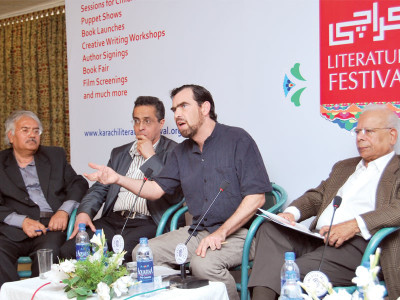
<p>But during “The Arab Spring” talk at the Karachi Literature Festival, there was no expression of kudos for the valorous protesters, nor any musings about the romantic possibility of a Pakistani spring. In fact, the discussion focused on hard facts of the political upheaval that has shaken the Middle East and North Africa in recent times.</p>
<p>Dean of Institute of Business Administration Dr. Ishrat Husain — the moderator for the session — began by pinpointing the harsh truth of a much-celebrated change. “In Egypt, the economic growth rate was 6 to 7%, but since the revolution, it has slid to 1to 2%,” he said. “Tourism is in decline, investment is not taking place. This is the price one pays for dislodging an unrepresentative government.”</p>
<p>Yet, according to British-Syrian scholar Robin Yassin-Kassab, the popular resistance in the Middle East was inevitable. “It’s good when history moves,” he asserted.</p>
<p>Subsequently, the speakers at the session— all foreigners— did not just highlight the significant variations characterising the political transformation of Arab countries, but also expressed apprehensions about the protracted revolts and nature of regime change.</p>
<p>“The young people in Egypt do not feel represented by the election results, in which Islamist parties— the Muslim Brotherhood and the Salafists— have been largely successful,” said German scholar Stefan Weidner.  “There appears to be a secret coalition between the military and the Islamists in Egypt, which are both conservative in nature and do not want to encourage growth of civil society.”</p>
<p>“But the revolutionaries in Egypt are very active and conservative rule will not make them disappear from politics,” he added with optimism.</p>
<p>However, this note of sanguinity was short-lived. When Yassin-Kassab opined about Syria, which is still caught in the throes of popular resistance, the collapse of the Assad regime appeared quasi-impossible.</p>
<p>Yassin-Kassab, highlighted how ‘divide and rule’ was now the Syrian regime’s mantra to crush the popular resistance.</p>
<p>“The regime has turned the revolt into sectarian conflict. They are arming Alawites from villages to rape, kill and burn Sunni cities.”</p>
<p>And all the speakers were daunted by the possibility of Islamist forces filling the power vacuum in the Arab world.</p>
<p>“Secularism is the only way to be politically free,” claimed French-Algerian intellectual Anouar Benmalek. Implicit in the opinions of the speakers, was a deep ideological yearning for representative rule in the Arab world, born out of disorder and bloodshed, to follow an orderly trajectory of liberal, secular democracy.</p>
<p>It seems like those who analysed the onset of Spring from afar, want it to exclusively bear fruits well-suited to their tastes.</p>
<p><em>Published in The Express Tribune, February 13<sup>th</sup>, 2012.</em></p>
</p>
			<br clear="all"/>
		]]>
		</description>

		<media:content width="424" height="318"
							isDefault="true" medium="image" url="http://i1.tribune.com.pk/wp-content/uploads/2012/02/335626-PanellistsphotoARIF-1329079478-415-640x480.jpg">
			<media:title>Panellists-photo-ARIF</media:title>
			<media:description>Panellists point out the harsh realities of the 2011 Arab uprisings. PHOTO: ARIF SOOMRO/EXPRESS
</media:description>
			<media:thumbnail url="http://i1.tribune.com.pk/wp-content/uploads/2012/02/335626-PanellistsphotoARIF-1329079478-415-160x120.jpg" width="160" height="120" />
      </media:content>

		<wfw:commentRss></wfw:commentRss>
		<slash:comments>0</slash:comments>
	</item>
		<item>
		<title>10 things I hate about parties</title>
		<link>http://tribune.com.pk/story/330367/10-things-i-hate-aboutparties/</link>
		<pubDate>Sun, 05 Feb 2012 06:35:56 +0000</pubDate>

		<guid isPermaLink="false">http://tribune.com.pk/?p=330367</guid>

		<description>
		<![CDATA[
			<a href="http://tribune.com.pk/story/330367/10-things-i-hate-aboutparties/">
				<img src="http://i1.tribune.com.pk/wp-content/uploads/2012/02/330367-party-1328423711-740-160x120.jpg" width="160" height="120" alt="" />
			</a>
			<p><p>1.    The middle-aged merry-makers. Abandon all hopes of spotting eye candy. You’d think that a happening party will be thronged by hot youngsters, but instead you’ll be seeing mostly pot-bellied uncles and over-botoxed cougars.</p>
<p>2.    The inaccessible washrooms. Be warned: you will never find an unoccupied washroom once the party gets going. Bang on the locked toilet doors all you want, but don’t expect the people inside to pay heed to pleas of impending bladder damage.</p>
<p>3.    The lack of proper refreshments.  A note to the host: Since when did chips fried in cow fat and Rs20 nimko sold at shoddy CNG pumps begin counting as “snacks”? Considering you’re selling tickets for Rs10,000 per couple, can’t we at least expect Planter’s peanuts?</p>
<p>4.    The cheap Hindi music. Just when the Chemical Brothers get you into the mood to dance, the DJ switches to Munni Badnaam and suddenly aunties with gyrating hips occupy the dance floor. Why must all merry-making in Pakistan ultimately resemble big desi weddings?</p>
<p>5.    The same phony conversations.</p>
<p>Stranger:  So you work at a bank. Do you know so-and-so there?</p>
<p>You: Yes, he’s my colleague.</p>
<p>Stranger: Oh you do. What a small world it is!</p>
<p>Well stranger, curb your phony enthusiasm. The world is a small place for Pakistan’s privileged cliques. Try going outside and finding a mutual connection with a person on the street.</p>
<p>6.     The underage teens — Amongst the hordes of aunties and uncles, you will always spot a few overexcited teenagers — skinny boys with oodles of hair gel and girls in skin-tight clothes. Some genuine advice for them: Dear kids, it’s way past your bed time, so go home and come back in 10 years.</p>
<p>7.    The confusing social dynamics  — Why do some couples, who arrive together and spend most of their time engaging in public displays of affection, suddenly break up and leave the party with other people? It’s really confusing and makes you wonder what you missed out on for hours.</p>
<p>8.    The all-too desi pick-up lines — My father’s an MNA, Chaudhry XYZ … do you want to dance with me?</p>
<p>Oh, so you’re a PTI supporter? So am I! Let’s go out and discuss this further over coffee.</p>
<p>9.    The smoke. I don’t know what’s worse: inhaling diesel fumes on my way back home from work or sitting in a room full of cigarette smoke for hours. Shindigs in Pakistan should come with a serious health warning.</p>
<p>10.    The dance floor discussions on politics. If drawing room discussions on politics weren’t vacuous enough, dance floor musings on the country’s “sad state of affairs” take empty talk to another level. Do people even realise how lame they sound when they lament the civil-military imbalance in between dance routines?</p>
<p><em>Published in The Express Tribune, Sunday Magazine, February 5<sup>th</sup>, 2012.</em></p>
</p>
			<br clear="all"/>
		]]>
		</description>

		<media:content width="424" height="318"
							isDefault="true" medium="image" url="http://i1.tribune.com.pk/wp-content/uploads/2012/02/330367-party-1328423711-740-640x480.jpg">
			<media:title>party</media:title>
			<media:description>The all-too desi pick-up lines — My father’s an MNA, Chaudhry XYZ … do you want to dance with me?</media:description>
			<media:thumbnail url="http://i1.tribune.com.pk/wp-content/uploads/2012/02/330367-party-1328423711-740-160x120.jpg" width="160" height="120" />
      </media:content>

		<wfw:commentRss></wfw:commentRss>
		<slash:comments>30</slash:comments>
	</item>
		<item>
		<title>Mansoor Ijaz’s video and other absurdities </title>
		<link>http://tribune.com.pk/story/324077/mansoor-ijazs-video-and-other-absurdities/</link>
		<pubDate>Thu, 19 Jan 2012 17:47:00 +0000</pubDate>

		<guid isPermaLink="false">http://tribune.com.pk/?p=324077</guid>

		<description>
		<![CDATA[
			<a href="http://tribune.com.pk/story/324077/mansoor-ijazs-video-and-other-absurdities/">
				<img src="http://i1.tribune.com.pk/wp-content/uploads/2012/01/324077-MariaWaqarNew-1326992090-598-160x120.JPG" width="160" height="120" alt="" />
			</a>
			<p><p>Life is absurd, say the existentialists. They believe that its vicissitudes are not governed by fate or destiny. In fact life’s capricious events are utterly meaningless — there is no lucid narrative tying them together.</p>
<p>But as a strong believer in the coherence and interrelations of events in this world, I had never paid much heed to this philosophy until yesterday, two minutes and 47 seconds into the music video of Italian House DJ Junior Jack’s song “<a href="http://www.youtube.com/watch?v=B0QvR1eP2yg">Stupidisco</a>”, my worldview floundered like a castle of cards. There he was — none other than <a href="http://tribune.com.pk/story/323483/stupidisco-mansoor-ijaz-features-in-music-video/">Mansoor Ijaz — amidst a blatant display of flesh, keeping the scorecard for female wrestlers.</a></p>
<p>Seeing the man, whose allegations shook the foundation of our civilian government, in a video featuring semi-nude female warriors was just bizarre, to say the very least.</p>
<p>We, as a nation, have spent several months speculating about the origins and motives of the mysterious American-Pakistani who precipitated a furore in Pakistani politics. <a href="http://tribune.com.pk/memogate/">We have seriously wondered why Ijaz came out of the blue with his allegations</a>, brandishing his BlackBerry transcripts against former ambassador Husain Haqqani.</p>
<p>Many of us have desperately tried to salvage the truth from the deluge of clichés that we have been subjected to in this case — is Ijaz a RAW agent or a member of the Zionist lobby?</p>
<p>But for those interested in knowing more, here’s some additional information to satiate your curiosity. Not only has he made millions and negotiated between governments, Ijaz has also made an appearance in an unctuous music video. Don’t expect this piece of information to serve as an epiphany about his ‘true’ interests and identity; in fact it will just hurl you in throes of utter confusion.</p>
<p>At least that’s what it did to me. Just as I saw Ijaz judge a melee between women clad in bikinis, that left little to the imagination, a news alert in the adjacent tab on my computer screen conveyed that the American-Pakistani will be judged very soon. Not in a wrestling ring, but in front of the judicial commission in investigating the memogate scandal.</p>
<p>I tried to connect the dots — find some sort of an explanation linking the ludicrous juxtaposition of an important businessman whose words have profoundly impacted Pakistani politics, with a cameo in an R-rated music video. But it just didn’t make sense. Damn, I thought, couldn’t he just have been a RAW agent? It would have made so much more sense. But it appears that in this case, fact is indeed stranger than fiction.</p>
<p>At that moment, I wondered how our electronic media would debate this ‘issue’. How will our news channels, relentless in their quest for pithy political analysis, link Ijaz’s appearance in a sleazy video to the memo case?</p>
<p>After all, the coterie of strident politicians and screeching talk show hosts take this country’s myriad issues very seriously. They take its politics very seriously. <a href="http://tribune.com.pk/veenamalik">They even take Veena Malik seriously</a>.</p>
<p>So, how will they ever contextualise this new development in the momentous memogate scandal?</p>
<p>Well, the flurry of speculations has already begun to gain momentum. After watching the video, Ijaz’s opponents are casting aspersions on his character in an attempt to undermine him and his allegations. He has responded, alleging that those behind the video are Haqqani sympathisers, a charge that has been denied.</p>
<p>But the truth is that, for once, we need to stop rationalising and finding causal linkages and just ponder over the absurdity of the situation. The instigator of the memogate controversy, which has aggravated the civil-military schism like no other issue in recent times, is the same man who chuckles when the voluptuous Double D ‘gives it good’ to her opponent. There is nothing more to it; there’s no superior sense you can make out of it.</p>
<p>Pakistani politics has always been exciting and overwhelming, but it has now officially entered the realm of the absurd.</p>
<p><em>Published in The Express Tribune, January 20<sup>th</sup>, 2012.</em></p>
</p>
			<br clear="all"/>
		]]>
		</description>

		<media:content width="424" height="318"
							isDefault="true" medium="image" url="http://i1.tribune.com.pk/wp-content/uploads/2012/01/324077-MariaWaqarNew-1326992090-598-640x480.JPG">
			<media:title>Maria Waqar  - New</media:title>
			<media:description> The writer is a associate sub-editor at The Express Tribune and tweets @MariaWaqar</media:description>
			<media:thumbnail url="http://i1.tribune.com.pk/wp-content/uploads/2012/01/324077-MariaWaqarNew-1326992090-598-160x120.JPG" width="160" height="120" />
      </media:content>

		<wfw:commentRss></wfw:commentRss>
		<slash:comments>35</slash:comments>
	</item>
		<item>
		<title>The empty cradle</title>
		<link>http://tribune.com.pk/story/316447/the-empty-cradle/</link>
		<pubDate>Sun, 08 Jan 2012 07:18:34 +0000</pubDate>

		<guid isPermaLink="false">http://tribune.com.pk/?p=316447</guid>

		<description>
		<![CDATA[
			<a href="http://tribune.com.pk/story/316447/the-empty-cradle/">
				<img src="http://i1.tribune.com.pk/wp-content/uploads/2012/01/316447-Nest-1325691694-129-160x120.jpg" width="160" height="120" alt="" />
			</a>
			<p><p><strong>It’s a typical afternoon at the Australian Concept Infertility Medical Centre (ACIMC) in Clifton, Karachi, crowded with women draped in abayas and men with blank expressions. Going by the looks of the patients in the centre’s waiting lounge, it’s hard to tell that behind their respective veils, many of them are concealing signs of turmoil.</strong></p>
<p>But in the privacy of the doctor’s office, their repressed anguish often gives way to emotional outbursts.</p>
<p>“Many infertility patients are under serious mental strain. Women often start weeping during consultation,” says Dr Syed Sajjad Hussain, the CEO of ACIMC in Karachi, in a matter-of-fact tone. “We try to comfort them, but as doctors we also need to be realistic and professional with them.”</p>
<p>Infertility — medically defined as the inability of a couple to conceive within 12 months of unprotected sex — affects nearly 1 out of 5 couples of childbearing age. However, this biological condition has grave ramifications for couples in our society, where producing children is arguably considered the most important function of marriage.  The failure to produce children is considered a social taboo, and it is generally the woman who gets a disproportionate share of the blame.</p>
<p>Mahnum*, who has been married for four years and lives in the UK with her husband, has been diagnosed with polycystic ovarian syndrome, a hormonal disorder which affects one out of five women and is the leading cause of sub-fertility in women.</p>
<p>“I dread coming to Pakistan because of questions about the ‘missing’ baby,” she says wryly. “Distant relatives and even strangers come to me at get-togethers and wistfully declare that children are the light of one’s life, just to taunt me.”</p>
<p>The social pressure to have a child has entangled Mahnum in a vicious cycle: her inability to conceive means that she is bombarded with prying questions from relatives, which stresses her out, and that in turn interferes with her ability to conceive.</p>
<p>“Doctors have often told me that stress disturbs my hormones and hence prevents my pregnancy,” she explains. “But how can I curb my anxiety when there’s so much pressure?”</p>
<p>Many infertile couples then pin their hopes on fertility treatments — a popular one being in vitro fertilisation (IVF) — but their success rate varies between 35 and 50 per cent at best.</p>
<p>“I went through IVF twice and it was highly stressful,” says Lahore-based Mehrunissa*. “Since, my in-laws had great expectations from the treatment, I thought that I would let everyone down if it did not work out.”</p>
<p>IVF failed to bear fruit for her, but she refused to go through it a third time because she was wary of having more hormones injected in her body. Instead, she and her husband adopted a child from within the family.</p>
<p>Many years after she had the ineffectual IVF procedures, she was diagnosed with leukemia. However, she miraculously beat the life-threatening disease after a bone marrow transplant and heavy chemotherapy.</p>
<p>“Even though doctors could not pinpoint a cause for my cancer, I blame all the hormones injected into my body since I don’t have a family history of cancer at all,” she asserts adamantly.</p>
<p>“There is a mild risk of cancer if hormones are used repeatedly over a long period of time, but one or two IVF cycles will not increase the risk,” says embryologist Sara Tanwir Ahmed.</p>
<p>The link between IVF treatments and an increased risk of cancer is a subject of heated debate in the field of medicine, but despite extensive research, there are still no clear answers.</p>
<p>Many couples who don’t opt for fertility treatments, or for whom such treatments are ineffective, ultimately adopt children like Mehrunnisa eventually did. However, women who can’t have children are often still plagued by the insecurity that their husbands will remarry to have children who are ‘of their own blood’.</p>
<p>For those on the verge of losing their husbands this way, desperate times call for desperate measures.</p>
<p>More than a decade ago, Yasmeen*, a woman in her late 30s, brought a strikingly beautiful teenage girl to see Dr Neelofer Leghari, a leading gynecologist based in Lahore, for a medical examination.</p>
<p>Yasmeen was very upset that the 17-year-old girl had not conceived even after two months of regular, unprotected sex.</p>
<p>“I really want her to get pregnant, somehow,” she blurted anxiously.</p>
<p>When Dr Leghari asked her how Yasmeen was related to the girl, out tumbled an infertile housewife’s scheme gone awry.</p>
<p>“Yasmeen had ‘bought’ the girl from an Afghan camp after an agreement with her parents that her husband would temporarily marry and impregnate her,” recounts the doctor. “Her plan — fully endorsed by her husband and the girl’s family — was to keep the baby and then send the girl back to the camp after getting her divorced.”</p>
<p>She had told her in-laws that the Afghan girl was a maid at their house, but every night Yasmeen secretly coaxed her to have sex with her own husband.  But two months into her own plan, the barren woman had grown jealous and lost patience.</p>
<p>This is clearly an atypical case. However, it is a good indicator of how infertility takes an emotional toll on women in a society where marital security is often tied to a woman’s ability to have children.</p>
<p>Dr Leghari has also witnessed other cases of women organising ‘temporary marriages’ for their husbands with girls from lower  income groups.</p>
<p>For barren women, she says, the imperative of saving their marriage in the long-term is often the most important motive for producing children.</p>
<p>But a second marriage, or even these ‘temporary’ marriages, is hardly a guarantee for producing children. In approximately 50 per cent of infertility cases, the male is the sole or the contributing factor.</p>
<p>However, ignorance about this fact is quite widespread, confirms Dr Hussain.</p>
<p>“I have witnessed the same man bring his four wives for fertility treatment, even though the problem is actually in him,” he says.</p>
<p>A man’s inability to produce children implies a lack of virility and to be labelled a namard in surely damning for men. But, in our patriarchal society, it is easy to shift the blame on to the woman.</p>
<p>“Many men refuse to get tested,” says Dr Hussain, “while others reject their semen analysis reports because they just aren’t ready to believe that something is wrong with them.”</p>
<p>And ironically, women themselves are complicit in spreading the notion that the burden of infertility should be borne solely by them.</p>
<p>Jamal Mahar, a student of Aga Khan University (AKU), witnessed this while at the department of gynecology and obstetrics at AKU hospital.</p>
<p>“When doctors would tell women to bring their husbands for testing, their mothers-in-law, who were accompanying them, would openly refuse and say that they believed their sons had no problem,” he says.</p>
<p>Junior consultant Lubna Durrani at Atia General Hospital is no stranger to men’s reluctance in dealing with their failure to produce children.</p>
<p>On a busy Saturday afternoon, the spry doctor counsels a couple on IVF in a modest room at the Sindh Institute of Reproductive Medicine in Atia General Hospital. Adjacent to the consultation room is the waiting area which is chock-full of patients.</p>
<p>“Many men request us not to tell their wives of their condition while they undergo treatment,” she explains, as she sits to catch a moment’s breath after the couple exits.</p>
<p>Sitting right across the doctor is Azeen*, who is engrossed in an intense discussion with another medical consultant. She clutches a file containing a record of medical tests in her hands — but that record is neither hers nor her husband’s. It is in fact her brother’s, who is suffering from azoospermia — the lack or absence of sperm in a man’s semen.</p>
<p>“My brother’s in Bahrain. He doesn’t want his wife to know about his condition, so I am here to consult the doctor regarding his medical tests,” says Azeen. “He will come to Karachi for his treatment soon.”</p>
<p>The woman’s sister-in-law remains in the dark about her husband’s biological shortcoming. She’s been vaguely told by hospital authorities that due to ‘certain problems’, she and her husband can only have a child through IVF treatment.</p>
<p>Azeen adds quietly, “Actually my brother is married to our first cousin. He’s afraid that if his wife finds out about his condition, she will make a big issue and let everyone in the family know.”</p>
<p>According to Islamic law, a woman has the right to divorce her husband if his infertility is the sole obstruction in childbearing. But, unlike men, who are ready to remarry if their wife is infertile, women are less likely to abandon their sterile husbands. In fact, many women sympathise with their husbands and emotionally support them after finding out about their physical shortcoming, if testimonies of medical experts are to be believed.</p>
<p>“My experience shows that women become very caring and sympathetic towards their husbands when they find out about their biological predicament,” explains Dr Sajjad.</p>
<p>And in the jam-packed waiting rooms of fertility clinics, one will find many women who are keen to support their husbands through this ordeal. Twenty-four-year-old Kiran is one such woman, with a soft corner for her barren spouse. She waits patiently in ACIMC ‘s waiting lounge, as her partner sees the clinic’s urologist.</p>
<p>“I have had numerous tests but all of them were clear; the real problem is actually with my husband,” she explains compassionately. “I often accompany him to the centre, so that nobody finds out that he’s actually the one with the issue.”</p>
<p>But the tone of her voice suddenly changes, as she sarcastically blurts out, “And it’s really no use telling his family the truth. It’s not like his mother is ever going to believe that there’s anything wrong with her son!”</p>
<p>There’s a clear gender imbalance in the implications that infertility has for men and women. But there are people who say that education and class make a marked difference in this regard.</p>
<p>Nabat*, who has been married for the past seven years, found out that her husband had azoospermia six months into her marriage.</p>
<p>“He has absolutely no hang-ups in acknowledging his condition and discussing it with family members. My husband comes from an educated family of doctors and thus has full knowledge of what he is going through,” she says.</p>
<p>She continues with a sympathetic smile, “He is very loving and has often told me that I am free to divorce him and remarry if I want kids.”</p>
<p>Nabat’s spouse Fareed* has no qualms in acknowledging his condition.</p>
<p>“I have openly discussed my condition with my sister, who’s a doctor in the US, and my mother. What’s the problem in doing that?” he says in a matter-of-fact manner.</p>
<p>There are also others, like Lahore-based urologist Dr Ramzan Chaudhry, who claim that educated men from urban areas willingly go through testing, and actively seek treatments for infertility.</p>
<p>“Times are changing now. I have worked for 30 years in the field and young men of today do not typically resist fertility tests,” he says.</p>
<p>They may have recourse to the latest fertility treatments, but the uncertainty that accompanies such procedures is excruciating for the couples waiting in queues at crowded infertility clinics, caught between hope and despair.</p>
<p>As Kiran says with a sad smile, “It’s God’s will, after all — He is the one who decides when to gift a couple with a child.”</p>
<p>*Names have been changed to protect privacy.</p>
<p>&nbsp;</p>
<p><em>Published in The Express Tribune, Sunday Magazine, January 8<sup>th</sup>, 2012.</em></p>
</p>
			<br clear="all"/>
		]]>
		</description>

		<media:content width="424" height="318"
							isDefault="true" medium="image" url="http://i1.tribune.com.pk/wp-content/uploads/2012/01/316447-Nest-1325691694-129-640x480.jpg">
			<media:title>Nest 01</media:title>
			<media:description>Both men and women may experience the frustration of not being able to have a child — but it is mostly the women who bear the stigma of infertility.</media:description>
			<media:thumbnail url="http://i1.tribune.com.pk/wp-content/uploads/2012/01/316447-Nest-1325691694-129-160x120.jpg" width="160" height="120" />
      </media:content>

		<wfw:commentRss></wfw:commentRss>
		<slash:comments>4</slash:comments>
	</item>
		<item>
		<title>Twists and turns in the Benazir murder probe</title>
		<link>http://tribune.com.pk/story/312518/twists-and-turns-in-the-benazir-murder-probe/</link>
		<pubDate>Tue, 27 Dec 2011 04:13:19 +0000</pubDate>

		<guid isPermaLink="false">http://tribune.com.pk/?p=312518</guid>

		<description>
		<![CDATA[
			<a href="http://tribune.com.pk/story/312518/twists-and-turns-in-the-benazir-murder-probe/">
				<img src="http://i1.tribune.com.pk/wp-content/uploads/2011/12/312518-BanazirBhutto-1324928734-530-160x120.JPG" width="160" height="120" alt="" />
			</a>
			<p><div><strong class='location'>KARACHI:&nbsp;</strong>
<p><strong>While anti-terrorism courts (ATC) are designed to mete out speedy justice, the proceedings of the Benazir Bhutto murder case have defied this rationale.</strong></p>
</div>
<p>Five militants linked to Tehreek-i-Taliban commander Baitullah Mehsud were charged with conspiring to kill Bhutto on November 22, 2008 at an ATC in Rawalpindi’s Adiala jail.</p>
<p>The trial was, however, subsequently adjourned on August 22, 2009 for further investigation by the Federal Investigation Agency (FIA) and finally commenced four years on, on November 5, 2011.</p>
<p>Like other investigations into high-profile assassination cases – such as former prime minister Liaquat Ali Khan’s in 1951, which ultimately faded from public memory – Bhutto’s murder has by no means been under-examined.</p>
<p>Four separate inquiries – by the Scotland Yard, the UN commission and joint investigation teams (JIT) of the Punjab Police and the FIA – have explored multiple facets relating to her death, ranging from its cause to the alleged culprits.</p>
<p>“We’ve had several in-country investigations …yet we seem to be no closer today than we were four years ago to getting at the perpetrators of this catastrophic assassination,” said Fasih Ahmed, the editor of Newsweek Pakistan.</p>
<p><strong>Establishment-controlled investigations?</strong></p>
<p>Based on the inquiry of the FIA JIT, seven people, including five militants and two policemen – former Rawalpindi city police officer (CPO) Saud Aziz and Superintendent Police Khurram Shehzad – were indicted by Rawalpindi’s ATC.</p>
<p>The militants were charged with criminal conspiracy for bringing the suicide bomber from South Waziristan, while the two police officers were charged with breaching Bhutto’s security plan.</p>
<p>The ATC has also issued arrest warrants for former president Pervez Musharraf, who has been accused of conspiring to kill Bhutto and for trying to influence post-murder investigations.</p>
<p>On May 30, the ATC declared him a proclaimed offender (PO) for willfully avoiding court proceedings.</p>
<p>FIA’s special prosecutor for the case Chaudhry Zulfiqar asserted, “There is solid, incriminating evidence against the accused. In fact, we have confessional statements of madrassa students linked to Mehsud.”</p>
<p>But despite the protracted inquiry into the matter – overtly intended for a more intensive investigation – it’s still quite contentious whether the inquiry has been objective and comprehensive.</p>
<p>The probe has been largely predetermined by the previous Punjab police-led investigation, which, according to a 2010 UN commission report, was heavily directed and controlled by intelligence agencies.</p>
<p>The FIA’s findings, ironically, reflect the concerns of the UN report about the Punjab police investigation, which were rejected by the-then foreign minister Shah Mehmood Qureshi for their alleged uncorroborated finger-pointing at the country’s establishment.</p>
<p><strong>Politicisation of the case  </strong></p>
<p>The FIA clearly followed leads of the controversial UN inquiry report in its investigation. However, it did so discriminately; thus, making accusations selectively, implying that the investigation has been politicised.</p>
<p>The investigation accuses CPO Saud Aziz and SP Khurram Shehzad for breach of Bhutto’s security plan, refusal to conduct her postmortem and washing away the crime scene – findings which are clearly stated in the UN report.</p>
<p>It also acknowledges another key finding of the UN report: that the federal and provincial government failed to provide adequate security for the slain leader on the day of the Liaquat Bagh address.</p>
<p>However, the FIA challan, filed on February 7, 2011, singled out only one government functionary – Pervez Musharraf – as a culprit in the conspiracy to kill Bhutto.</p>
<p>The finger-pointing appears to be highly selective and often devoid of hard facts.</p>
<p>Ahmed, who has won a New York Press Club award for Newsweek’s coverage of Benazir Bhutto’s assassination, disputes the factual weight of this accusation.</p>
<p>“The case against Musharraf thus far is flimsy,” he said.</p>
<p>The FIA has named Mark Siegel – an American journalist who was Bhutto’s lobbyist – in the list of prosecution witnesses against Musharraf. Siegel was present when Bhutto received a phone call from the dictator, in which he threatened her with ‘dire consequences’ if she returned to Pakistan.</p>
<p>While the FIA considers this testimony as incriminating evidence against Musharraf, it has taken little notice of the letter Bhutto wrote to Musharraf in 2007, nominating four people involved in an alleged plot to kill her, including former intelligence officers and the then-Punjab chief minister and PML-Q leader Chaudhry Pervaiz Elahi.</p>
<p>However prosecutor Zulfiqar is quick to defend the credibility of the probe. “Accusations are made on the basis of evidence and there’s no evidence implicating other federal and provincial government functionaries.”</p>
<p>Yet many think that the case has been seriously determined by alliances of the PPP government; the PML-Q currently is part of the PPP-led coalition government and Elahi is the senior minister for defence production.</p>
<p>“It will be hard for the incumbent party to drown out criticism that they partnered with politicians Bhutto had suspected of plotting against her,” said Ahmed.<em></em></p>
<p><em>Published in The Express Tribune, December 27<sup>th</sup>, 2011.</em></p>
</p>
			<br clear="all"/>
		]]>
		</description>

		<media:content width="424" height="318"
							isDefault="true" medium="image" url="http://i1.tribune.com.pk/wp-content/uploads/2011/12/312518-BanazirBhutto-1324928734-530-640x480.JPG">
			<media:title>Banazir Bhutto01</media:title>
			<media:description>Blame appears shifting according to who partners with whom at the helm.</media:description>
			<media:thumbnail url="http://i1.tribune.com.pk/wp-content/uploads/2011/12/312518-BanazirBhutto-1324928734-530-160x120.JPG" width="160" height="120" />
      </media:content>

		<wfw:commentRss></wfw:commentRss>
		<slash:comments>0</slash:comments>
	</item>
	
</channel>
</rss>
<!-- Performance optimized by W3 Total Cache. Learn more: http://www.w3-edge.com/wordpress-plugins/

Page Caching using apc
Database Caching 9/36 queries in 1.639 seconds using memcached
Object Caching 1386/1539 objects using apc

 Served from: tribune.com.pk @ 2013-05-24 11:58:30 by W3 Total Cache -->